Silver mid-year outlook: From record high to record crash. Can the metal return to $100?
Silver’s spectacular rise and brutal collapse in 2026 may look like the classic boom and bust story. But the metal’s rollercoaster ride is more complex: Silver was caught in the crossfire of the Iran war as investors fled precious metals, the US Dollar strengthened and rate-cut expectations faded. But Silver’s industrial backbone remains intact, supported by surging demand from artificial intelligence, renewable energy and electrification. This should keep bears on hold for the rest of the year, unless another wave of policy uncertainty from Mr. Donald Trump changes the equation.
Silver started the second half of the year trading near levels last seen in September 2025. Back then, global inflation among major economies was as close to central banks’ goals as it had ever been since the Coronavirus pandemic global disruptions. And yet, concerns about mounting price pressures – triggered by United States (US) President Donald Trump's protectionist measures – pushed the metal to a record peak of $121.65 an ounce by January 2026.
It was not just fears of mounting inflationary risks. Silver also benefited from tech demand, focused on the AI boom, electric vehicles and solar power production, with demand for the metal outpacing supply, further boosting its price.
What happened next, none saw coming. And while fears turned into panic, Silver more than halved its price in a couple of months. How come?
US President Trump decided that the US would need to lead the Oil market. Taking over Venezuela was “easy”, but Iran proved much more complicated. Global tensions increased demand for safety, and market players rushed into the US Dollar (USD) and dropped precious metals’ longs. Logical, given that Oil prices more than doubled in a couple of months and triggered speculation that inflation would soar.
The US Dollar (USD) strengthened on the back of speculation that the Federal Reserve (Fed) would have no choice but to respond to inflationary pressures by hiking interest rates. The case for higher rates was further supported by Jerome Powell ending his term as the Fed’s Chair and Kevin Warsh, Trump's new favorite, taking his place.
Geopolitics and protectionism aren’t helping Silver this time
US policies, or better said, Donald Trump policies, stand in the eye of the storm and are the main market mover these days, and most likely, will remain so for the rest of the year.
On the one hand, the Middle East war, the main inflationary factor, has no end in sight. The closure of the Strait of Hormuz, a critical sea passage for major Oil producers’ vessels, is likely to revive inflationary pressures amid escalating tensions at the start of Q3. The temporary June relief is likely to be wiped out in less than a month should the conflict continue.
With mounting speculation that inflation will soar comes rate hike bets. The odds for a Fed hike before year-end see-saw accordingly to data under Warsh's leadership, yet for the most part, the USD is likely to find demand should the war continue. This isn’t good for Silver.
However, on the other hand, President Trump revived protectionism in mid-July, and resumed threatening tariffs left and right – the main factor that pushed the Greenback into an abyss throughout 2025 – despite, well, TACO.
So, will the Greenback turn north on war doldrums, or south amid widespread tariffs? Not an easy question to answer, but generally speaking, both are seen as inflationary factors, which means the Fed is likely to pull the trigger more than once before year-end.
Given that other major central banks are also on the tightening path, the Fed’s hikes may be enough to prevent the USD from collapsing this time, but it seems hard for the American currency to gain massive momentum across the board.
But it is not only about the USD. There are always two factors in the equation.
Where is Silver demand heading?
Silver is considered an outstanding electrical and thermal conductor, a key component of the technological transformation driving the global economy. This means that, beyond speculative interest, prices soared amid global industrial demand.
Solar energy, electric vehicles, data centers, and artificial intelligence are expected to drive demand higher through 2030, according to a report released by the Silver Institute. “The acceleration of digitalization and the widespread adoption of AI are expected to continue gathering pace, placing growing demands on both digital and physical infrastructure.”
Global Silver industrial use is poised to grow further as demand from vital technology sectors accelerates over the next five years.
And what’s up with supply?
Demand outpaced supply for a fifth consecutive year in 2025, and expectations indicate that 2026 would be the sixth shortfall in a row.
Global mined Silver supply increased by 3% YoY to 846.6Moz in 2025, while recycling climbed to a 12-year high of 197.6Moz. Still, the Silver market ran an annual deficit of 40.3Moz in the same year. Such a deficit is expected to widen to 46.3Moz, with mine production expected to stay roughly flat through 2026, according to the Silver Institute.
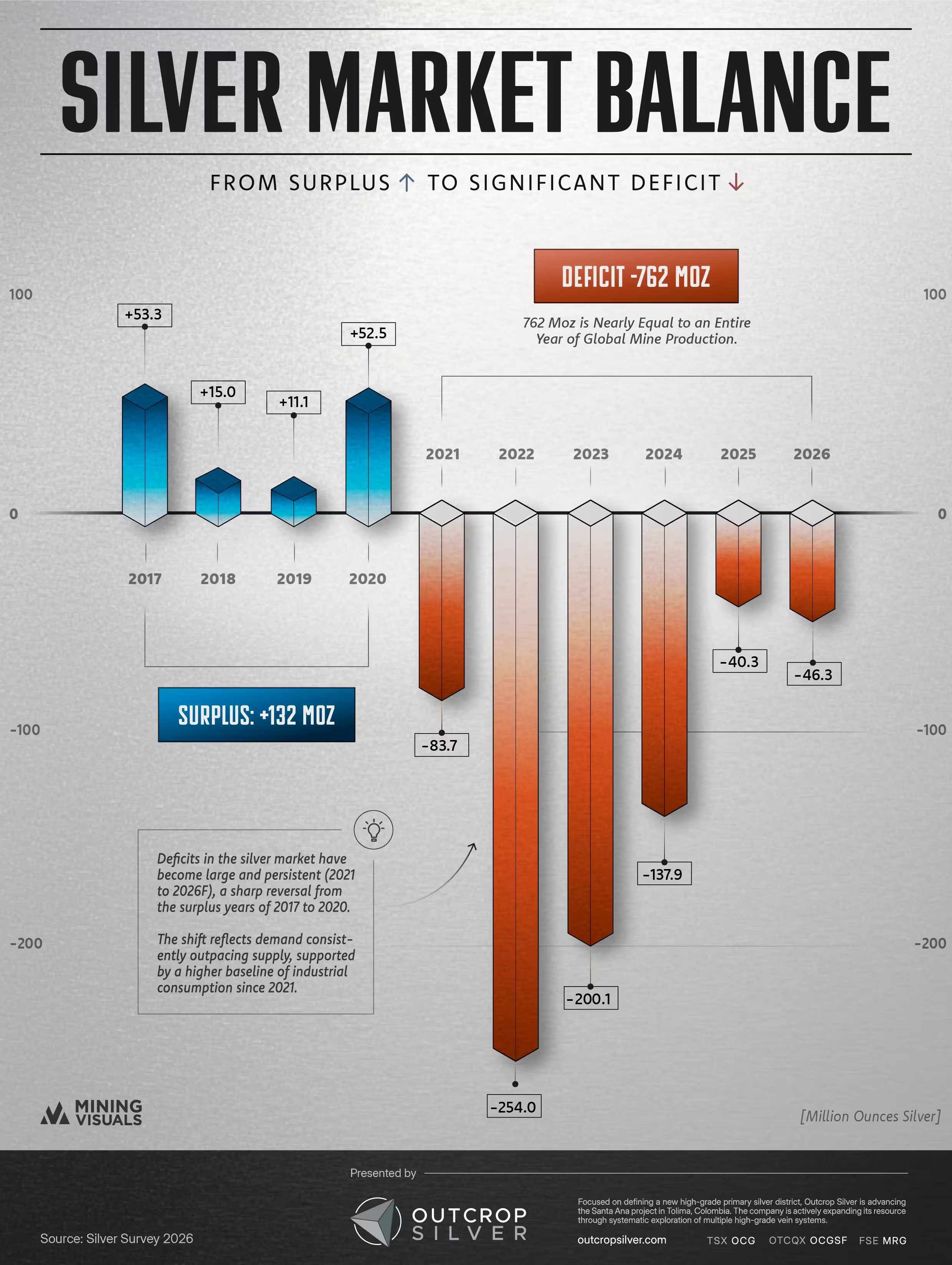
Source: Mining Visuals, Silver Survey 2026
The Silver demand/supply imbalance should inevitably result in higher Silver prices, particularly if, as expected, mining supply remains flat. As long as consumption remains above production, the most likely scenario for the rest of 2026, a sharp decline in Silver prices is out of the picture.
Fundamental Conclusion
Silver has the highest electrical conductivity of any metal. Demand is widely anticipated to surpass supply, which means that, beyond speculative interest, the precious metal has life of its own. And that “life” points to a price recovery in the second half of the year.
The extent of Silver recovery will be conditioned by USD demand, while the latter will depend on sentiment related to the impact of Trump’s policies.
Regardless of his aggressive threats and the noise those trigger, the better chance the US Dollar has, and thus the worst scenario for Silver, is the end of the Middle East war combined with a hawkish Fed, not the most likely scenario.
Technical Outlook
Silver peaked at a record high of $121.66 in January and fell to a yearly low of $54.77 in July. The XAG/USD pair has spent the month seesawing around $58.50, which suggests the monthly low is turning into a relevant bottom. The bright metal's bearish momentum seems to be over, as it holds flat for July despite the US Dollar Index (DXY) retaining a good chunk of its monthly gains.
There is still a chance of lower lows, with a major barrier at the psychological $50 mark, a level Silver conquered in October 2025. As long as the level holds, the odds skew the risks to the upside, although the way north won’t be easy.
The first threshold to reconquer is the not-too-far $61 area. The price zone has provided relevant support in S1, and attempts to run beyond it in July have been quickly reversed. Once Silver settles above it, the next relevant barrier comes at $74, an inflection point through Q2. If somehow Silver regains the latter, the initial rally could extend towards $88 en route to the $100 magical mark.
Losing the $50 threshold for good opens the door for a test of $39, while losses below the latter are quite unlikely given the macro scenario.
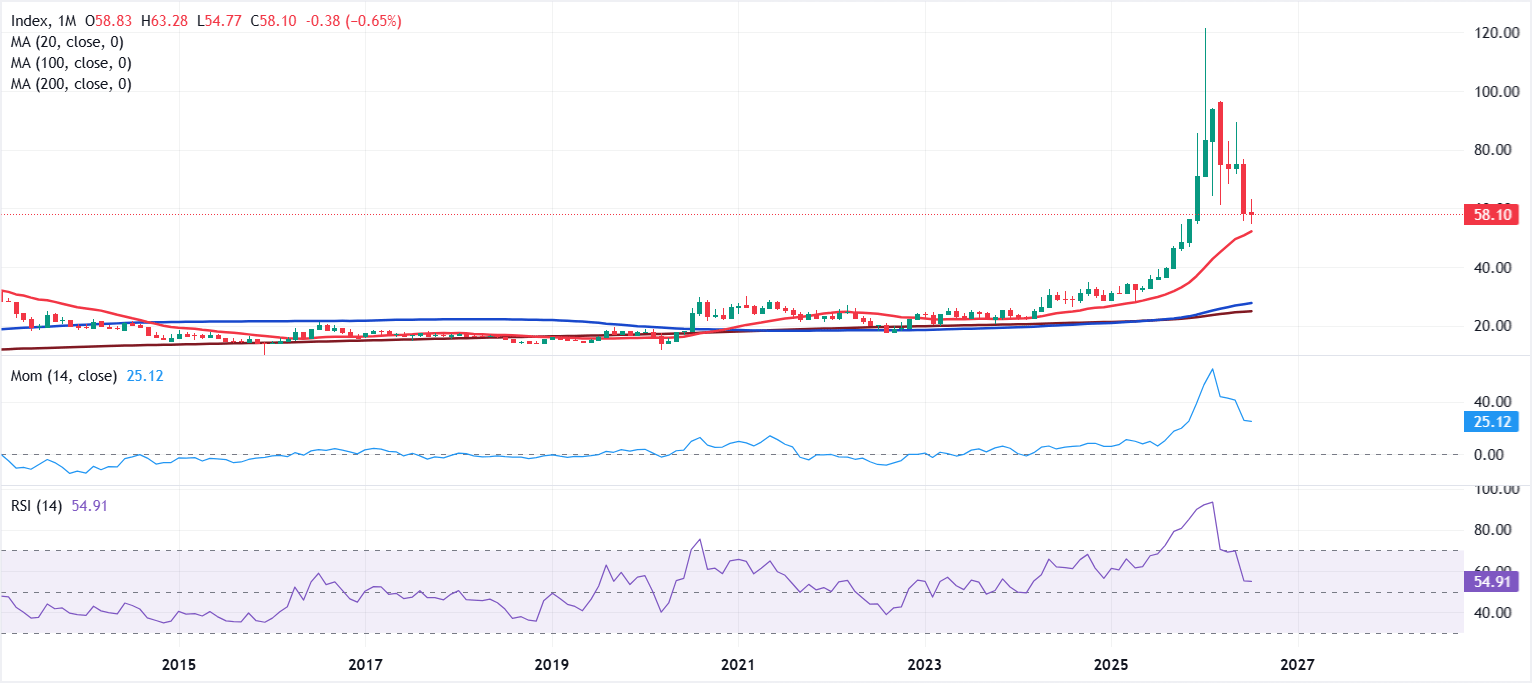
Technical readings in the monthly chart show that the massive decline remains corrective. The XAG/USD pair remains far above a bullish 20 Simple Moving Average (SMA), currently at around $52, while the longer 100 and 200 SMAs lack directional strength below the $28 level, too far away to be relevant in the upcoming months. The same chart shows that technical indicators have erased extreme overbought conditions and begun flattening within positive territory, limiting the bearish case.
Author

Valeria Bednarik
FXStreet
Valeria Bednarik was born and lives in Buenos Aires, Argentina. Her passion for math and numbers pushed her into studying economics in her younger years.

















