Silver balances industrial participation and Fed expectations ahead of the FOMC

Key takeaways
Silver enters one of the most important macro weeks of the quarter as markets shift their attention from Asia-Pacific central banks toward Wednesday’s Federal Reserve decision.
The metal continues operating at the intersection of monetary repricing and industrial participation, making it particularly sensitive to both real-yield expectations and manufacturing sentiment.
Recent price action suggests participation remains constructive following last week's inflation-driven advance, although investors remain cautious ahead of the FOMC statement, updated projections and Chair Powell's press conference.
The current structure reflects a market evaluating whether improving industrial engagement can coexist with a potentially restrictive monetary backdrop.
Silver enters the Fed week from a position of relative strength
Silver begins the European session with a different profile than many other major commodities.
The market has already absorbed the latest decisions from the Bank of Japan and the Reserve Bank of Australia. Neither event materially altered the broader global macro landscape.
Attention has now shifted almost entirely toward the Federal Reserve.
Tomorrow's FOMC statement, updated dot plot and Jerome Powell's press conference represent the dominant macro catalysts facing global markets this week.
For silver, that transition matters.
The metal occupies a unique position within the commodity universe. It responds to monetary conditions through real yields and interest-rate expectations, while simultaneously reflecting industrial activity, manufacturing demand and investment across strategic sectors.
That dual identity often creates opportunities for divergence.
Periods when monetary and industrial signals move in different directions frequently become the most important phases for silver pricing.
The current environment increasingly resembles one of those periods.
Monetary repricing remains a powerful influence
The Federal Reserve remains the central variable for financial markets.
Recent inflation data eased some concerns surrounding persistent price pressures and encouraged a modest reassessment of future policy expectations.
Treasury yields subsequently stabilized, while the US dollar surrendered part of its previous strength.
Silver benefited from that adjustment.
The transmission channel remains straightforward.
Federal Reserve expectations influence Treasury yields.
Treasury yields influence real yields.
Real yields influence the opportunity cost of holding precious metals.
That framework applies to silver just as it applies to gold.
The difference is that silver rarely trades solely as a monetary asset.
Investors evaluating silver must also assess the broader industrial environment.
As a result, monetary repricing often explains only part of the story.
The remaining portion comes from industrial participation.
Industrial demand continues providing structural support
This is where silver begins to separate itself from the broader precious-metals complex.
The strongest silver narratives over the past year have emerged when industrial considerations become more important than traditional defensive flows.
That theme remains relevant today.
Copper continues acting as the primary industrial barometer across the metals complex. Manufacturing activity remains mixed across major economies, yet demand linked to electrification, renewable infrastructure and strategic industrial investment continues providing an important layer of support.
Silver increasingly reflects those forces.
Investors are evaluating not only whether growth is accelerating or slowing, but also where growth is occurring.
Participation linked to electrification, solar installations, energy infrastructure and technology investment remains significantly more resilient than several traditional manufacturing segments.
That divergence matters.
Broad industrial activity does not need to accelerate everywhere for silver demand to remain constructive.
The metal continues benefiting from exposure to sectors where long-term investment trends remain active.
This helps explain why silver frequently behaves differently from both gold and copper during transitional macro environments.
The market is searching for confirmation
One of the defining features of current market conditions is uncertainty regarding the next major source of confirmation.
Inflation has eased.
Growth remains positive.
Central banks continue navigating a delicate balance between inflation control and economic stability.
Investors therefore remain cautious about extending positions aggressively ahead of the Federal Reserve meeting.
That caution is visible across rates, currencies and commodities.
Silver reflects that same dynamic.
Participation remains present.
Conviction remains limited.
The market appears willing to maintain exposure to industrial themes while simultaneously waiting for greater clarity regarding monetary policy.
That combination creates a more balanced environment than the one observed during the sharp repricing phases seen earlier in the quarter.
Technical structure: Silver consolidates gains ahead of the Fed
The technical structure reflects a market transitioning from expansion toward consolidation.
The Renko framework shows a powerful advance from the June lows near 61.5 toward the recent peak above 70.
That move represented one of the strongest participation phases observed across the precious-metals complex during the past several sessions.
More recently, momentum has moderated.
Price has rotated back toward the 69.0–69.1 participation corridor, which now acts as the most important near-term structural pivot.
The broader advance remains intact despite this pullback.
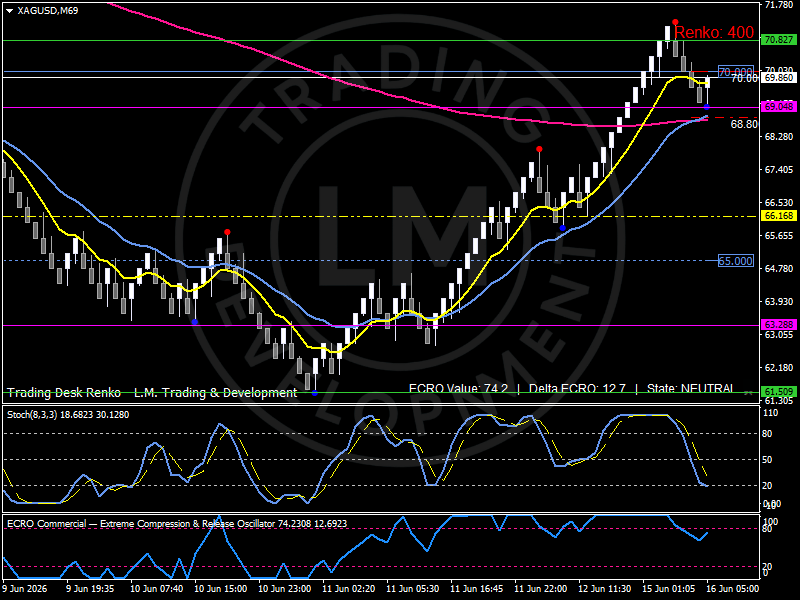
The market continues trading above the major stabilization zone near 63.3, while maintaining most of the gains generated during last week's rally.
The ECRO indicator remains elevated near the mid-70s, suggesting participation remains healthy despite the recent cooling phase. At the same time, momentum indicators have retreated from overextended conditions, reducing some of the excess that accompanied the previous advance.
Resistance begins near 70.0, followed by the recent high around 70.8.
Support remains concentrated near 69.0, while the broader structural floor continues developing around 63.3–64.0.
The overall configuration remains consistent with a market consolidating ahead of a major macro catalyst rather than reversing its broader participation trend.
Bird’s eye view
Silver currently operates at the intersection of monetary repricing and industrial participation.
The market has largely moved beyond the BOJ and RBA decisions and is now focused on tomorrow's Federal Reserve meeting, updated economic projections and Chair Powell's guidance.
Structurally, silver remains supported above the 69.0 participation pivot, while 70.0–70.8 defines the primary resistance corridor. The broader stabilization framework remains anchored near 63.3.
The dominant variables remain Federal Reserve expectations, Treasury yields, copper leadership and industrial participation.
Outlook
Silver enters the FOMC meeting with stronger participation than many other major commodities and with a narrative that extends beyond monetary policy alone.
The Federal Reserve will influence real yields, Treasury markets and dollar positioning.
Industrial demand will continue influencing how investors evaluate the metal's longer-term role within the commodity complex.
That combination remains silver's defining characteristic.
The next directional phase will depend on whether monetary conditions become more supportive following the FOMC and whether industrial participation continues attracting capital across strategic sectors of the global economy.
For now, silver remains one of the clearest expressions of the interaction between industrial demand and macro policy expectations.
Author

Luca Mattei
LM Trading & Development
Luca Mattei is a market analyst focusing on FX, metals, and macroeconomic trends. He develops trading tools for retail and professional traders, coding indicators and EAs for MT4/MT5 and strategies in Pine Script for TradingView.