Uchida Speech: BoJ Deputy Governor discusses policy outlook after the expected interest rate hike

Bank of Japan (BoJ) Deputy Governor Shinichi Uchida is addressing the press conference, explaining the reason behind raising the key interest rate by 25 basis points (bps) to 1.0% as expected.
Deputy Governor, one of the key architects of BoJ policy for more than a decade, will stand in for Governor Kazuo Ueda who was hospitalized last week for treatment of a liver cyst infection.
BoJ press conference key highlights
Japan economy has recovered moderately, although some weaknesses have been seen in part.
Risk of significant economic slowdown appears to have decreased compared with a while ago.
Japan's economy has been developing generally in line with BoJ's baseline scenario.
There is risk of underlying inflation deviating upward to level above price target.
Financial conditions have been accommodative.
Real interest rates have been negative mainly in short-, medium-term zone.
Will continue to raise policy rate in response to developments in economic activity, prices, financial conditions.
Will examine likelihood of realising baseline scenario as well as risks, in considering timing and pace of policy adjustment.
Will continue to look at impact of Middle East situation, when asked about pace of future rate hikes.
Wage-price mechanism has taken root.
Wage-price mechanism has aligned with 2% price target in recent years.
Neutral rates estimates are too diverse to be useful for monetary policy.
Governor Ueda's hospitalisation is short-term, don't see impact on monetary policy conduct.
Will need to carefully assess whether Middle East peace talks affect economy more or prices.
The section below was published on June 16 at 3:45 GMT to cover the Bank of Japan's monetary policy announcements and the initial market reaction.
The Bank of Japan (BoJ) announced on Tuesday that it increased the short-term interest rate by 25 basis points (bps) to 1% after concluding the two-day monetary policy review meeting.
The decision came in line with the market expectations.
Summary of the BoJ’s Monetary Policy Statement
BoJ makes rate decision by 7-1 vote.
Board member Asada dissented to rate decision.
Will continue to raise policy rate in response to developments in economic activity, prices, financial conditions.
Will examine likelihood of realising baseline scenario as well as risks, in considering timing and pace of policy adjustment.
Accommodative financial conditions are expected to be maintained after change in policy rate, continuing to firmly support economic activity.
Japan's economy has recovered moderately, although some weaknesses have been seen in part.
Risk of significant economic slowdown appears to have decreased compared with a while ago.
Japan's economy has been developing generally in line with BoJ’s baseline scenario.
Pass-through of rising oil prices has been progressing at relatively faster pace, which could spread to increase in consumer prices across wide range of items.
There is risk of underlying CPI inflation deviating upward to level above price target.
Japan's financial conditions have been accommodative.
Real interest rates have been negative mainly in short-, medium-term zone.
Japan's economic growth is likely to decelerate, but is expected to continue growing moderately.
Year-on-year increase in CPI likely to accelerate to a level clearly above 2%.
Mechanism in which wages and prices rise moderately in tandem will be maintained.
Underlying CPI inflation expected to increase gradually, reach level consistent with the price target between the 2nd half of fiscal 2026 and fiscal 2027.
For the time being, need to pay particular attention to impact of future course of middle east situation on financial, FX markets, economy and prices.
Must pay attention to the effects of global AI-related demand, future FX moves on Japan's economy, prices.
Will conduct monetary policy as appropriate from the perspective of sustainably and stably achieving 2% inflation target.
To pause bond taper from April 2027, keep the monthly pace of JGB buying at around 2 trln yen.
No change in current plan to reduce monthly JGB buying by 200 bln yen each quarter until January-March 2027.
Decision on bond tapering approved by 7-1 vote.
Will discontinue practice of conducting interim assessment of bond taper plan.
Will respond nimbly, such as by increasing JGB buying and conducting fixed-rate purchase operations, in case of rapid rise in long-term rates.
Market reaction to the BoJ policy announcements
USD/JPY maintains the offered tone around 160.15 following the Bank of Japan's (BoJ) monetary policy announcement, down 0.07% on the day.
Japanese Yen Price Today
The table below shows the percentage change of Japanese Yen (JPY) against listed major currencies today. Japanese Yen was the strongest against the New Zealand Dollar.
| USD | EUR | GBP | JPY | CAD | AUD | NZD | CHF | |
|---|---|---|---|---|---|---|---|---|
| USD | 0.04% | 0.09% | -0.10% | 0.06% | 0.20% | 0.23% | 0.05% | |
| EUR | -0.04% | 0.06% | -0.11% | 0.02% | 0.14% | 0.19% | 0.02% | |
| GBP | -0.09% | -0.06% | -0.17% | 0.00% | 0.07% | 0.14% | -0.03% | |
| JPY | 0.10% | 0.11% | 0.17% | 0.14% | 0.25% | 0.31% | 0.15% | |
| CAD | -0.06% | -0.02% | -0.00% | -0.14% | 0.12% | 0.16% | -0.01% | |
| AUD | -0.20% | -0.14% | -0.07% | -0.25% | -0.12% | 0.06% | -0.11% | |
| NZD | -0.23% | -0.19% | -0.14% | -0.31% | -0.16% | -0.06% | -0.17% | |
| CHF | -0.05% | -0.02% | 0.03% | -0.15% | 0.01% | 0.11% | 0.17% |
The heat map shows percentage changes of major currencies against each other. The base currency is picked from the left column, while the quote currency is picked from the top row. For example, if you pick the Japanese Yen from the left column and move along the horizontal line to the US Dollar, the percentage change displayed in the box will represent JPY (base)/USD (quote).
This section below was published on June 15 at 23:00 GMT as a preview of the Bank of Japan Interest Rate Decision.
- The Bank of Japan is expected to hike interest rates to 1% in its June meeting.
- Governor Kazuo Ueda will not precede the meeting due to health issues.
- USD/JPY retains its bullish bias despite easing demand for the US Dollar.
The Bank of Japan (BoJ) will announce its monetary policy decision on Tuesday, at around 3:00 GMT.

The BoJ is widely expected to deliver a hawkish move by hiking the benchmark interest rate by 25 basis points (bps) to 1%, its highest level since 1995. The hike is meant not only to address mounting inflationary pressures but also the Japanese Yen’s (JPY) strength.
Governor Kazuo Ueda, who was hospitalized last week, won’t attend the monetary policy meeting. Deputy Governor Ryozo Himino would chair the policy meeting, while Deputy Shinichi Uchida would hold the press conference following the decision.
Ahead of the announcement, the USD/JPY pair trades above the 160.00 mark, a line in the sand for Japanese authorities, as it is usually seen as an intervention level.
Finally, the Middle East crisis has reached an inflection point: The United States (US) and Iran reached an agreement that will reopen the Strait of Hormuz and extend the ceasefire for another 60 days, allowing talks to continue. Financial markets are optimistic ahead of the announcement, resulting in mild US Dollar (USD) weakness across the FX board.
What to expect from the BoJ interest rate decision?
An interest rate hike has long been priced in, meaning the rate move itself should have a limited impact on the JPY. Japanese policymakers, however, will also discuss the BoJ’s plan to reduce purchases of Japanese Government Bonds (JGBs) to allow long-term rates to be guided more by the market. Their decision on the matter could define the JPY’s near-term direction.
Japan’s annual inflation, as measured by the Consumer Price Index (CPI), stood at 1.4% in April this year, easing from 1.5% in March. However, wholesale inflation jumped to 6.3% You in May, a clear sign that inflationary pressures are likely to extend in time, despite a potential end to the Iran war later this week.
But it is not only about higher Oil prices: the significant depreciation of the JPY also results in inflation stemming from pretty much all imported goods and raw materials. And the BoJ's mandate is clearly focused on the matter: “The Bank of Japan, as the central bank of Japan, decides and implements monetary policy with the aim of maintaining price stability,” targeting 2% annual inflation.
That being said, the current CPI at 1.5% YoY may not be enough to justify a rate hike, but wholesale prices and JPY weakness are.
BoJ Governor Ueda said before being hospitalized that policymakers should not look at Oil prices in isolation, noting that temporary energy shocks can become persistent and affect wages, expectations, and price-setting behavior.
"If inflation expectations are already high and wages are accelerating, the risk of second-round effects is large," Ueda stated, adding that the boundary between temporary and persistent inflation is not mechanical
How could the Bank of Japan's monetary policy decision affect USD/JPY?
As previously noted, market participants have already priced in a 25 bps rate hike. Any decision on future bond purchases is partially discounted. Japanese policymakers don’t tend to surprise investors and tend to act too cautiously. With that in mind, and given that the press conference will be led by Deputy Shinichi Uchida, the BoJ’s announcement is likely to have a limited impact on JPY.
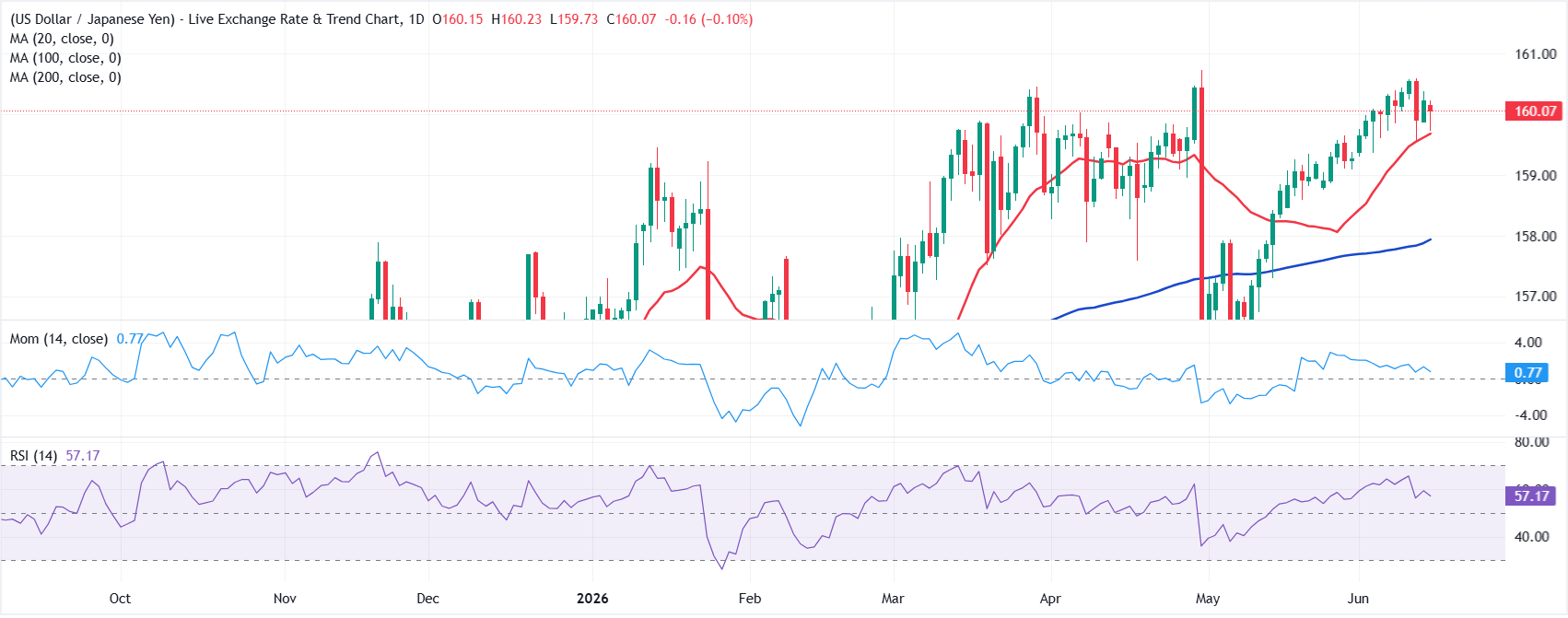
Valeria Bednarik, Chief Analyst at FXStreet, notes: “The USD/JPY pair trades around the 160.00 mark, maintaining the positive bias despite easing market concerns undermining demand for the USD. The daily chart for the pair shows a bullish 20-day Simple Moving Average (SMA) that heads north, well above the 100- and 200-day SMAs. The same chart shows that technical indicators have lost their upward momentum but remain above their midlines, lacking directional strength. The mentioned 20-day SMA has attracted buyers and now provides near-term support at around 159.65”
Bednarik adds: “Once below the aforementioned dynamic support, the pair can extend its slide towards 159.00, while additional selling pressure could see the pair aiming for 158.60, a static support level. The USD/JPY pair peaked at 160.73 in April, a multi-decade high and a critical level to watch should JPY continue to weaken. Next comes 161.00, although it seems unlikely that Japanese authorities will allow the currency to weaken that much without actually intervening in the market.”
Bank of Japan FAQs
The Bank of Japan (BoJ) is the Japanese central bank, which sets monetary policy in the country. Its mandate is to issue banknotes and carry out currency and monetary control to ensure price stability, which means an inflation target of around 2%.
The Bank of Japan embarked in an ultra-loose monetary policy in 2013 in order to stimulate the economy and fuel inflation amid a low-inflationary environment. The bank’s policy is based on Quantitative and Qualitative Easing (QQE), or printing notes to buy assets such as government or corporate bonds to provide liquidity. In 2016, the bank doubled down on its strategy and further loosened policy by first introducing negative interest rates and then directly controlling the yield of its 10-year government bonds. In March 2024, the BoJ lifted interest rates, effectively retreating from the ultra-loose monetary policy stance.
The Bank’s massive stimulus caused the Yen to depreciate against its main currency peers. This process exacerbated in 2022 and 2023 due to an increasing policy divergence between the Bank of Japan and other main central banks, which opted to increase interest rates sharply to fight decades-high levels of inflation. The BoJ’s policy led to a widening differential with other currencies, dragging down the value of the Yen. This trend partly reversed in 2024, when the BoJ decided to abandon its ultra-loose policy stance.
A weaker Yen and the spike in global energy prices led to an increase in Japanese inflation, which exceeded the BoJ’s 2% target. The prospect of rising salaries in the country – a key element fuelling inflation – also contributed to the move.
Author

FXStreet Team
FXStreet
Composed of a group of economic journalists and FX experts, the FXStreet content team produces and oversees all content published on FXStreet. It provides a purely journalistic approach to the Forex market.