|

Show me the money – US personal savings keep growing

Summary

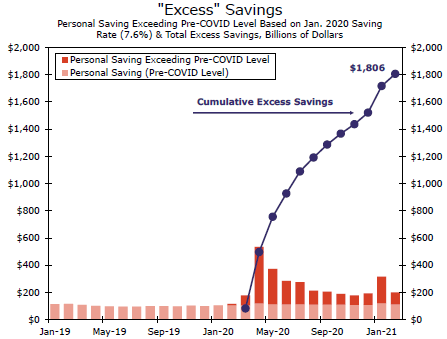
Households are sitting on a cash hoard of nearly $2 trillion. At its peak later this year, we estimate excess savings will swell to $2.4 trillion. Consumers, the story goes, are flush with cash. But what if they're not?

Although banks report sharp increases in deposit accounts, there is no way to know for certain the excess savings is parked in consumer bank accounts. This report considers the alternative uses for savings and what they mean for consumer spending.

Note that our forecast does not rely on a large draw-down of this excess savings. Even if we are wrong about the amount of savings households have to tap once the economy reopens, consumer spending can still be strong.

Did you know the human head weighs eight pounds?

We calculate excess savings as the cumulative amount of money saved since March 2020, less the amount that would have been saved by households had the saving rate remained at its pre-pandemic, January 2020 rate of 7.6%. Said differently, it is the aggregation of monthly income less monthly outlays that are above pre-COVID saving levels.

By our estimates, excess savings reached $1.8 trillion in February and are set to reach as high as $2.4 trillion in the third quarter of this year. At face value, this implies consumers will soon be sitting on enough cash to fund nearly 20% of consumer spending in a given year pre-pandemic. But can we take these estimates at face value? 
fxsoriginal

Source: U.S. Department of Commerce and Wells Fargo Securities

Personal saving in the National Income and Product Accounts (NIPAs) is the disposable personal income left over after deducting personal outlays (personal consumption expenditures, personal interest expenses, and net current transfer payments). Personal income used to acquire assets is therefore not counted as consumption and instead included in personal savings. So what else might consumers have done with excess savings? And what are the implications for the consumer spending outlook?

Download The Full Special Report

Author

More from Wells Fargo Research Team
Share:

Editor's Picks

EUR/USD flirts with daily highs, retargets 1.1900

EUR/USD regains upside traction, returning to the 1.1880 zone and refocusing its attention to the key 1.1900 barrier. The pair’s slight gains comes against the backdrop of a humble decline in the US Dollar as investors continue to assess the latest US CPI readings and the potential Fed’s rate path.

GBP/USD remains well bid around 1.3650

GBP/USD maintains its upside momentum in place, hovering around daily highs near 1.3650 and setting aside part of the recent three-day drop. Cable’s improved sentiment comes on the back of the Greenback’s  irresolute price action, while recent hawkish comments from the BoE’s Pill also collaborate with the uptick.

Gold clings to gains just above $5,000/oz

Gold is reclaiming part of the ground lost on Wednesday’s marked decline, as bargain-hunters keep piling up and lifting prices past the key $5,000 per troy ounce. The precious metal’s move higher is also underpinned by the slight pullback in the US Dollar and declining US Treasury yields across the curve.

Crypto Today: Bitcoin, Ethereum, XRP in choppy price action, weighed down by falling institutional interest 

Bitcoin's upside remains largely constrained amid weak technicals and declining institutional interest. Ethereum trades sideways above $1,900 support with the upside capped below $2,000 amid ETF outflows.

Week ahead – Data blitz, Fed Minutes and RBNZ decision in the spotlight

US GDP and PCE inflation are main highlights, plus the Fed minutes. UK and Japan have busy calendars too with focus on CPI. Flash PMIs for February will also be doing the rounds. RBNZ meets, is unlikely to follow RBA’s hawkish path.

Ripple Price Forecast: XRP potential bottom could be in sight

Ripple edges up above the intraday low of $1.35 at the time of writing on Friday amid mixed price actions across the crypto market. The remittance token failed to hold support at $1.40 the previous day, reflecting risk-off sentiment amid a decline in retail and institutional sentiment.














