Shenzhen gave Putin a photo and gave markets nothing

Here we go again, ninety minutes of trailetaral costly meeting.. That is how long the first meeting ever between Trump, Xi and Putin lasted on Thursday in Shenzhen, China. The main output was a four point "declaration toward peace" and some very nice group pictures. What we did not get is the one thing the global markets were waiting for: a general update on the US China trade truce that expires on January 10 2027.
What was signed
The joint declaration has a few interesting points. First, reform the United Nations, second, increase the production and supply of refined petroleum products, third respect the immunity of state officials, and fourth; start a dialogue on nuclear risks.
If you read it the document twice you will be able to tell that nothing impactful happened and you will see more clearly who won. The oil and gas point helps Russia, whose refineries are constaly under Ukrainian drones attaks. The immunity point is a message to the International Criminal Court, which has a warrant for Putin’s arrest. And this the facto kills all the sanction, and the isolation built by Europe since 2022. Putin came to his first APEC since 2017 and left with almost everything he wanted, without even discussing the Ukraine war. This is effective politking by the Kremlin.
What was also missing in the document was the Iran war. The day before the trilateral meeting, Iran struck Bahrain and Kuwait again, the first attacks of these kinds in about two months. This week Iran also managed to strike the Public Investment Fund (PIF) headquarter, the Saudi trillion dollar sovereign wealth fund.
What was not signed
Trump and Xi met for about an hour before the trilateral meeting. Very warm, a "special relationship". But on chips, rare earths, tariffs and Taiwan nothing was discussed, and there is no extension after January 10. According to the Washington think-tank CSIS, Chinese rare earth exports to the US are still about 75% below pre-trade war escalation. Furthermore, Beijing is only buying about half of the soybeans from the US it promised in May.
President Trump did not impose new limits on AI chips export to China, a sign he does not want to make January harder. In other words, President Trump came back to the US an empty declaration document and a date that has still not been moved.
Nvidia: Smoke, and Trump agrees
A few days ago I wrote on Fxstreet that the Nvidia spy story was a lot of smoke. In Shenzhen even Trump said it: "We spy on China, they spy on us." Every big American tech company is a target, Nvidia had a big name as the leader, and that Nvidia CEO story could not be wasted.
The numbers say a similar story supporting my argumentt. In the first quarter without Jensen Huang, Nvidia reported $115.8 billion of revenue, up 103% in a year, and guided $130 billion for this quarter assuming zero data center revenue from China. The business does not need China much to continue its incredible growth. The problem is political: chips are no longer a card Trump can easily play with Xi, with Huang testifying before Thanksgiving and Congress pushing for more controls.
Anthropic: The other news of the day
This Thursday was also a big day for the Wall Street since Anthropic, led by the Italian CEO Amodero, made its Nasdaq debut. It raised $81.3 billion at $83 a share, the largest IPO in history, ahead of SpaceX in June, and with a separate $26 billion placement with tech companies, Nvidia included, the total is roughly $107 billion, with a valuation of close to $2 trillion. Impressive.
I realize that many are speculating that Anthropic share are too expensive on the ground that revenues could slow. Is that true? Revenue in the first nine months was $33.24 billion, this is about 1,200% growth. It is true that the company is not profitable yet and a lot of this growth is based on FOMO from investors.
For macro the point is different. No other country can raise $80 billion for one AI company in one day. The American lead in AI is now also a capital markets lead, and that pulls money toward the dollar and the Nasdaq.
What I watch now
For FX the message from Shenzhen is: no news is not always good news. These were meetings between three weakened leaders who are trying to project strength and cooperation in the middle of wars, market volatility and weak macroeconomic trends. Nothing concrete came out and that is not good and nobody was willing to give in on anything.
So of course now, the Miami meetings in December is what we are looking at. The G20 at Trump's Doral resort is on December 14 and 15. Xi is expected, Putin is invited and nobody knows if he will come. After Shenzhen, Doral is the last realistic place to fix the January 10 deadline.
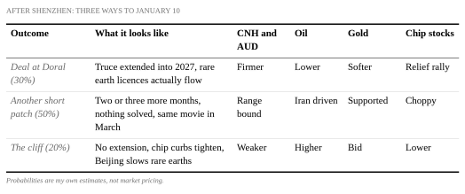
My base case moved after Thursday. More weight on another short patch, two or three months, the same story again in March. Good for nobody, but the easiest thing to sign in front of cameras.
In Italy we say *tanto fumo e poco arrosto*, a lot of smoke and very little roast. That was Shenzhen. If there is a roast, it will be served in Miami.
Author
Andrea Zanon
Confidente
Andrea Zanon has 20 years of professional experience as a disaster risk management, sustainability, and entrepreneurship specialist. Mr. Zanon has advised international institutions and countries across the Middle East and North Africa. Mr.

















