Dollar up as Bitcoin, Gold and stocks fall on Fed rate worries

A Coinbase Institutional report confirmed that the US dollar strengthened 2.5% in the month to November 18, making it the only gainer among 14 major assets and benchmarks tracked. Meanwhile, Bitcoin, gold, and equities all suffered meaningful declines.
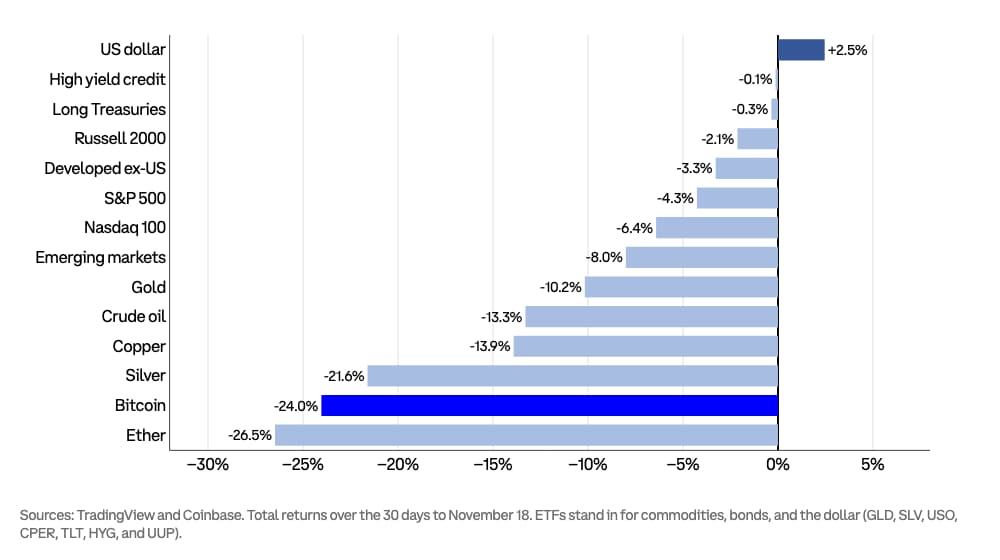
Here is a breakdown of what happened and the Fed-driven mechanism behind it.
The scoreboard: Dollar as the sole safe haven
The dollar's advance coincided with a broad sell-off in risk assets and perceived "stores of value":
- Bitcoin: Fell roughly 17% from the dollar's September low through mid-November.
- Gold: Declined about 14% over the same period, dropping below the $4,000 mark.
- Stocks: The tech-heavy Nasdaq fell sharply, with AI-related names under pressure as higher yields compressed valuation multiples.
- The Dollar Index (DXY): Climbed to near 103.8, touching its highest level since April 2, 2025.
Why the Fed made the Dollar the "wrecking ball"
The mechanism is straightforward: the Fed's hawkish pivot made holding cash-like dollar assets more attractive than holding anything else.
- Rate-hike expectations repriced: Minutes from the October Fed meeting showed that nearly all officials expected further interest-rate increases to combat inflation. Strong economic data—including a much hotter-than-expected October jobs report and sticky core inflation—reinforced this view. By mid-November, markets were pricing roughly a 95% probability of a rate hike at the December meeting.
- The "debasement trade" unwound: For much of the prior period, a popular bet was that a weakening dollar and swelling government debt would push investors into gold and Bitcoin. When the Fed signaled higher-for-longer rates, that thesis collapsed. Coinbase explicitly called the reversal an "unwind of the debasement trade"—gold and Bitcoin, which pay no interest, fell together as the dollar rallied.
- Real yields did the work: The inflation-adjusted yield on 10-year US government bonds climbed near an 18-year high. That makes dollar deposits and short-term Treasuries genuinely competitive against non-yielding assets for the first time in years. As Bank of America's Michael Hartnett put it, a surging dollar with gold back below $4,000 signals that "global liquidity... is in retreat".
The December Fed meeting
The probability of a rate hike has shifted noticeably as new data and Fed commentary is post, creating a fluid and nervous market environment.
- Evolving odds: Earlier in November, after a strong jobs report, the market-implied probability of a 25-basis-point hike jumped to 76.8%. By November 21, this had climbed further to around 91.5%, though traders were no longer pricing it as a certainty. The current target range is 3.75%–4.00%.
- The 50-basis-point wildcard: Fed Governor Christopher Waller has explicitly suggested that a 50-basis-point hike may be needed to "shock the market" and demonstrate the Fed's resolve. While many economists view this as an overreaction, the mere possibility has introduced significant tail risk.
- Beyond December: The debate is not just about one meeting. JPMorgan expects the Fed to hike at its December 2026, January 2027, and March 2027 meetings, which would take the benchmark rate to the 4.50%–4.75% range. Markets are also assigning a 62.5% probability to another hike in January.
Asset-by-asset outlook
With the Fed's path so pivotal, here is how the major asset classes are positioned heading into the decision.
US Dollar: Strength with a ceiling?
The dollar's rally is widely expected to persist in the near term, but analysts are increasingly questioning how much further it can run.
- Near-term support: JPMorgan believes the dollar's rise can continue on expectations of a more hawkish Fed. The logic is simple: higher US rates attract global capital, boosting demand for the dollar.
- Overextension risk: However, Brown Brothers Harriman (BBH) notes that the dollar has "overshot the level implied by rate differentials," which limits the scope for further near-term gains. BNY Mellon also expects a softer dollar over the medium term, particularly against select Asian and Canadian currencies, once the market begins to look past the peak in Fed tightening.
Bitcoin: Facing a liquidity crunch
Bitcoin is the most vulnerable to the Fed's hawkish stance, as higher rates directly reduce the liquidity available for speculative assets.
- Bearish technicals and flows: Market maker Wintermute warns that Bitcoin could slide into the $50,000s after losing its key 200-week moving average near $68,000. This is compounded by significant capital outflows: spot Bitcoin ETFs have seen roughly $1.9 billion in net outflows in 2026, a stark reversal from the prior year.
- The rate-hike peak is key: The medium-term outlook hinges on when the Fed stops hiking. Analysts suggest it is not yet time to call a bottom, but rather to wait for the December FOMC to confirm the "rate hike peak." Once the market is confident the tightening cycle is over, the pressure on crypto could ease. Grayscale also views the current pullback as offering attractive entry points for longer-term investors.
Gold: A potential turning point?
Gold's outlook is more nuanced than Bitcoin's, with a possible short-term rebound on the horizon despite strong headwinds.
- The December pivot: Some analysts, like those at Xinhua Finance, see the Fed meeting as the likely inflection point for a "phase rebound" in gold prices. The reasoning is that the market has already priced in a hike, so the actual announcement could trigger a "sell the rumor, buy the news" reaction, especially after a sharp sell-off that took gold below $3,600/oz.
- Structural support vs. cyclical headwind: Major banks have cut their targets—Goldman Sachs now sees gold at $4,150 by year-end 2026—but remain constructive long-term. The key structural support is relentless central bank buying, running at an estimated 85 tonnes per month, which is far above the pre-2022 average. The dynamic is clear: Fed policy is the cyclical headwind, but central bank demand is the structural floor.
Stocks: The "Fed put" has disappeared
Equities are caught between solid corporate fundamentals and a tightening liquidity environment.
- The core risk: Barclays warns that the "bigger challenge for equities is the perception that the Fed put has disappeared". The implicit safety net that investors relied on during past sell-offs is gone, as the Fed is now actively fighting inflation rather than supporting markets.
- A divergence of views:
- The bear case: Barclays sees further weakness into year-end, comparing the setup to December 2018, when stocks fell roughly 20% before the Fed pivoted. They see the December meeting and the subsequent CPI report as critical catalysts.
- The bull case: UBS disagrees, arguing that a "measured tightening cycle" of 25-basis-point hikes in December and March will not derail the US economy or the equity rally. They forecast strong S&P 500 earnings growth of 25% in 2026.
The dollar's strength and Bitcoin's weakness are the most direct expressions of this, while gold and stocks are caught in a tug-of-war between the cyclical pressure of rate hikes and their own structural or fundamental supports. The December 9 decision will either confirm the "higher-for-longer" regime or provide the first signal that the end of the tightening cycle is finally in sight.
Author
Isai Alexei
Independent Analyst
I am Isai Alexei. I work as a journalist and financial analyst covering cryptocurrency markets and traditional securities. I have spent ten years analyzing digital assets, trading activity, and market structure.

















