|

Sentiment in the Eurozone on a free fall

  • ZEW index of investors sentiment fell to the lowest level since July 2016.
  • German business sentiment indicators are set to slide lower as trade wars and geopolitics weigh.

With the forward-looking sentiment indicators like purchasing managers indices (PMIs) in the Eurozone reaching higher highs until they peaked at the turn of the year 2018, the growth prospects for the Eurozone looked very positive. Now the mood in the Eurozone is changing. Rapidly changing.

German investors sentiment indicator piled up by ZEW Institute in Mannheim is the early warning sign with the investors' sentiment index out for April already and the news are rather negative.

Related story

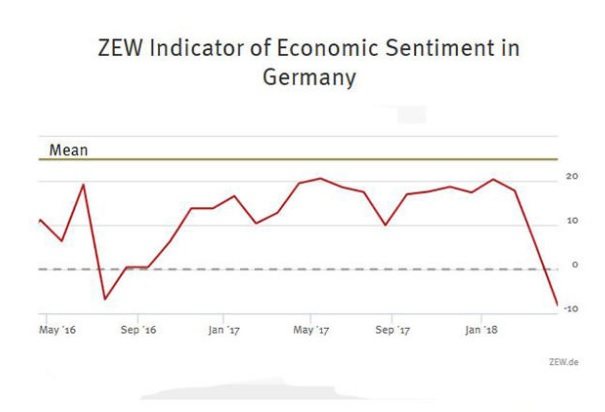
Since February this year, the ZEW index fell from 17.2 level to -8.2 in April. So for the investors' sentiment indicator, it took just two months to swing from positive to negative reading last recorded in July 2016 when the sentiment was hammered by post-Brexit referendum uncertainty.

The reasons behind the downturn in investors sentiment are stemming from both geopolitics and the international trade after the US-led push against both China and Syria.

“The reasons for this downturn in expectations can mainly be found in the international trade conflict with the United States and the current situation in the Syrian war. The significant decline in production, exports and retail sales in Germany in the first quarter of 2018 is also having a negative effect on the future economic development,” professor Achim Wambach and ZEW Institute president said in the release.

Now with the main gauge of German business confidence indicator due on April 24, the IFO business climate indicator is set to follow the pattern of ZEW index, possibly falling below 110 from 117.6 peaks in December 2017.

German ZEW index of investors' sentiment


Author

Mario Blascak, PhD

Mario Blascak, PhD

Independent Analyst

Dr. Mário Blaščák worked in professional finance and banking for 15 years before moving to journalism. While working for Austrian and German banks, he specialized in covering markets and macroeconomics.


More from Mario Blascak, PhD
Share:

Editor's Picks

GBP/USD bounces off lows, back above 1.3200

After bottoming out near 1.3160, GBP/USD manages to regain a bit of shine and reclaim the 1.3200 mark and beyond at the end of the week. Stronger-than-expected UK Retail Sales data seem to be helping the British Pound limit its losses, while the chaotic UK political environment keeps the bulls at bay for now.

EUR/USD looks consolidative around 1.1460

EUR/USD stages a modest rebound after slipping to a three-month low below 1.1420 at the end of the week. That said, the pair now looks to consolidate humble gains just above 1.1460 despite growing uncertainty surrounding the next round of US-Iran negotiations, which keeps the US Dollar’s downside contained.

Gold slips back to six-day lows, targets $4,100

Gold retreats for the third consecutive day on Friday, eroding gains seen in the first half of the week and approaching the key $4,100 mark per troy ounce. Indeed, the precious metal continues to face headwinds from the Fed's hawkish stance and renewed uncertainty surrounding the next round of US-Iran negotiations.

Solana extends correction despite ETF inflows, RWA adoption

Solana (SOL) price edges below $70 extending its losses for the fourth straight day this week. The institutional demand for Solana is building, with steady inflows so far this week and Morgan Stanley’s amended S-1 filing for a Solana-focused Exchange-Traded Fund.

The Iran war didn't break the US economy, but what happens next?

Nearly four months after the start of the Iran war, the US economy remains remarkably resilient. While the conflict initially triggered a severe disruption to global energy markets and a sharp rise in Oil prices, recent diplomatic progress between Washington and Tehran has eased concerns about a prolonged supply shock.

Regime change: Inside Kevin Warsh's first move to make the Fed unreadable on purpose

The rate did not move. That was the least interesting thing about Kevin Warsh's first meeting in charge of the Fed. The FOMC held its benchmark at 3.50%-3.75% for the fourth straight meeting, exactly as priced, and then the new chair used his first press conference to dismantle the machinery the market has leaned on for a decade.















