‘Sell America’ trade on? Japanese intervention pressures USD


Last week, we talked about how USDJPY is at an inflection point. Price was pressing into a known resistance zone, while still holding above the daily 50-EMA band, a level we consistently use to assess trend health.
As long as the lower bound of that band held, USDJPY could remain in an uptrend. However, the higher price pushed into resistance, the greater the risk of a reversal.
Well, by the end of the trading week, it appears the beaver has broken the dam. USDJPY gapped down below the supportive band, dragging DXY down along with it.
USD/JPY breaks trend support
On the daily chart, USDJPY has now lost its 50-EMA band; a meaningful shift in short-term structure.
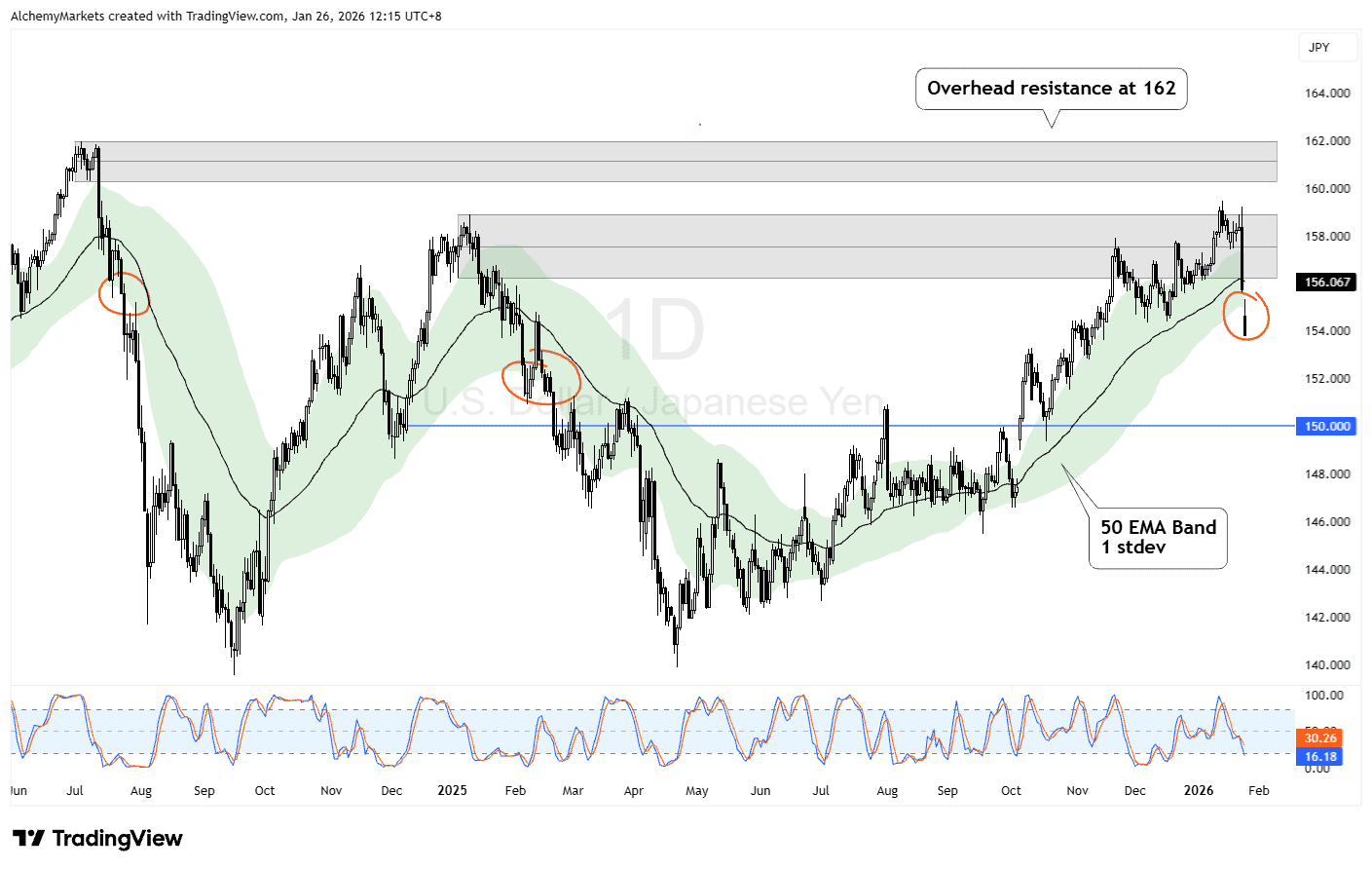
While momentum indicators such as Stochastic RSI are now approaching oversold territory, there has not yet been a confirmed bullish crossover. This places USDJPY in a technically vulnerable position: oversold, but still below trend resistance.
In this context, any rebound should be treated as a retracement, not a trend reversal, unless price can reclaim and hold above the EMA band. USD is showing significant weakness at this juncture.
Dollar weakness follows through
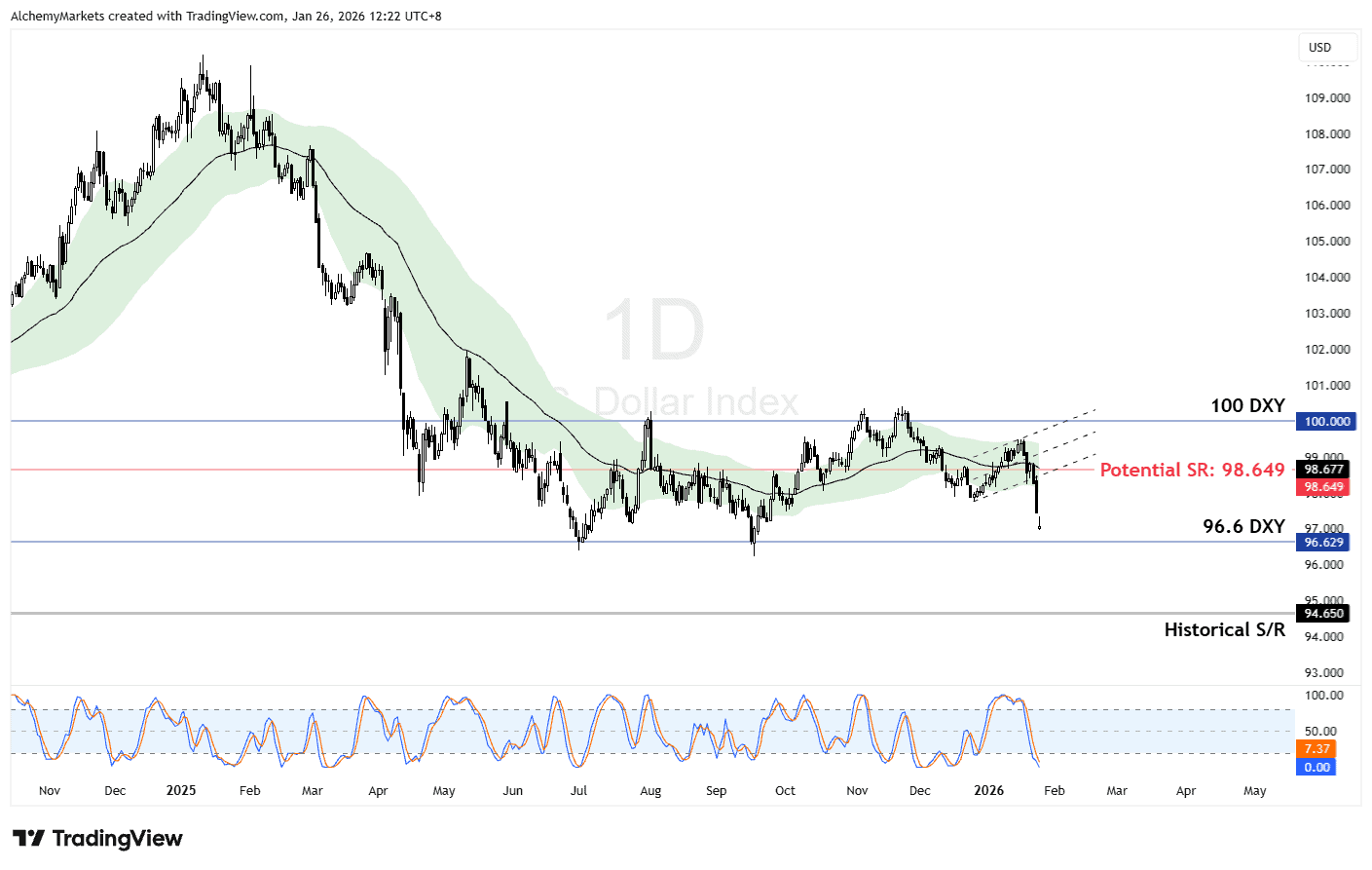
The same structural damage is visible on the DXY.
The dollar index has slipped below its own daily 50-ema band trend support (projected via a Bollinger Bands®) mirroring the USDJPY breakdown. As with USDJPY, momentum conditions suggest the potential for a reflex bounce… but structurally, the dollar remains suppressed as long as it trades below the 50-EMA zone.
This keeps pressure on the dollar in the near term, even if we see short-lived counter-trend rallies.
Is the “Sell America” trade turning on?
At its core, a Sell America trade refers to a period where capital rotates away from US assets on a relative basis.
This usually shows up first through US dollar weakness (this is possibly where we are), followed by pressure in US equity leadership, while capital reallocates into commodities, hard assets, or non-US markets.
Importantly, this is not a single event, nor does it imply an outright collapse in US equities. In many past cycles, the process has unfolded in stages, with FX moving first, equities lagging, and leadership gradually shifting rather than breaking outright.
Against that backdrop, recent dollar behaviour and USDJPY’s trend shift naturally raise the question:
Are we seeing the early signals of such a rotation?
While direct confirmation is rarely provided in real time, markets infer action through behaviour. In this case, the price action of USDJPY aligns with prior episodes where Japanese authorities have stepped into FX markets to stabilise the yen (after threatening intervention), primarily via direct currency intervention funded through reserves.
Historically, periods of sustained dollar downside have often coincided with:
- Reduced demand for US assets on a relative basis.
- Outperformance in commodities and hard assets.
- Increased volatility in US equity leadership.
That said, a falling dollar does not automatically translate into an immediate sell-off in US equities. In many past episodes, stocks initially held firm, or even advanced, while the dollar weakened, before leadership eventually rotated elsewhere.
The current setup suggests we may be entering the early stages of such a process, rather than a fully developed Sell America regime.
MAG7: Leadership at an inflection point
If a broader “Sell America” rotation were to develop, US equity leadership would be one of the first areas to show stress. That makes the Magnificent 7 an important tell.
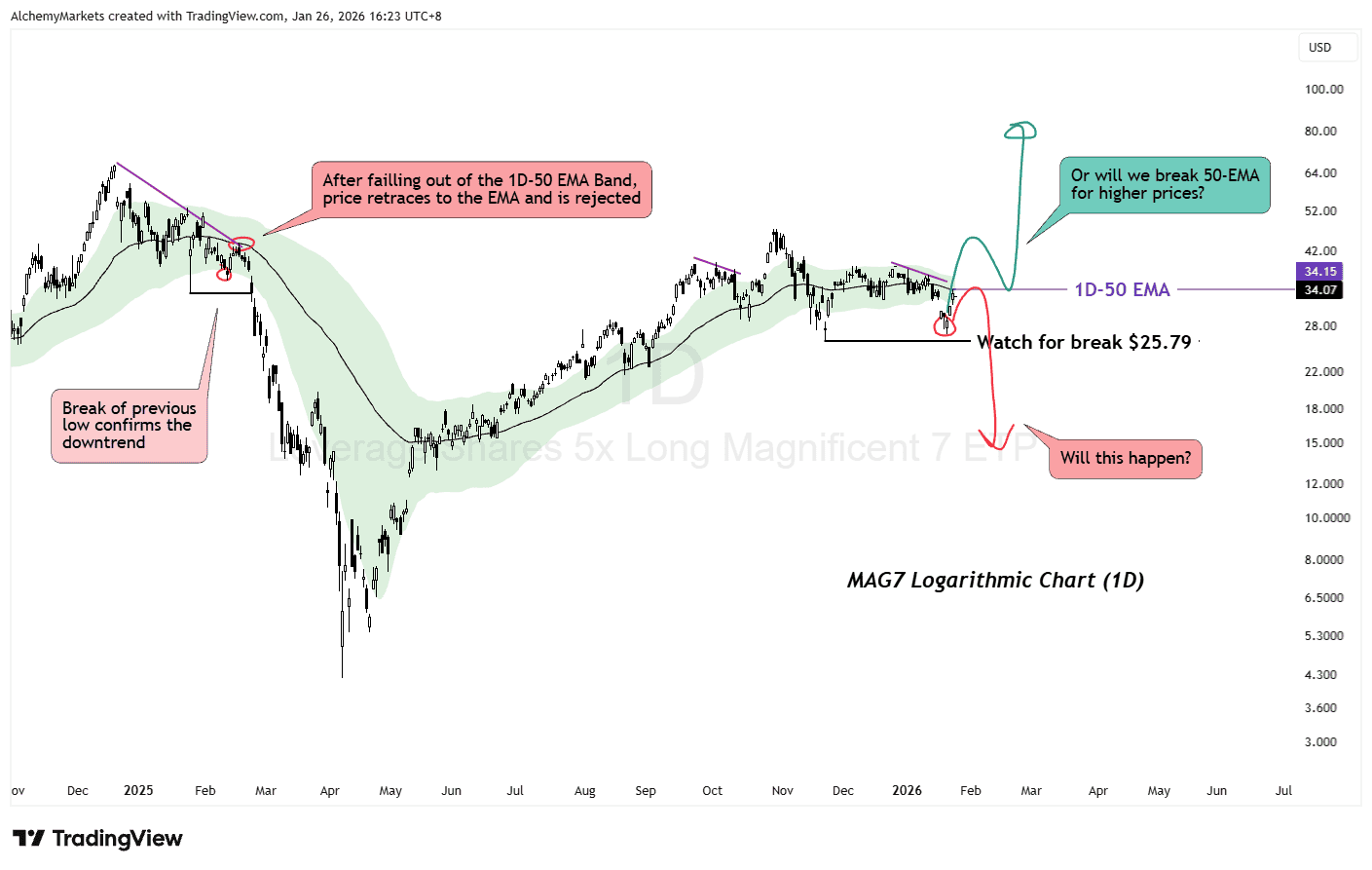
On the daily chart, MAG7 is at its 50-EMA, retesting as potential resistance, as it has previously broken below the 50-EMA band. In 2025, a failure to reclaim this zone marked the transition from consolidation into a deeper corrective phase.
Structurally, the setup is now binary.
On the downside, a clean break below the recent swing low near $25.79 would confirm a loss of short-term trend control and increase the risk of a broader pullback, similar to what followed in 2025.
On the upside, if price can stabilise here and reclaim momentum above the 50-EMA, leadership may yet reassert itself, keeping US equities supported even as the dollar weakens.
As long as leadership holds above key support, dollar weakness alone is unlikely to trigger a full risk-off move. However, a failure here would add weight to the idea that FX-led pressure is beginning to spill into US equity leadership.
Bottom line
Dollar weakness remains the dominant theme while USDJPY and DXY trade below their 50-EMA bands, with rebounds best treated as tactical rather than structural.
For risk assets, MAG7 is the key tell: hold above support and rotation stays contained; lose it, and “Sell America” dynamics gain traction.
Author
Zorrays Junaid
Alchemy Markets
Zorrays Junaid has extensive combined experience in the financial markets as a portfolio manager and trading coach. More recently, he is an Analyst with Alchemy Markets, and has contributed to DailyFX and Elliott Wave Forecast in the past.

















