Scott Bessent has a plan to cut mortgage rates. It hinges on one war
US Treasury Secretary Scott Bessent's plan to lower borrowing costs has two parts. One is buying back more long-dated government bonds. The other is getting past the war with Iran; after that, he has reportedly said rates should drop. The 30-year mortgage rate is at its highest in almost three years, and the bond yield it follows has added very little for war-driven inflation. Ending the fighting would take out what the war added to expected inflation, and that is the smallest piece of the rise.
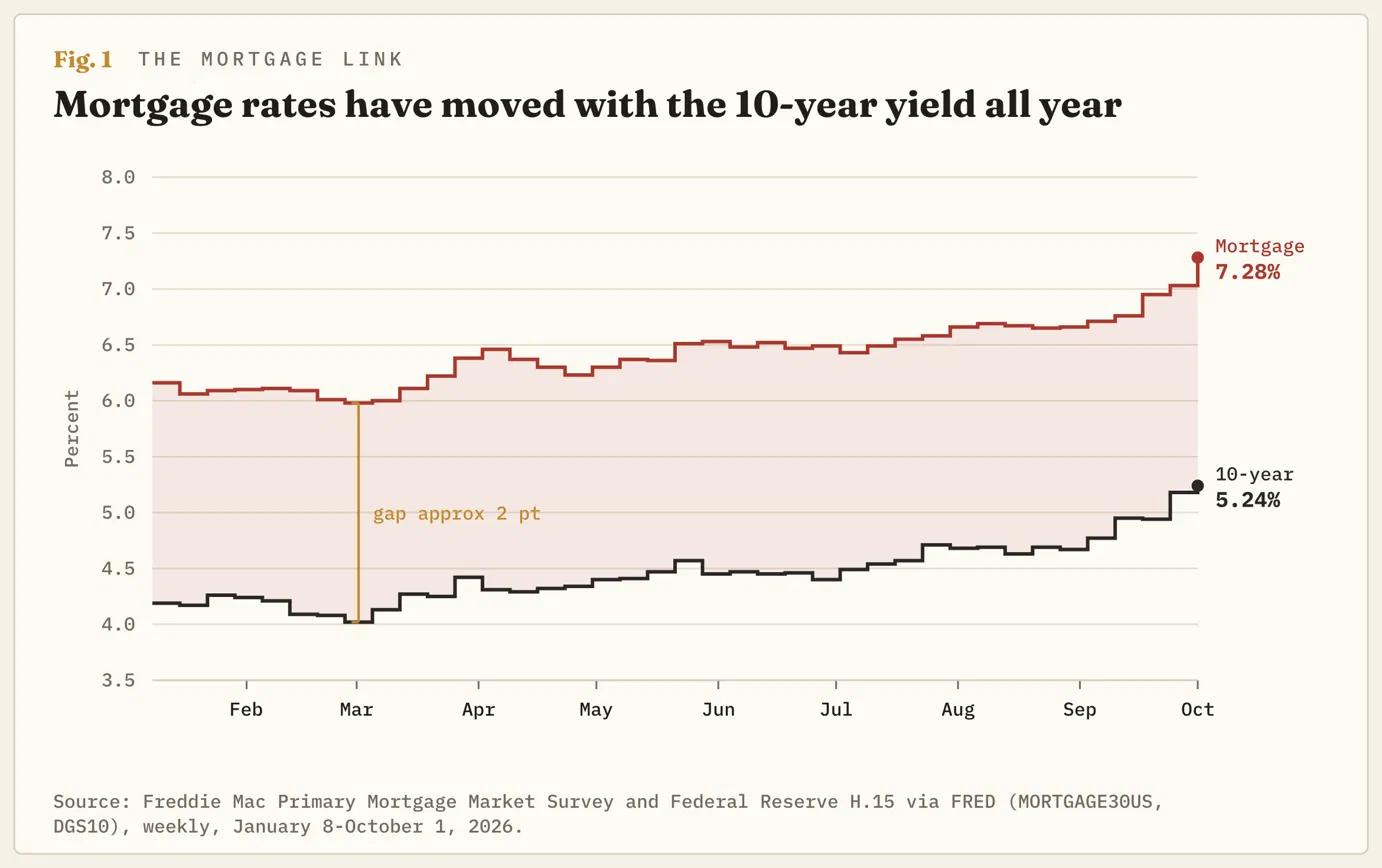
The Mortgage Bankers Association (MBA) put the average 30-year fixed rate at 7.49% in the week to October 2, up from 7.30% a week earlier. Freddie Mac's measure was 7.28% on October 1, its highest since November 2023. It was 5.98% on February 26, two days before the war began. Anyone buying a house with a loan pays for that move, and the question for Bessent's plan is how much a ceasefire would undo.
Mortgage rates follow the 10-year yield
A 30-year mortgage is priced off the 10-year Treasury yield, the rate the US government pays to borrow for a decade, plus a margin for the lender. The 10-year yield was 4.02% on February 26 and 5.31% on Monday, its highest since May 2002. On Freddie Mac's numbers, the lender's margin was about 2 points in February and still about 2 points on October 1. The mortgage rate is the 10-year yield plus a fee, and the fee is what it was before the war. Lowering mortgage rates means lowering the 10-year yield, in the part that actually rose.
Seven months of war added 0.08 of a point to expected inflation
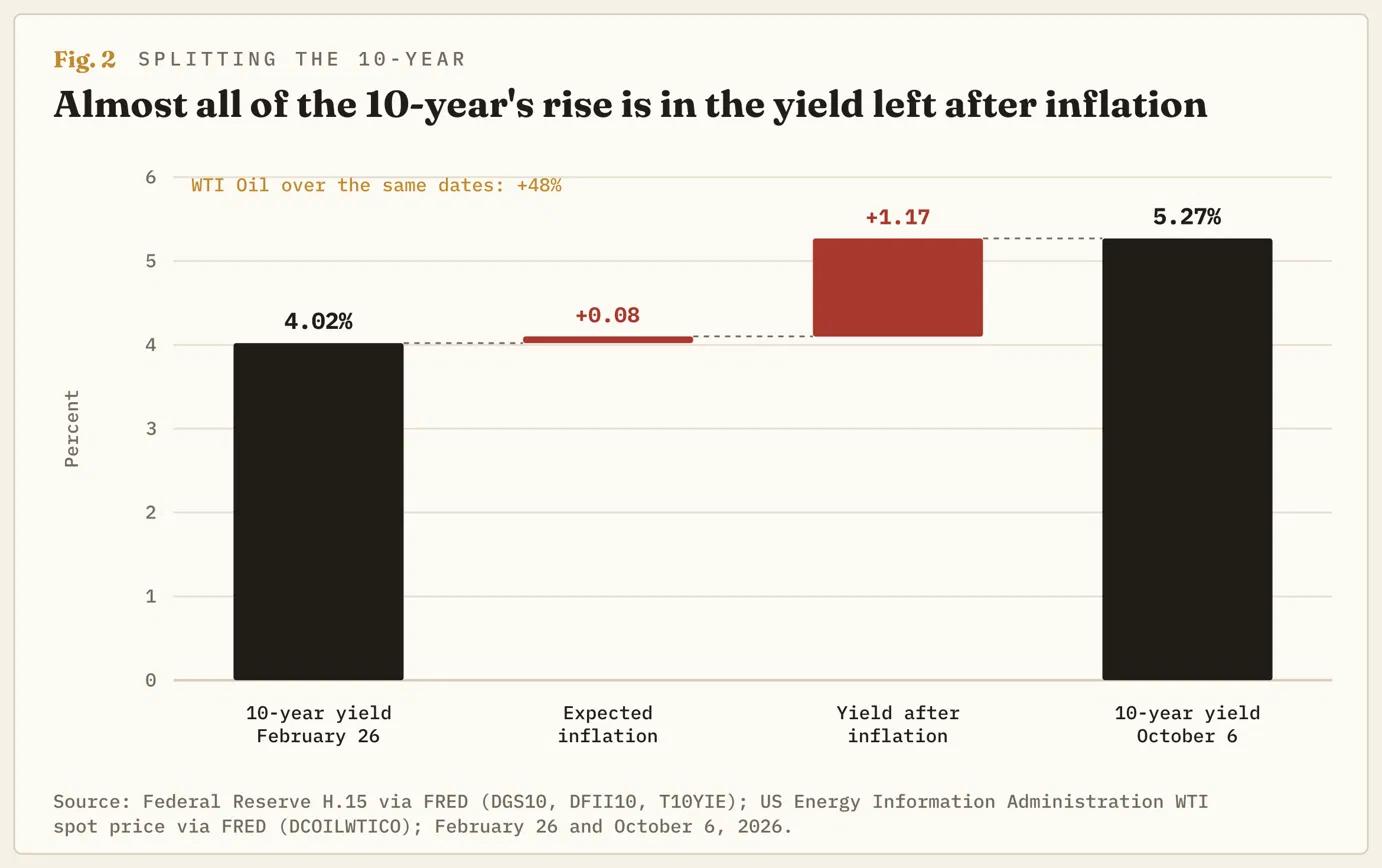
The 10-year yield can be split in two using the government's inflation-protected bonds. One part is what investors expect inflation to average over the next ten years. The other is the return they want on top of that, the yield left after inflation.
The first part was 2.28% on February 26 and is 2.36% now. That's a rise of 0.08 points through seven months of war and an Oil shock. The second part was 1.74% and is 2.91%, a rise of almost 1.2 points. In April, Bessent described the war's effect on prices as temporary. The bond market agreed with him about inflation, and the rise came in the other half of the yield.
A ceasefire works first on Oil and on expected inflation. It can only remove what the war added, 0.08 of a point, from a 7.49% mortgage rate. The war can still reach mortgage rates through the Federal Reserve (Fed), if dearer Oil keeps officials raising rates. That route runs through the yield left after inflation and through the Fed's own list of reasons for hiking, one of which is Oil.
Since the hike, the 10-year has risen on its own
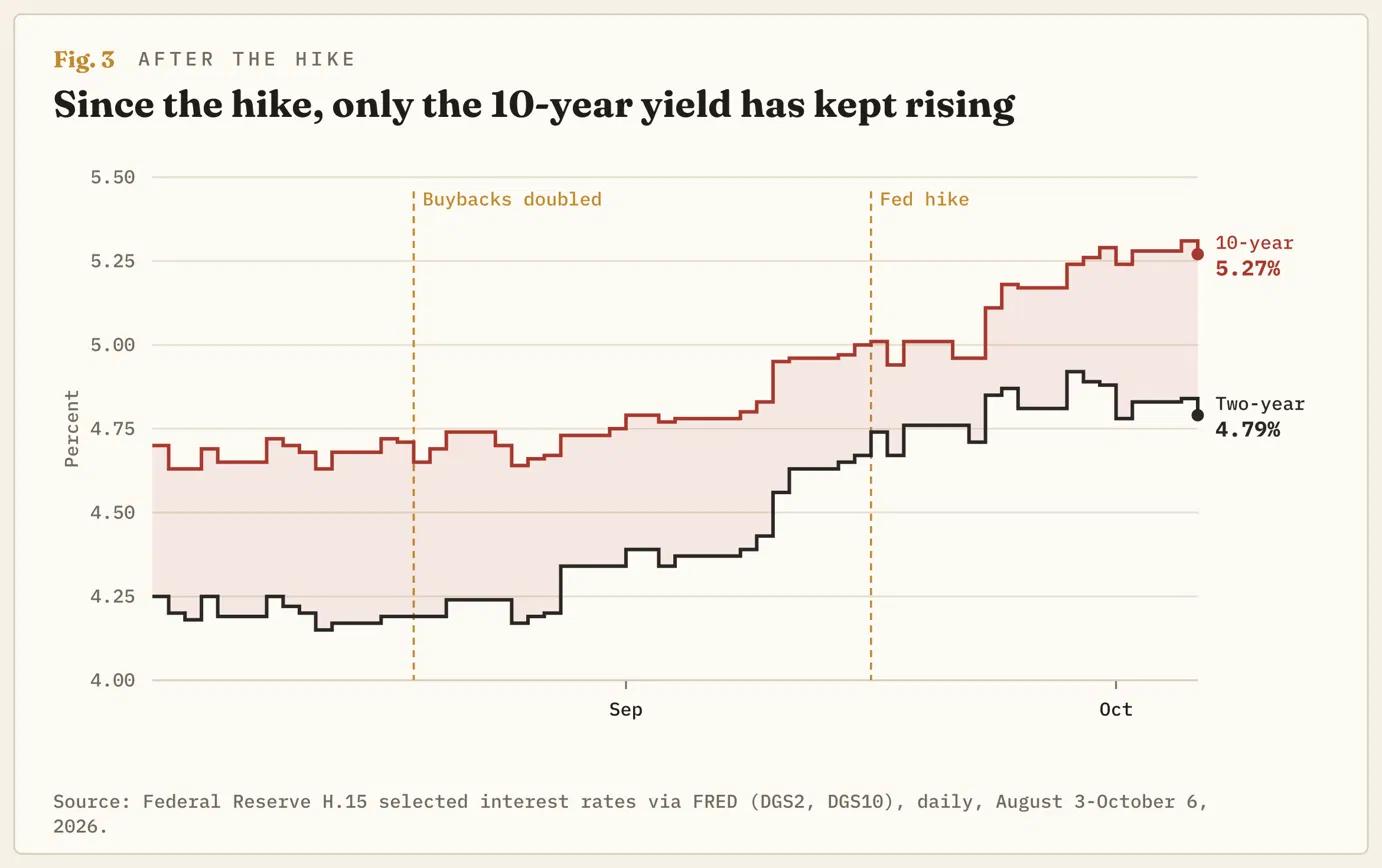
The Fed raised its rate by a quarter point to 3.75%-4.00% on September 16. Since then, the two-year Treasury yield, which tracks what investors expect the Fed to do over the next two years, has risen 0.05 of a point. The 10-year has risen 0.26 points, and Freddie Mac's mortgage rate has gone from 6.95% to 7.28%. The latest leg is investors asking more to lend for ten years. It isn't a bet on more Fed hikes, and it isn't Oil, which is lower than on the day of the hike.
Bessent's other tool targeted exactly that part. On August 19, the Treasury doubled its buybacks of long-dated government bonds for a programme running from September 9 to November 4, which Bessent has defended as a way to limit the rise in long-term yields. The 10-year yield fell to 4.66% on the announcement and is 5.27% now, so the half of the plan that doesn't depend on the war has run for a month with the yield rising through it.
Which half of the yield falls
The war's end date remains an open question, and the two accounts point in opposite directions. President Donald Trump has said the war would end immediately after the November 3 elections. He has also told aides he expects to resume strikes after the vote, according to the Wall Street Journal. Reuters has reported that his aides are working to keep the fighting from escalating before then.
If the fighting ends, the 10-year yield is likely to give back the 0.08 of a point in expected inflation. The test of Bessent's plan is what happens to the yield left after inflation. If that part falls by half a point or more as Oil comes down and officials stop talking about hikes, mortgage rates could go back under 7%. The plan would then work through the Fed rather than Oil. If that part holds near 2.9%, the ceasefire takes a tenth of a point off a 7.49% mortgage and leaves the rest.
If the strikes resume after November 3, Oil is likely to rise again and the case for another Fed hike in December gets stronger. In that branch, the yield left after inflation has more reason to rise than fall, and the expanded buybacks are due to stop on November 4, the day after the vote.
The split of the 10-year yield into its two parts is published every trading day, so it will show which half of the plan is working before the next mortgage survey does. A ceasefire that lowers Oil and keeps the 10-year above 5% ends the war and leaves mortgage rates about where they are.
Author

Joshua Gibson
FXStreet
Joshua joins the FXStreet team as an Economics and Finance double major from Vancouver Island University with twelve years' experience as an independent trader focusing on technical analysis.