Three fundamental drivers are all pushing the Euro south. This chart shows them lining up on 1.1000
EUR/USD has already fallen sharply, but the forces pushing the pair lower are becoming increasingly interconnected. French fiscal concerns, renewed energy pressure and an uncomfortable policy dilemma for the European Central Bank (ECB) are colliding with a US economy that continues to give the Federal Reserve (Fed) little reason to turn dovish. Options markets suggest investors are taking the downside risk seriously. The road toward 1.1000 is increasingly difficult to dismiss.
EUR/USD approaching 1.1000 would have looked like an aggressive call only a few weeks ago. It looks considerably less so now.
The Euro (EUR) has come under renewed pressure as fiscal concerns in France have intensified, energy prices have climbed and investors have reassessed the relative monetary-policy outlook on both sides of the Atlantic.
None of these factors alone necessarily represents a decisive argument for a substantially weaker European currency. Together, however, they are beginning to form a much more uncomfortable macroeconomic picture.
More importantly, the weakness is no longer confined to the spot market.
An analysis of EUR/USD risk reversals shows investors are paying unusually heavily for downside protection, even after accounting for the currency pair's recent decline.
That suggests the options market sees something potentially more significant than an ordinary correction.
France turns political uncertainty into a Euro risk
France has become the most immediate source of pressure.
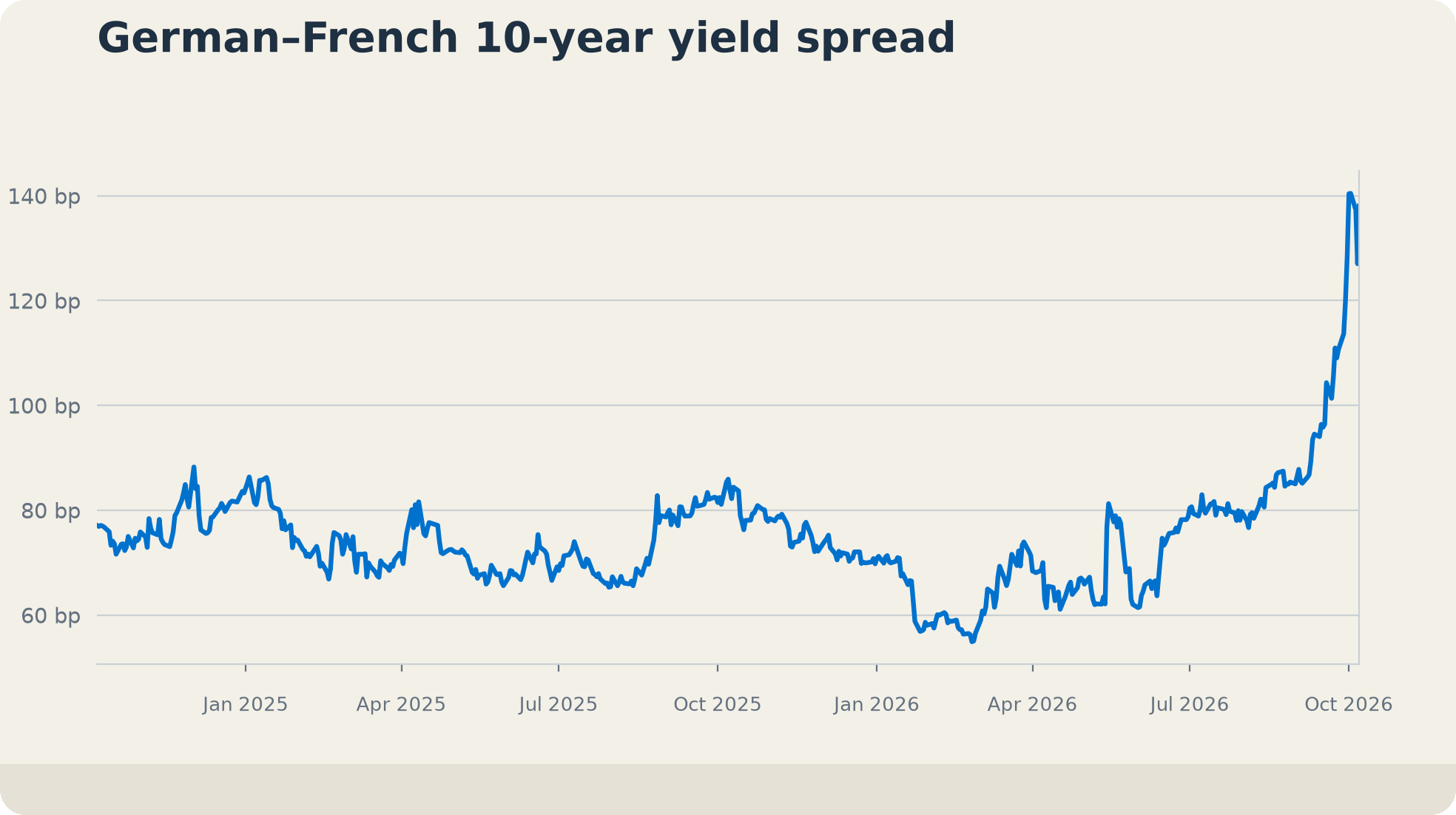
Growing concerns surrounding the country's fiscal position have pushed French government bond spreads sharply wider against Germany, reviving a problem the Euro area has repeatedly encountered since the sovereign debt crisis: monetary policy may be common, but fiscal risk is not.
For the FX universe, the importance of wider French spreads extends beyond France itself.
Persistent widening raises the possibility of a renewed fragmentation premium across European assets. It can increase funding costs, weaken investor confidence and ultimately complicate the ECB's ability to respond to inflation.
That last point is particularly important.
Under normal circumstances, persistent inflation should strengthen expectations for tighter monetary policy and potentially support the currency.
But Euroland is moving into anything but normal circumstances.
If tighter financial conditions emerge through sovereign markets as economic growth weakens, the ECB's tolerance for additional tightening becomes considerably more limited.
France therefore risks transforming what initially appeared to be a domestic fiscal story into a broader constraint on European monetary policy.
For EUR/USD, that matters.
Europe's energy problem is back
The persistent increase in energy prices adds another layer to the problem.
Europe remains considerably more exposed to imported energy than the United States, meaning a sustained increase in Oil and gas prices represents both an inflation shock and a deterioration in the region's terms of trade.
That combination is particularly unfriendly for the Euro.
Higher energy costs reduce households' purchasing power, squeeze corporate margins and weaken domestic demand. At the same time, they can prevent headline inflation from falling as quickly as policymakers would like.
The ECB could therefore find itself confronting an increasingly uncomfortable combination: higher inflation, weaker growth and tighter financial conditions.
That is very different from the traditional FX relationship, where higher inflation leads markets to price higher interest rates and therefore a stronger currency.
If imported energy rather than excessive domestic demand predominantly drives inflation, additional monetary tightening cannot solve the source of the problem. It can, however, further weaken activity.
For the currency, the distinction is crucial.
The energy shock could therefore become another reason investors demand a larger risk premium for holding European assets rather than a reason to expect an aggressively hawkish ECB.
The Fed faces a very different problem
Across the Atlantic, the policy dilemma looks markedly different.
US inflation remains elevated, but the broader economy continues to display considerable resilience, which markets have christened “exceptionalism”.
That combination has allowed markets to maintain expectations for further Federal Reserve tightening and, perhaps more importantly, has provided little justification for investors to anticipate meaningful policy easing.
The divergence with Europe is subtle but increasingly important.
The bearish EUR/USD argument does not require the Fed to embark on another aggressive hiking cycle.
It merely requires US economic activity to remain sufficiently robust and inflation sufficiently persistent for the Fed to maintain restrictive policy, or tighten somewhat further, while the ECB becomes increasingly constrained by weaker growth, fiscal stress and widening sovereign spreads.
The relative policy outlook continues to move in the Greenback’s favour.
For an exchange rate, relative conditions matter more than absolute ones.
And at present, those relative conditions are becoming progressively less favourable for the Euro.
Options traders are moving faster than spot
The options market provides one of the clearest indications that investors are taking the deterioration in the single currency quite seriously.
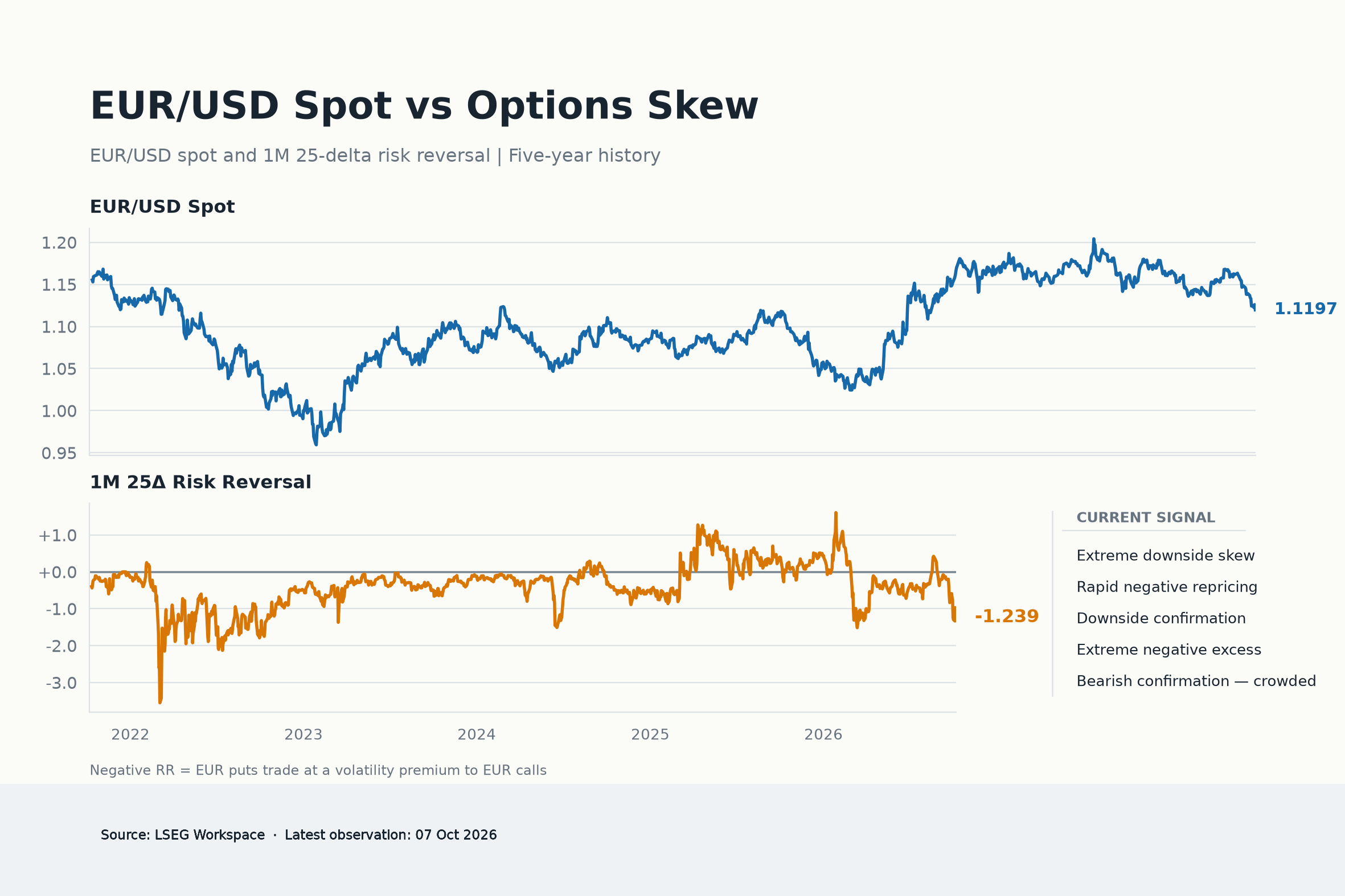
Indeed, one-month EUR/USD 25-delta risk reversals fell to -1.239 on Wednesday, leaving the market with a pronounced preference for Euro puts over calls.
The level itself is bearish without being historically exceptional. The current risk reversal stands nearly at the 10th percentile of its five-year distribution, with a z-score of -1.43.
The more important signal is how quickly the market got there.
The one-month risk reversal has deteriorated by -1.042 volatility points over the past month, a move sitting at just below the 5th percentile of the five-year distribution. Even over the latest week, the skew deteriorated another -0.487 points.
In other words, it is not just the amount of downside protection that investors currently hold that stands out. It is the speed at which they have been acquiring it.
Let’s check the spot-adjusted model:
EUR/USD declined around 3.70% over the same one-month period. Based on the historical relationship between movements in spot and risk reversals, that decline would normally have produced an approximately -0.550-point change in the options skew.
The actual change was -1.042.
That leaves an excess bearish repricing of around -0.493 volatility points beyond what the decline in EUR/USD alone would historically imply. The out-of-sample residual stands at the 9.1th percentile of its distribution.
Options are therefore not merely following spot lower.
They are confirming the decline while pricing an additional layer of downside risk.
Speculators have already joined the trade
The futures market tells an equally bearish story, although it also introduces an important warning.
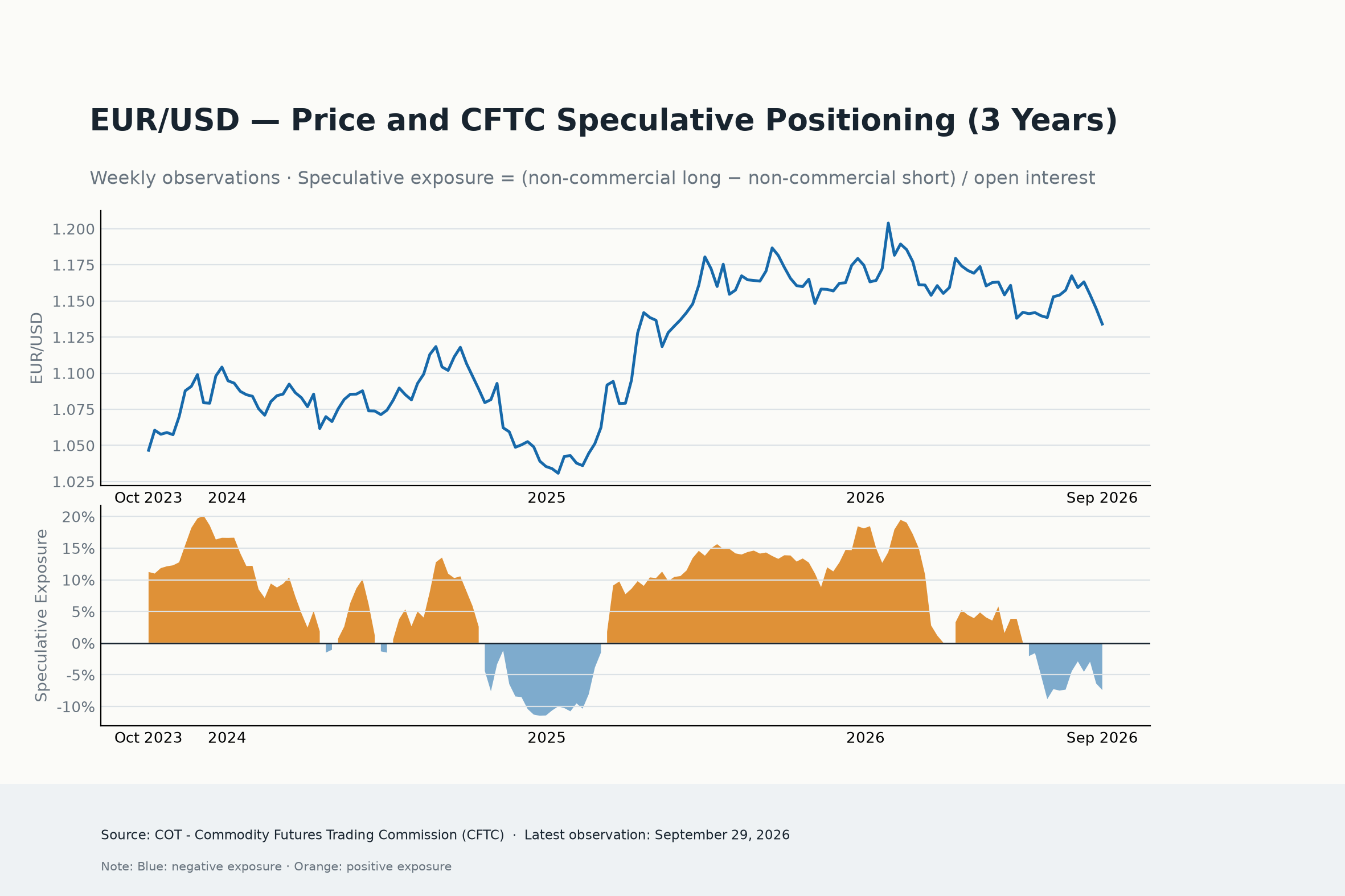
Commodity Futures Trading Commission (CFTC) data for the week ending September 29 showed speculative net EUR positioning falling to nearly 63.3K contracts after another roughly 11K contracts of net selling during the week.
More strikingly, net positioning has deteriorated by just over 38.3K contracts in only four weeks.
That places EUR positioning at just the 3.5th percentile of its five-year distribution, with a z-score of -1.74.
Unlike the options market, therefore, where the speed of the bearish repricing is more extreme than the absolute level, speculative futures positioning is already approaching the historically bearish end of its range.
Open interest also sits at the 91.2nd percentile, suggesting the move has occurred alongside substantial market participation rather than simply reflecting investors closing existing positions.
That matters for two reasons.
First, it provides unusually strong confirmation of the underlying move.
Spot is falling. Options traders are rapidly paying for downside protection. And speculative futures accounts are aggressively increasing outright EUR shorts.
Three different parts of the FX market are therefore pointing in the same direction.
But there is another side to that signal: the bearish EUR trade is becoming crowded.
At the 3.5th percentile of its five-year positioning distribution, the market can no longer be described as lightly positioned for further Euro weakness. A substantial amount of bearish conviction is already embedded in speculative portfolios.
That does not invalidate the case for 1.1000.
It changes the likely path toward it.
Further EUR/USD weakness may increasingly be interrupted by violent short-covering rallies, particularly following any improvement in French fiscal sentiment, decline in energy prices or softer-than-expected US inflation data.
The distinction is important. Crowded does not necessarily mean wrong.
Crowded positioning becomes particularly dangerous when the fundamental catalyst supporting the trade disappears.
For now, it has not.
French fiscal concerns remain unresolved, Europe's energy exposure has worsened, the ECB faces an increasingly difficult inflation-growth trade-off, and resilient US fundamentals continue to support expectations for restrictive Fed policy.
Speculators may already be heavily short the Euro.
But so far, the macro environment continues to give them reasons to stay there.
Why 1.1000 no longer looks extreme
The combined signal is unusually coherent.
Spot says the trend is lower. Options say investors are hedging against additional downside faster than the decline in spot alone would justify. CFTC positioning says speculative money has aggressively joined the move.
That is powerful confirmation.
It is also why the path from current levels toward 1.1000 increasingly looks less like a tail-risk scenario and more like a plausible extension of the existing trend.
The biggest challenge to that call may no longer be finding another bearish catalyst.
It may be positioning.
With speculative EUR shorts already deeply stretched, the pair is increasingly vulnerable to sharp counter-trend rallies. A favourable French fiscal headline, lower energy prices or a meaningful reassessment of Fed tightening expectations could trigger a sizeable squeeze.
But unless one of those developments alters the underlying macroeconomic configuration, such rallies may increasingly represent corrections within a broader bearish trend rather than evidence that the trend itself has ended: the so popular “sell the rallies”.
That leaves 1.1000 as a credible downside objective, but probably not one EUR/USD will reach in a straight line.
Author

Pablo Piovano
FXStreet
Born and bred in Argentina, Pablo has been carrying on with his passion for FX markets and trading since his first college years.