War should be bullish for Gold. Right now it's capping it
Oil is up by more than a third since the US and Israel went to war with Iran on February 28. Gold is down by about a fifth over the same stretch. The war reaches Gold through the Federal Reserve (Fed) rather than through fear. Every jump in Oil adds to the case for higher US interest rates, and higher rates make a metal that pays nothing more expensive to hold. For the asset people buy as insurance against bad news, that's an expensive policy to have held through seven months of bad news.
Officials raised rates on September 16. Their minutes, released on Wednesday, say most of them still expect one more hike before the end of the year. President Donald Trump has said strikes on Iran could resume after the November 3 midterms. Until the talk of more hikes stops, more war is more likely to lower the price of Gold than raise it.
Oil is up 30% since the fighting restarted and Gold is up less than 1%
Before the war, Gold and Oil tended to rise and fall on the same days. Across January and February, their daily moves had a correlation of 0.32, on a scale where 1 means they always move together and -1 means they always move opposite. Since February 28, it has been -0.26, and it has stayed negative through the fighting, the ceasefire and the fighting again.
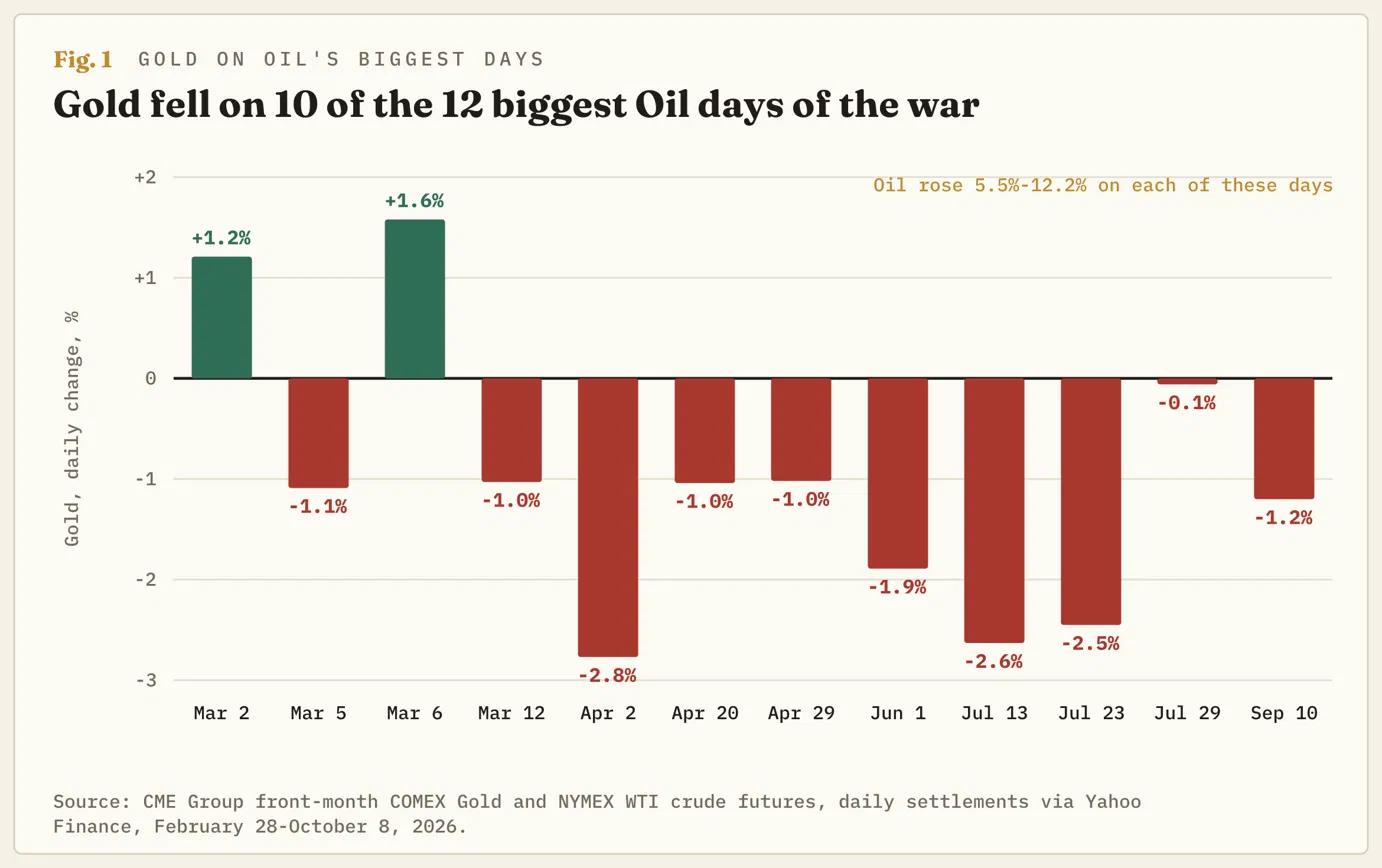
The biggest days are plainer still. On 12 of the war's days when Oil rose most, Gold fell on 10 of them, by about 1.5% on average. Since the fighting restarted on July 10, Oil is up 30%, and Gold is up less than 1%. That's what a haven looks like when holders are thinking about interest rates instead.
The war reaches Gold through the two-year yield
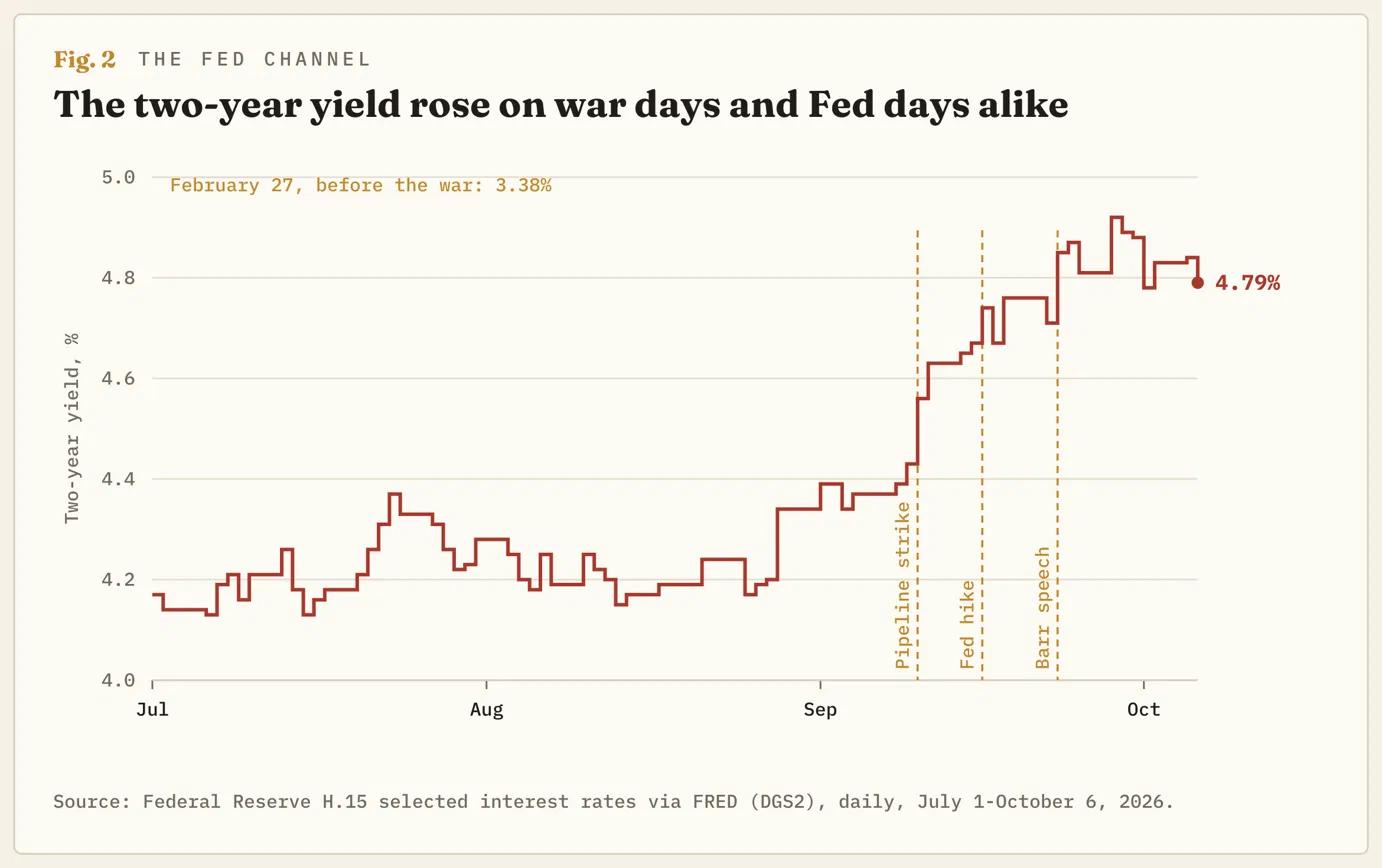
Gold pays no interest. Holding it means giving up what the same money would earn in a US government bond. When investors expect the Fed to raise rates, that lost income goes up and some holders sell. The clearest gauge of those expectations is the two-year Treasury yield, which rises when investors expect higher Fed rates over the next two years. It was 3.38% the day before the war began and 4.79% on October 6.
Oil feeds that number because it feeds inflation. On September 10, the day drones hit Saudi Arabia's East-West pipeline, Oil rose 6.7% and the two-year yield rose 0.13 of a point. Gold fell 1.2%. Whatever buying the attack brought in from people wanting safety, the selling from people doing the interest-rate arithmetic was bigger.
The same thing happens with no Oil involved at all. On September 23, Fed Governor Barr said further rate hikes would likely be needed to bring inflation back to 2%. The two-year yield rose 0.14 of a point and Gold fell 1.3%, on a day when Oil fell 2.6%.
The hike cost Gold less than the talk about it
The Fed's quarter-point hike on September 16 took its rate to 3.75%-4.00%, and the vote was unanimous. Gold rebounded the next day as Treasury yields eased back from their highest level since 2024. It reached its highest point after the decision on September 18 and is now about 6% below that, with the rate unchanged.
What changed was the talk. Barr's speech came first, then minutes showing that most officials expected another quarter-point hike before the end of 2026. The minutes promise one more hike and give no date, which leaves every Fed speech before December free to set one.
Traders are betting on a date anyway. Prediction markets put the odds of a hike at the October 28 meeting near 17% and at the December 9 meeting near 75%, so officials have until December 9 to keep making the case, and the pressure on Gold can run until then.
Two dates five weeks apart
The next two events that matter for Gold are five weeks apart. President Trump has said strikes on Iran could resume after the November 3 midterms if no deal is reached. According to the Wall Street Journal, he has told aides he expects to strike again after the vote. The Fed decides on December 9 and publishes officials' new 2027 rate projections the same day.
Say Oil jumps after November 3 while officials are still making the case for December. On the record of the last seven months Gold falls, because the jump arrives as more hike talk rather than as more demand for safety. If instead the Fed raises rates in December and the projections show no further hikes in 2027, the talk runs out. The pressure on Gold that has come from it would end with nothing on the calendar to restart it. If the projections show more hikes in 2027, the same cycle runs again with a new year to argue about.
The case is tested the next day Oil rises 5% or more. If Gold rises with it while the two-year yield holds steady or rises, buyers are treating Gold as a war asset again and the argument here is wrong. It is possible the next strike brings that buying back. It came back on two of the 12 biggest Oil days of the war so far, both in the first week of fighting. If Gold falls while the two-year yield rises, the war is still reaching Gold through the Fed, and how long that lasts depends on the December projections.
Author

Joshua Gibson
FXStreet
Joshua joins the FXStreet team as an Economics and Finance double major from Vancouver Island University with twelve years' experience as an independent trader focusing on technical analysis.