Risks to the pound from trade talks and Article 16 – Scenarios and outcomes
- Current talks over the Northern Ireland Protocol will lead to contained losses for sterling in its worst case.
- Other outcomes could be neutral or even positive for the currency.
- Potential retaliation from the EU against the UK for triggering Article 16 to add further downside risks to the pound.

Just ‘getting Brexit done’ has not been as simple as expected. Despite agreeing to a last-minute trade deal, the small not-so-small problem of how to make Brexit work across the Irish border still remains, like a festering wound that never quite heals up.
Recent acrimonious talks risk undermining the whole edifice of the Withdrawal Agreement and leading to an all-out trade war.
What are their various scenarios and outcomes and what are their implications for the pound? In this article, we will investigate.
Background: Why the UK wants to abandon Irish Sea border checks
The Northern Ireland Protocol (NIP) is the section of the trade deal that specifically covers trade between mainland Britain and Northern Ireland. It proposes border checks down the Irish Sea to avoid a hard border on mainland Ireland.
After agreeing to the deal, the UK is now claiming the NIP is unworkable. They cite excessive border checks and mountains of nuisance paperwork as key issues significantly impacting trade between the mainland and Northern Ireland (NI).
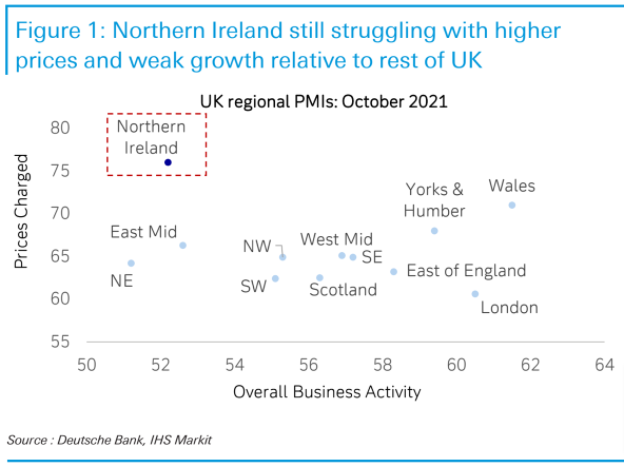
The UK wants a lighter touch system whilst the EU wants to stick with the protocol as it is. The UK has also questioned the role of the European Court of Justice (ECJ) as the ultimate arbiter if the dispute escalates.
Ongoing talks between the UK’s Lord Frost and EU’s Maroš Šefčovič have not untied the Gordian Knot, and whilst there is a possibility that the two sides might be able to resolve their issues by making small changes to the protocol, the UK has also threatened to invoke Article 16 (A16), an element of the NIP which enables either of the parties to unilaterally suspend elements of the Protocol in the event they are causing undue economic disruption.
According to the UK, this condition has now been met, and falling business activity vis-a-vis the rest of the UK in NI, higher prices, and supply constraints, suggest they have a case. This can be seen in the graph above, from research conducted by Deutsche Bank.
If the UK were to trigger Article 16 it would be seen as a major escalation in tensions and almost certainly negatively impact the pound. The question is, how much?
Alternatives to triggering Article 16
Before discussing the various scenarios in which the UK might decide to trigger A16 and its effects on sterling, let us first look at the alternatives – is there a way of resolving the dispute without triggering A16, and if so what is it?
One way would be to use Article 164 (A164) of the Withdrawal Agreement which allows for tweaks of the text under “unforeseen circumstances”.
If the two sides were to agree on a compromise using A164 instead of A16 it would be expected to have a mild positive effect on the pound, of no more than 1%, most probably less.
Article 16 scenarios
Although International Trade Secretary Anna-Marie Trevelyan has said the UK government will categorically not trigger Article 16 before Christmas, this is clearly a political move to ensure voters’ enjoyment of yuletide is not unduly disrupted.
The undeniable chagrin witnessed during talks so far, however, as well as the EU’s historic intransigence, suggests a still-not inconsiderable probability the UK government will eventually go ahead and trigger A16, at some point early in the new year.
If this happens there are two key factors that need to be taken into consideration when gauging the impact on the pound.
The first is the scope of the changes the UK wishes to make to the NIP, i.e are they just small changes to reduce paperwork and customs checks or are they more substantial, or even their complete removal?
The second is whether the UK wishes to make the changes immediately, using a clause in the NIP called Annex 7, which can be invoked in “exceptional circumstances”, or whether after a month-long arbitration process, which is the default route.
Worst case for the pound
The worst-case scenario for sterling would be if the extent of the changes was considerable or total i.e. the wholesale withdrawal or substantial watering down of border checks on goods, tariffs, customs, VAT that govern trade between mainland Britain and NI – and if their implementation was made immediately, by invoking Annex 7.
In such a scenario, sterling might be expected to fall anywhere between 1-2% on the news. This could then be followed by further losses, depending on the EU’s response.
EU retaliation would make it even worse
By the UK removing all, or almost all, the border checks between mainland Britain and Northern Ireland, it would effectively be challenging the integrity of the EU.
This would then set off a complex sequence of events in Brussels that might lead to the EU deciding to withdraw completely from the whole of its trade agreement with the UK, and a return to WTO terms of trade: effectively, a ‘Hard Brexit’.
This would not happen overnight but only after further talks lasting for a duration of 9-12 months.
The fate of the Withdrawal Agreement and sterling would then rest on the outcome of these talks.
There is a potential 5% loss of value for the pound in the event the situation escalates towards a Hard Brexit, according to a model developed by ING bank. The calculation is based on the risk premium of a Hard Brexit, above regular economic FX drivers, as measured at the height of the crisis in September 2019.
This is represented by the peak in September 2019 in the chart below. This time around, however, ING says the pound’s response could be more “muted”, given much of the damage has already been done, and the existing trade deal is only one notch above WTO.
-637744697559975216.png)
If the EU took steps to cancel the Withdrawal Agreement with the UK this could introduce a further 2-3% maximum risk to sterling above the initial 1-2% on the news of triggering A16, adding up to ING’s model calculation of 5%.
In a situation where the UK did not decide to use Annex 7, and not to make immediate changes, but went through the month-long arbitration process instead, the initial sell-off would not be as severe – perhaps amounting to around 1%, with further losses dependent on how those talks went.
More benign scenarios
It is unlikely the UK will opt for the drastic scenario outlined above, however, but rather it is much more likely to only make surgical cuts to the NIP. For example, limiting the number of checks on specific agrifood products or relaxing rules around medicines and chilled meats would constitute a more benign triggering of A16 with much less impact on sterling.
Depending on the extent of changes to the protocol and also whether Annex 7 was used to implement the changes immediately or not, this option would probably only have a mildly negative impact on sterling if immediate, of perhaps 0.5%.
If preceded by the one-month arbitration process the impact could be even milder (less than 0.25%).
Toppling the ECJ
Trade aside, there still remains the thorny issue of the authority of the ECJ as dispute resolution referee – which the UK opposes.
One possibility is that after triggering A16, the UK could try to use domestic law to challenge the authority of the ECJ as the arbiter. This would also have the effect of weakening sterling, firstly because it would undermine negotiations and secondly because it would be seen as extremely provocative by the EU and might lead to substantial retaliatory measures from Brussels in a clear escalation of the crisis.
The initial reaction to the challenge would probably be muted with perhaps a 0.5% drop in the pound. The extent of further weakness would be dependent on the EU’s reaction, however, given its reputation for intransigence, the likelihood of a compromise is quite low.
This might lead to the EU considering annulling the Withdrawal Agreement together, and a return to WTO terms, resulting in up to a further 4.5% potential weakness in line with ING’s calculation of sterling’s risk premium in the case of a Hard Brexit.
Here too, however, a relatively benign compromise exists, as suggested by Lord Frost in the form of an Independent Dispute Resolution Panel. Such a panel would be based on an EU-Swiss model. Acceptance of such a mechanism would, however, involve a political climbdown from the EU, which is not a given.
In terms of impact on the pound, the news of the adoption of a separate entity as arbiter would likely see the 0.5% losses from the challenge made back up.
Author

Joaquin Monfort
FXStreet
Joaquin Monfort is a financial writer and analyst with over 10 years experience writing about financial markets and alt data. He holds a degree in Anthropology from London University and a Diploma in Technical analysis.