XRP cools after rally as ETF inflows stay firm
- XRP reverses gains, trading around $1.48 on Monday, following a rejection at $1.70.
- Risk-on sentiment remains elevated, as evidenced by $40 million in US-listed XRP ETF inflows last week.
- XRP’s momentum shows signs of buyer exhaustion, with the RSI pulling back.

Ripple (XRP) is correcting on Monday, trading around $1.48, a 13% drop from last week’s peak of $1.70. The remittance token surged about 72% from $1.00 last week, in line with the broader crypto market’s bullish outlook.
A higher support level would go a long way toward reasserting bullish control. However, if profit-taking continues, XRP could be forced to give back some gains as it seeks stronger support.
XRP attracts growing ETF inflows
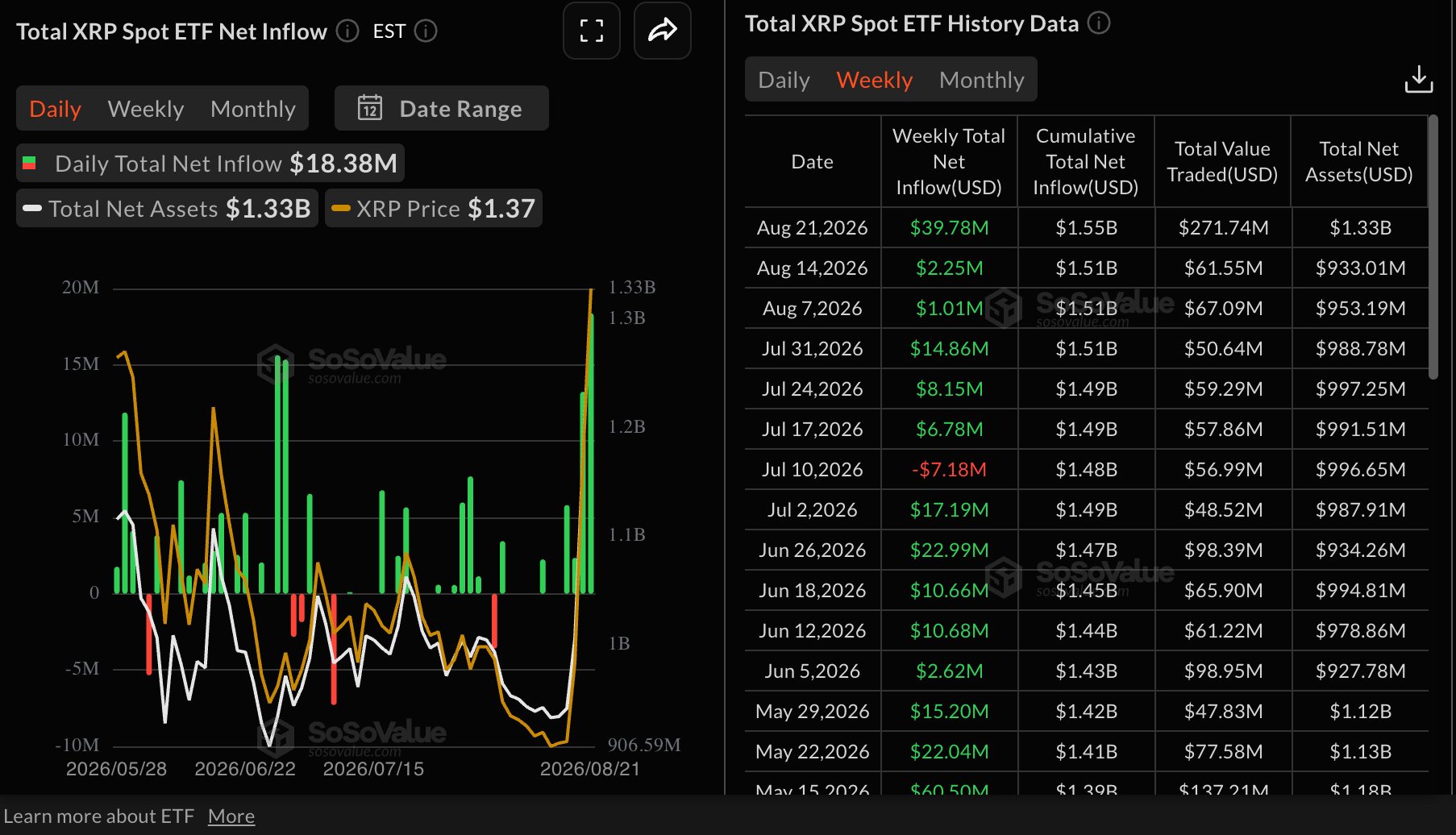
US-listed XRP spot Exchange-Traded Funds (ETFs) extended their bullish streak for the sixth consecutive week, with inflows of approximately $40 million through Friday. This marks a major jump from the $2.25 million recorded during the week ending on August 14.
Meanwhile, cumulative inflows stand at $1.55 billion, rising from $1.51 billion over the same period. SoSoValue data shows total assets under management at $1.33 billion, up from $933 billion.
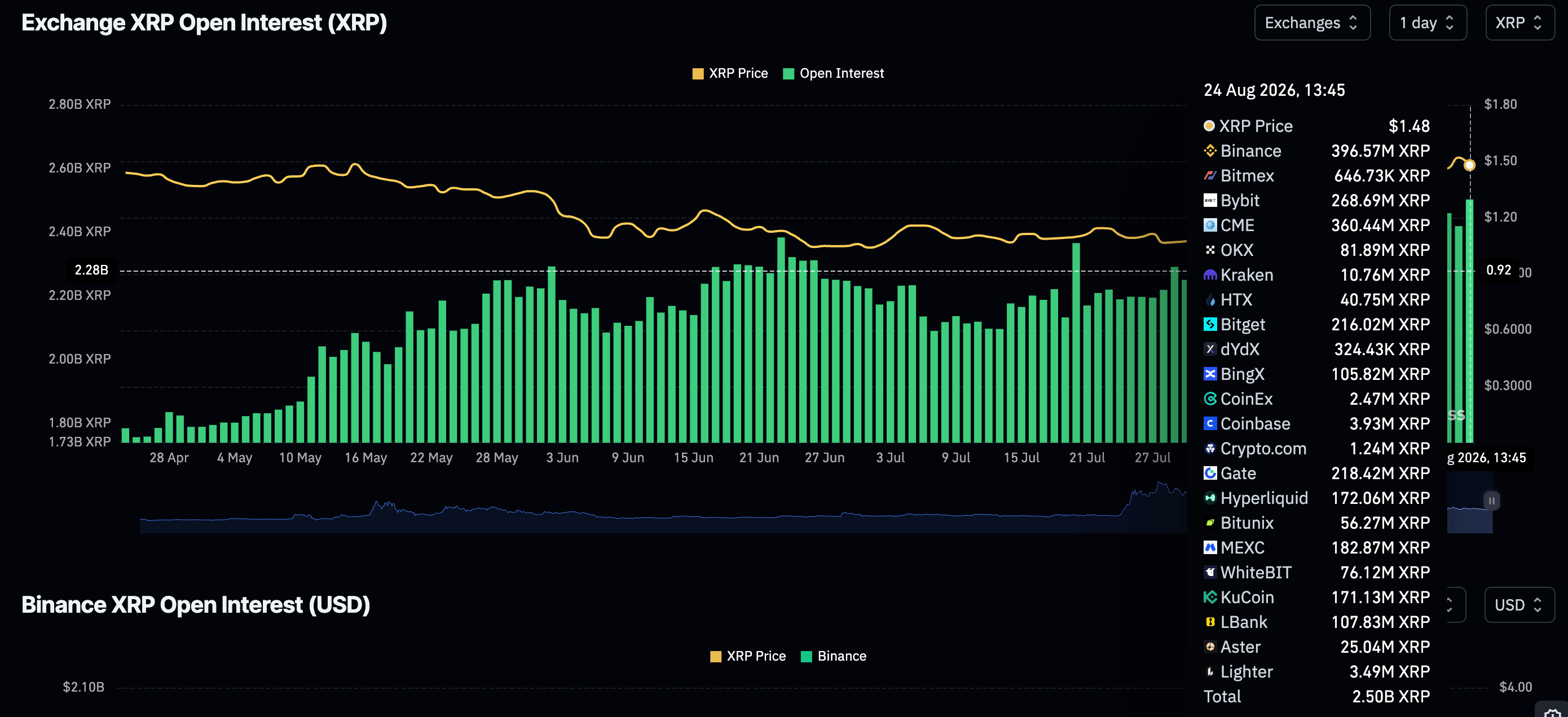
Retail demand remains relatively elevated with perpetual futures Open Interest (OI) at 2.5 billion XRP on Monday, up from 2.42 billion the previous day. If OI continues to expand, it could offset sell-side pressure amid possible profit-taking after last week’s rally.
"The more realistic marker to watch isn't last summer's $3.65 peak but the 1.40–1.50 zone, the range XRP held for much of early 2026 before this year's breakdown; reclaiming it would mark real recovered ground rather than a fresh high,” Iliya Kalchev, Nexo’s Dispatch Analyst, told FXStreet.
Technical analysis: XRP rally takes a breather
XRP trades around $1.48 after a rejection at last week's highs of $1.70. Despite the rejection, the remittance token extends a strong bullish phase after breaking well above its key Exponential Moving Averages (EMAs). The 200-day EMA at $1.35 now underpins the advance, with the 100-day EMA at $1.18 and the 50-day EMA at $1.14 reinforcing a stacked bullish structure below price.
The SuperTrend line at $1.25 also sits comfortably below the market, suggesting the broader uptrend remains intact. Momentum is stretched, as the Relative Strength Index (RSI) holds in overbought territory at 80, while the Moving Average Convergence Divergence (MACD) stays positive, suggesting the bullish impulse is strong but increasingly vulnerable to a corrective pullback.
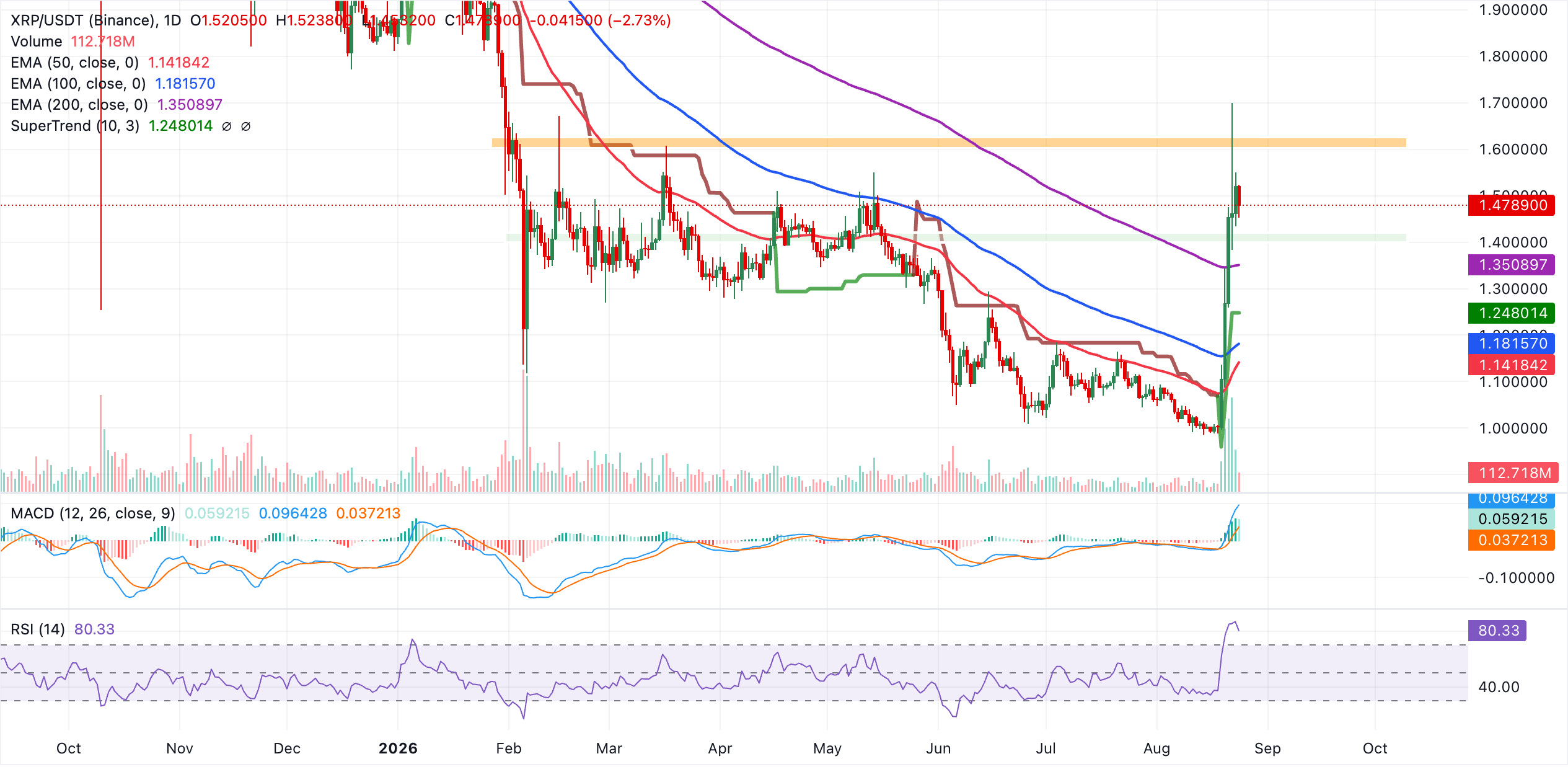
Immediate support lies at the recent price zone around $1.48, followed by firmer technical demand at the 200-day EMA near $1.35. Below that, SuperTrend support at $1.25 and the 100-day and 50-day EMAs at $1.18 and $1.14, respectively, define a broader bullish base that would likely attract buyers on deeper dips. As long as XRP holds above these clustered supports, the near-term bias remains constructive, although the overbought RSI warns that consolidation or a retracement toward the $1.35-$1.25 area cannot be ruled out before the next directional leg.
(The technical analysis of this story was written with the help of an AI tool. Know more.)
Cryptocurrency prices FAQs
Token launches influence demand and adoption among market participants. Listings on crypto exchanges deepen the liquidity for an asset and add new participants to an asset’s network. This is typically bullish for a digital asset.
A hack is an event in which an attacker captures a large volume of the asset from a DeFi bridge or hot wallet of an exchange or any other crypto platform via exploits, bugs or other methods. The exploiter then transfers these tokens out of the exchange platforms to ultimately sell or swap the assets for other cryptocurrencies or stablecoins. Such events often involve an en masse panic triggering a sell-off in the affected assets.
Macroeconomic events like the US Federal Reserve’s decision on interest rates influence crypto assets mainly through the direct impact they have on the US Dollar. An increase in interest rate typically negatively influences Bitcoin and altcoin prices, and vice versa. If the US Dollar index declines, risk assets and associated leverage for trading gets cheaper, in turn driving crypto prices higher.
Halvings are typically considered bullish events as they slash the block reward in half for miners, constricting the supply of the asset. At consistent demand if the supply reduces, the asset’s price climbs.
Author

John Isige
FXStreet
John Isige is a seasoned cryptocurrency journalist and markets analyst committed to delivering high-quality, actionable insights tailored to traders, investors, and crypto enthusiasts. He enjoys deep dives into emerging Web3 tren