Eight reasons why the Fed should raise rates
The FOMC meeting on September 15–16 is expected to mark a turning point with the Fed’s first rate hike since May 2023. While there may have been economic reasons to hold off and maintain the status quo until now (some negative signals on the employment front and some encouraging ones on the inflation front), the conditions for a necessary recalibration now appear to be in place.
Between the start of the year and September 11, out of a sample of nearly 90 central banks worldwide, 25 lowered their policy rates (an average cumulative decrease of 85 basis points), 25 raised them (an average cumulative increase of 75 basis points), and 36 left them unchanged. The U.S. Federal Reserve is part of this status quo group, while the ECB is among the central banks that have raised their rates (twice). Which is the odd one, the Fed or the ECB? At first glance, the Fed’s status quo seems harder to explain than the ECB’s rate hike: U.S. growth and inflation are significantly higher than Eurozone metrics. Why would this situation warrant a rate hike in the latter case but not (yet) in the former? In short, because the Fed has a dual mandate and, until recently, its focus has been more on the maximum employment component than on price stability.
Will the Fed continue to diverge from its peers this week, given that the ECB implemented another rate hike on September 10th and that further tightening by the BoJ (September 17–18) is also widely anticipated? And while a status quo from the BoE (which will also meet on September 17th) is expected, the vote is likely to be close (6-3 according to our forecasts, possibly 6-4) and the tone should be hawkish. In our new base case scenario, we believe the Fed will join the ranks of the hikers this week: it would no longer wait until December 2026 to begin the (short) cycle of (three) rate hikes (25 bp each) that we have been anticipating for several months. However, the outcome of the September 15–16 FOMC meeting remains somewhat uncertain: we believe the conditions are in place for a monetary policy adjustment. But will the Fed share the same view?
What has held the Fed back from raising rates so far? Some signs of weakness in the labour market and the K-shaped nature of growth
GDP growth is running at a relatively high pace (an average of 2.2% year-over-year since Q1 2025, double the Eurozone growth rate) but rests on narrow foundations that are largely dependent on the AI boom. It is this sector that is driving a large portion of non-residential investment (with, conversely, equally significant imports). And it is the wealth effects stemming from the sharp rise in stock market indices—driven by tech stocks—that largely underpin consumption among the wealthiest households, while consumption among lower-income households is struggling, constrained, and affected by the high cost of living.
Strong on the surface but more fragile beneath: this characteristic of U.S. growth has likely contributed, thus far, to tipping the scales in favor of the monetary status quo. The aim was to avoid the risk of stalling the AI engine and exacerbating the financial difficulties of lower-income households. An idea has also circulated: that this strong growth, driven by productivity gains (supposedly resulting from the deployment of AI[1]), might be disinflationary rather than inflationary. This theory has not, for the time being, been fully validated by the data: on the contrary, the AI boom appears to be rather inflationary in the short term, which should lead the Fed to reconsider its status quo.
The labour market, like economic growth, has both a positive side and a more worrisome one. The first is characterized by a low unemployment rate, downwardly oriented over the past few months, a trend which is expected to continue. The second stems from the volatility and relative weakness of job gains through July, the downward pressures on labour supply, and the uncomfortable balance of a situation combining low firing and low hiring. The Fed has been more sensitive to these vulnerabilities, in line with its dual mandate.
High inflation — though trending downward according to certain alternative measures — and anchored inflation expectations have also helped the Fed adopt a wait-and-see approach
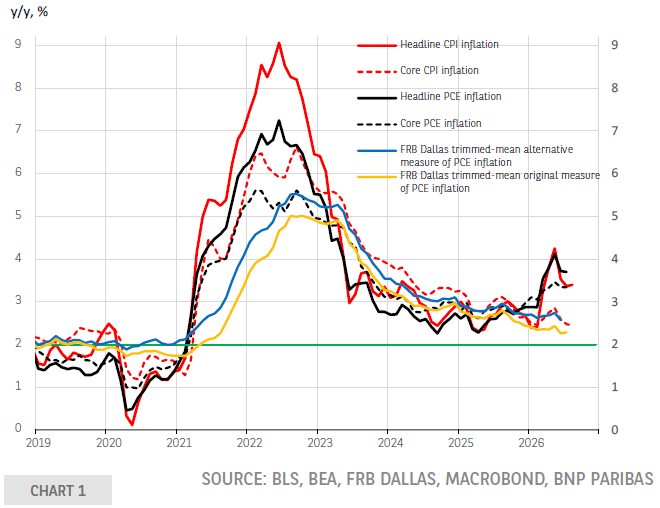
U.S. inflation is high and has been well above the 2% target for six years, according to the most widely used metrics; while alternative measures are closer to the target (see Chart 1). The trend, drivers, and composition of inflation also matter. As for its trend, data from June and July showed a slight downward trend, an encouraging sign further supported by the stability (no increase) seen in August (3.4% year-on-year for the headline CPI, with core inflation even edging down slightly from 2.5% to 2.4% y/y).
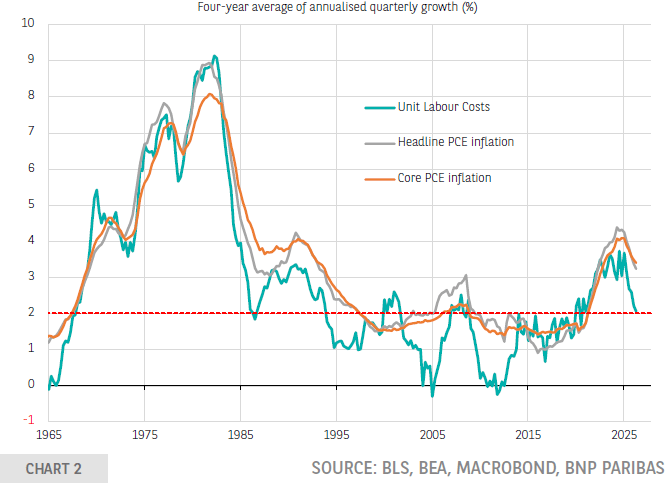
On the other hand, if we compare inflation with the trend in unit labor costs—a key driver, as Richard Clarida (former Fed vice chair)[2] points out—it clearly appears to be trending downward, with further disinflation on the horizon (see Chart 2).
Finally, in terms of composition, current inflationary pressures stem largely from the energy supply shock caused by the conflict in Iran. Such a development does not require an immediate response from the central bank, as long as inflation expectations remain anchored (which is currently the case) and provided that the inflation spike remains transitory, does not become widespread, and does not trigger second-round effects (which cannot be taken entirely for granted over the next few months, given persistent upward pressure on energy prices combined with resilient U.S. growth).
Why is the monetary status quo no longer tenable? There are at least seven reasons
A combination of factors justifies the Fed raising its policy rates, starting in September. From our perspective, it should have already done so, given the economic and inflation data.
First, the current environment is completely different and significantly more favorable than the one that prevailed at the time of the three insurance rate cuts in late 2025. Undoing this easing alone is justified today.
Second, the real GDP growth rate is well above its potential pace.
Our 3rd, 4th and 5th points are the following: unemployment is trending downward, inflation is well above target, and there is a risk that inflation expectations become unanchored.
Sixth, the balance of risks between the two components of the Fed's mandate has shifted: the easing of employment concerns brings the upward risks to inflation to the forefront.
Seventh, U.S. monetary policy is likely too accommodative — to a degree difficult to assess precisely, given the inability to accurately estimate the neutral rate (which, according to our estimates, falls within a range of 3.25% to 4.25% in nominal terms). But it is clear that current high productivity gains are pushing it higher. A recalibration of monetary policy therefore appears necessary to bring the Fed Funds target (currently 3.50–3.75%) at least toward the upper end of our estimate of the neutral rate, or even into restrictive territory.
Eighth, the Fed must back up its words with action
Regarding the outcome of the September 15–16 FOMC meeting, Kevin Warsh has not shown willingness to act upon the latest data. He wants a Fed that is less data-dependent and more guided by underlying trends. It is understandable and this shift could happen in the future, following the conclusions of the task forces. However, aside from the fact that Kevin Warsh is not the sole decision-maker, the latest data for August points towards a rate hike. This is clear in light of the strong rebound in nonfarm payroll employment. It is also clear regarding inflation, as the monthly change (seasonally adjusted) in the core CPI (+0.29%) exceeds the trigger threshold we had identified (a “big” 0.2%). In fact, the very persistence of high inflation[4], combined with an economic environment (both domestic and international) that remains inflationary, argues for a rise in the Fed Funds target.
If the Fed takes the markets’ signal into account — as Kevin Warsh seems inclined to do — then it must raise its policy rates without further delay. Not only do economic conditions require it, but it is also a matter of risk management.
It would also be a matter of Kevin Warsh walking the talk to reinforce the credibility of his remarks at Jackson Hole regarding the renewed firmness of his commitment to ensure price stability. And it would also be a matter of not adding to the tension and nervousness already present in the bond markets, regardless of their origin. If the Fed takes the markets’ signal into account — as Kevin Warsh seems inclined to do when he considers that the rise in long-term rates is doing part of the central bank’s job and when he highlights the reassuring anchoring of their inflation expectations — then it must raise its policy rates without further delay. Not only do economic conditions require it, but it is also a matter of risk management.
Author

BNP Paribas Team
BNP Paribas
BNP Paribas Economic Research Department is a worldwide function, part of Corporate and Investment Banking, at the service of both the Bank and its customers.

















