|

Retail Sales slip again in March after unusually strong start to year

Summary

Retail sales continued to reverse in March after a temporary surge to start the year. But the level of spending remains elevated and demonstrates there remains an underlying resilience among consumers.

January surge was temporary, spending gradually losing momentum

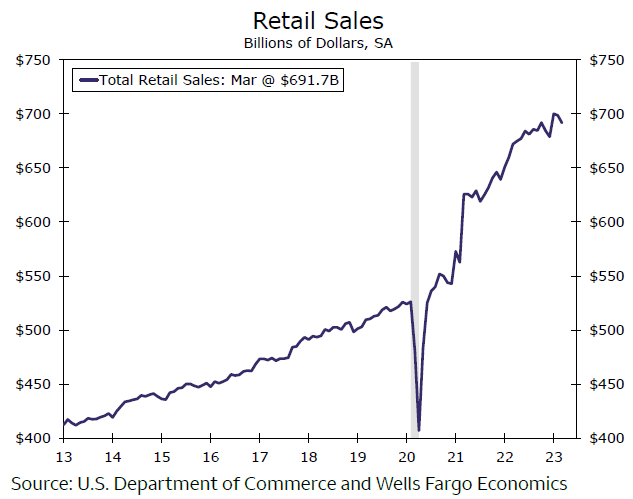
Consumer spending lost momentum over the course of the first quarter with retail sales falling for a second straight month down 1.0% in March. But even with some payback after an unusually strong start to the year, the level of retail spend is still nearly 2% ahead of where it was in December (chart). More plainly, consumers continue to spend at an elevated level, though the momentum appears to be downshifting.
Chart

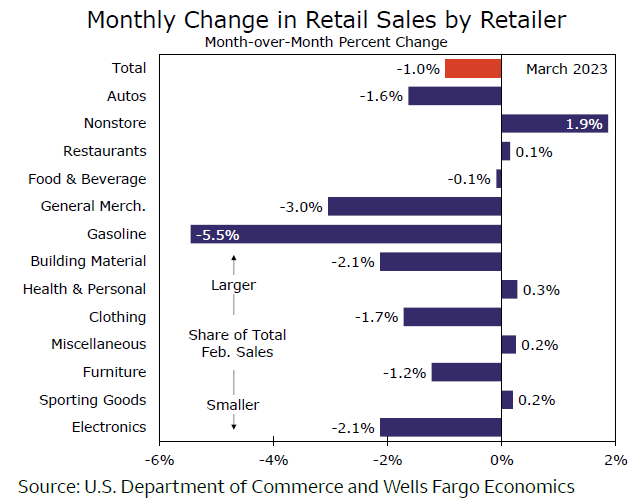
The main drivers of weakness continue to be retail categories that saw a large run up in spending throughout the pandemic and an unusually strong January surge in sales, like electronics (down 2.1% in March), clothing (-1.7%), autos (-1.6%) and furniture (-1.2%) (chart). Sales at gasoline stations were also weak, slipping 5.5%, and the level of gasoline sales is now more than 10% below where it was six months ago.
Chart

In cutting through some of the monthly volatility, control group sales slipped 0.3%. This measure excludes food services, building materials, gasoline and auto dealers from its calculation and is used by the BEA in estimating real personal consumption expenditures (PCE) in its GDP accounting. We estimate inflation-adjusted control group sales rose at a 6.2% average annualized rate the past three months, roughly consistent with our underlying expectations in our latest forecast that overall real PCE rose around a 4.4% annualized pace during the first quarter.

Download The Full Economic Indicator

Author

More from Wells Fargo Research Team
Share:

Editor's Picks

EUR/USD slumps below 1.1800 on hawkish Fed Minutes, eyes on ECB succession

The EUR/USD pair tumbles to a near two-week low around 1.1785 during the early Asian session on Thursday. The US Dollar strengthens against the Euro on hawkish FOMC minutes that revived speculation about potential interest rate hikes if inflation remains elevated. 

GBP/USD extends decline as weak jobs data bolsters BoE rate cut bets

The Pound Sterling continued to backslide under sustained pressure on Wednesday, following through after the UK employment report on Tuesday showed a labour market deteriorating faster than expected. 

Gold yearns for acceptance above the $5,000 mark

Gold preserves 2% advance seen on Wednesday as buyers gather pace early Thursday. The US Dollar holds January Fed Minutes-led gains ahead of more US macro data. Gold needs a sustained break above the key $5,000 barrier; daily RSI stays bullish.

Bitcoin approaches a critical zone: Bear pennant projects $56,000

Based on the most recent analyses from February 2026, the short answer is that it is highly unlikely that Bitcoin will reach $100,000 this month.

Mixed UK inflation data no gamechanger for the Bank of England

Food inflation plunged in January, but service sector price pressure is proving stickier. We continue to expect Bank of England rate cuts in March and June. The latest UK inflation read is a mixed bag for the Bank of England, but we doubt it drastically changes the odds of a March rate cut.

Sui extends sideways action ahead of Grayscale’s GSUI ETF launch

Sui is extending its downtrend for the second consecutive day, trading at 0.95 at the time of writing on Wednesday. The Layer-1 token is down over 16% in February and approximately 34% from the start of the year, aligning with the overall bearish sentiment across the crypto market.