Reserve Bank of New Zealand: 50 or 75?

Markets and economists widely anticipate that the Reserve Bank of New Zealand (RBNZ) will reduce the Overnight Cash Rate (OCR) by 50 basis points (bps) to 4.25% on Wednesday, a move that would push the OCR closer to neutral levels.
Markets fully pricing in a 50 basis point cut
Markets are assigning a 60% chance that the RBNZ will opt for a 50 bp cut (60 bps of easing priced in), with a 40% chance that the central bank may swing for a bulkier 75 bp reduction. A 50 bp cut in the OCR would follow a 50 bp reduction in October and a surprise 25 bp cut in August.
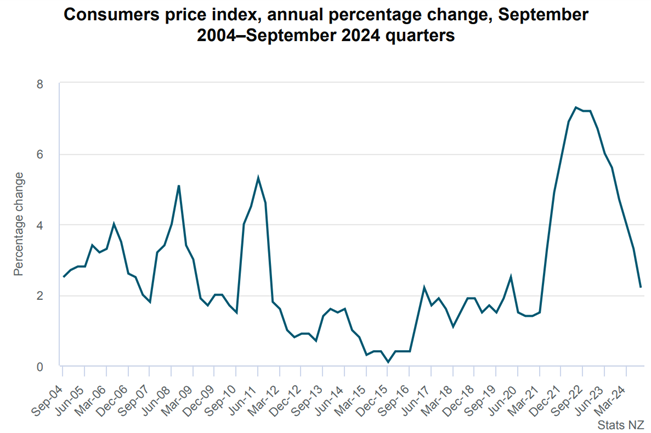
I expect the RBNZ to follow through and reduce the OCR by 50 bps this week. Inflation has cooled to 2.2% in Q3 24 and is now within the RBNZ’s target band of 1-3% for the first time since early 2021. Inflation expectations also remain pretty much anchored around the 2.0% mark.
Economic activity (GDP – Gross Domestic Product) remains well and truly in the doldrums; Q2 24 data showed economic growth shrank by 0.2%, following a paltry 0.1% expansion in Q1 24. GDP per capita also contracted by 0.5% in Q2 24, coupled with a loosening jobs market. Employment growth showed a contraction of 0.5% in Q3 24, and the unemployment rate rose to its highest level since late 2020 (4.8% in Q3 24).
However, on the other side of this fence, some desks – such as Goldman Sachs – highlight the possibility of a 75 bp cut given the economic downturn, increased unemployment, and the long break between now and the next meeting (mid-February next year), which could leave the central bank somewhat behind the curve.
Global risks remain uncertain
The re-election of Donald Trump and potential tariff changes introduce a degree of unpredictability for New Zealand’s economy, particularly for tradeable inflation. Still, it is merely speculation at this point, and the implications for New Zealand's inflation are unclear.
I anticipate that the November statement will reflect confidence in the progress made on inflation, and the central bank will emphasise a gradual approach to policy easing, contingent on incoming data. With that being said, considering the economic backdrop, I imagine the quarterly projections may reveal additional rate cuts next year, with CPI forecasts potentially being revised lower, with limited revisions for GDP growth metrics.
NZD/USD in focus
A 75 bp cut would likely trigger enough of a ‘surprise’ and see the New Zealand dollar (NZD) sell off quite extensively, particularly against the US dollar (USD). In contrast, a 50 bp cut, which, as I noted above, is fully priced in, is unlikely to yield that much of a surprise/reaction, especially if dovish language is absent and the OCR projections are only moderately revised lower towards the end of 2025.
I will be keeping a close eye on NZD/USD during the rate announcement. An outsized 75 bp cut might trigger a strong downside move in the pair, particularly as investors have pared back US rate-cut bets – markets are now just pricing in 13 bps of easing for December’s meeting – as well as the USD being bolstered by the incoming Trump administration and safe-haven demand.
The monthly chart shows that price is trading at range support from N$0.5846, while the daily chart suggests scope to push for nearby support at N$0.5807. Therefore, daily and monthly support provides a ‘floor’ for potential buyers, which could hold if the RBNZ opts for a 50 bp cut. A 75 bp cut, nevertheless, could see the aforementioned support zone challenged.
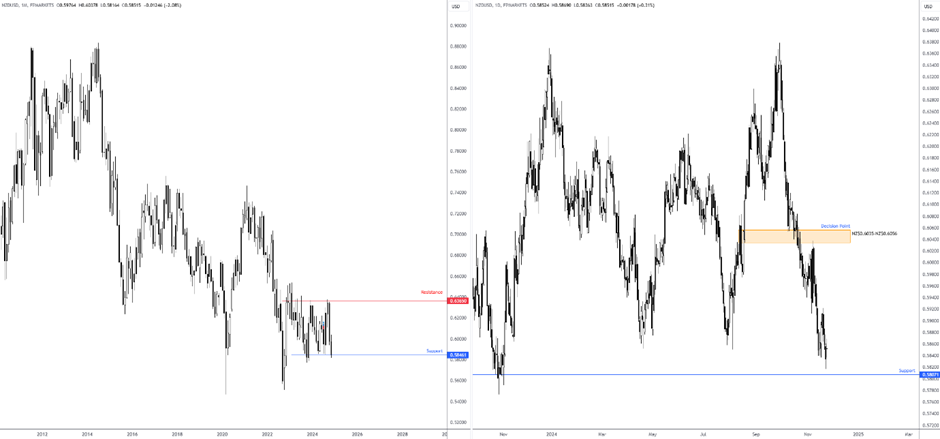
Chart created using TradingView
Author
Aaron Hill
FP Markets
After completing his Bachelor’s degree in English and Creative Writing in the UK, and subsequently spending a handful of years teaching English as a foreign language teacher around Asia, Aaron was introduced to financial trading,