RBA holds at 4.35%: What AUD/USD needs next

The Reserve Bank of Australia held the cash rate at 4.35%, with all nine board members voting to leave policy unchanged. The decision itself was expected. The more useful signal came from why the Bank chose to pause.
Inflation is still too high, but consumer spending, housing and the labour market are beginning to cool. After three rate hikes this year, the RBA now wants to see how much of that tightening is still working through the economy before deciding whether another increase is needed.
That leaves the RBA in an awkward middle ground: not enough evidence to hike again immediately, but not enough disinflation to declare the tightening cycle finished. For AUD, the next move is therefore a confirmation story rather than a simple hawkish-rate story.
The RBA is pausing to assess, not declaring victory
The latest statement suggests the RBA believes tighter policy is starting to have a real effect. Trimmed mean inflation remains elevated, but softer consumer spending, cooler housing conditions in some capital cities and a softer labour market all point to demand losing some momentum.
That is why the hold should not be read as a dovish pivot. The Bank can keep policy restrictive while waiting for the lagged effect of earlier hikes. If inflation remains sticky, or global energy risks keep price pressures elevated, the option of another hike remains open.
For AUD, this is supportive at the margin, but it is not a one-way bullish signal. The currency still has to prove that the RBA backdrop is strong enough to overcome resistance and whatever the US dollar does next.
AUD/USD now has to clear 0.704-0.708
AUDUSD is now testing the 0.704-0.708 resistance area on the daily chart. Price has pushed into a previous high range, but the latest candles are beginning to stall and momentum has failed to confirm the higher high.
From here, the US side of AUDUSD becomes the next immediate driver, with US CPI due tomorrow on 12 August.
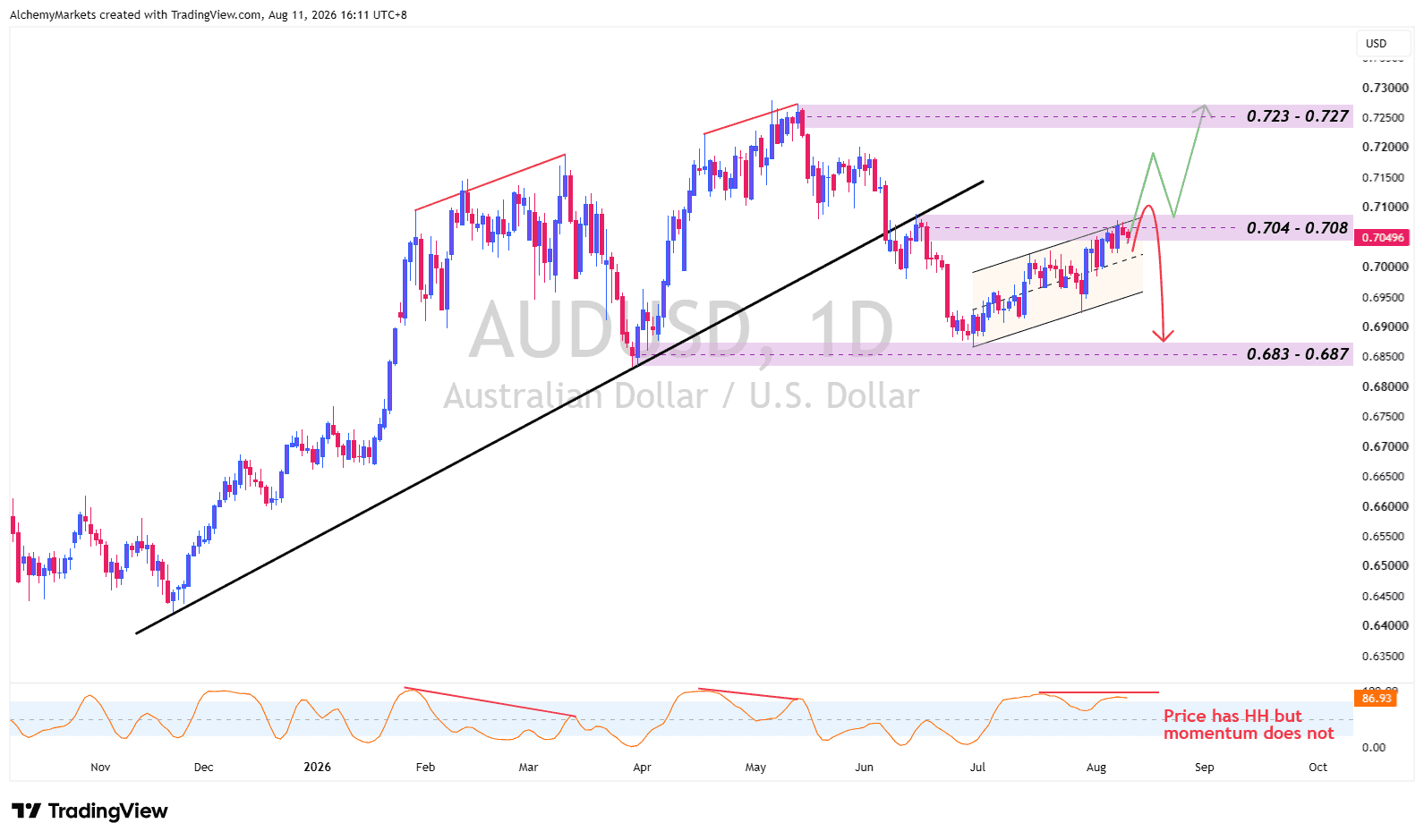
A hotter US inflation print would make it harder for AUDUSD to break higher. The first pullback references sit near the channel midline around 0.700 and the lower channel area near 0.695. A clean channel failure would expose the larger 0.683-0.687 support zone.
A cooler US CPI print would give the pair more room to break above 0.708. If price can close above that area and hold it on a retest, the next references are around 0.718 and then 0.723-0.727.
Fundamentally, the RBA is in a much more comfortable position than earlier in the year.
Softer housing activity, lending, consumer spending and labour conditions suggest its previous hikes are beginning to cool demand, which should gradually ease inflation pressure. Technically, AUDUSD may also be forming bearish divergence at resistance.
RBNZ shows a hawkish policy is not enough
The RBNZ offers a useful warning against treating a hawkish central bank as an automatic bullish currency signal. It raised the Official Cash Rate to 2.50% on 8 July and said further increases are likely, although the timing remains uncertain.
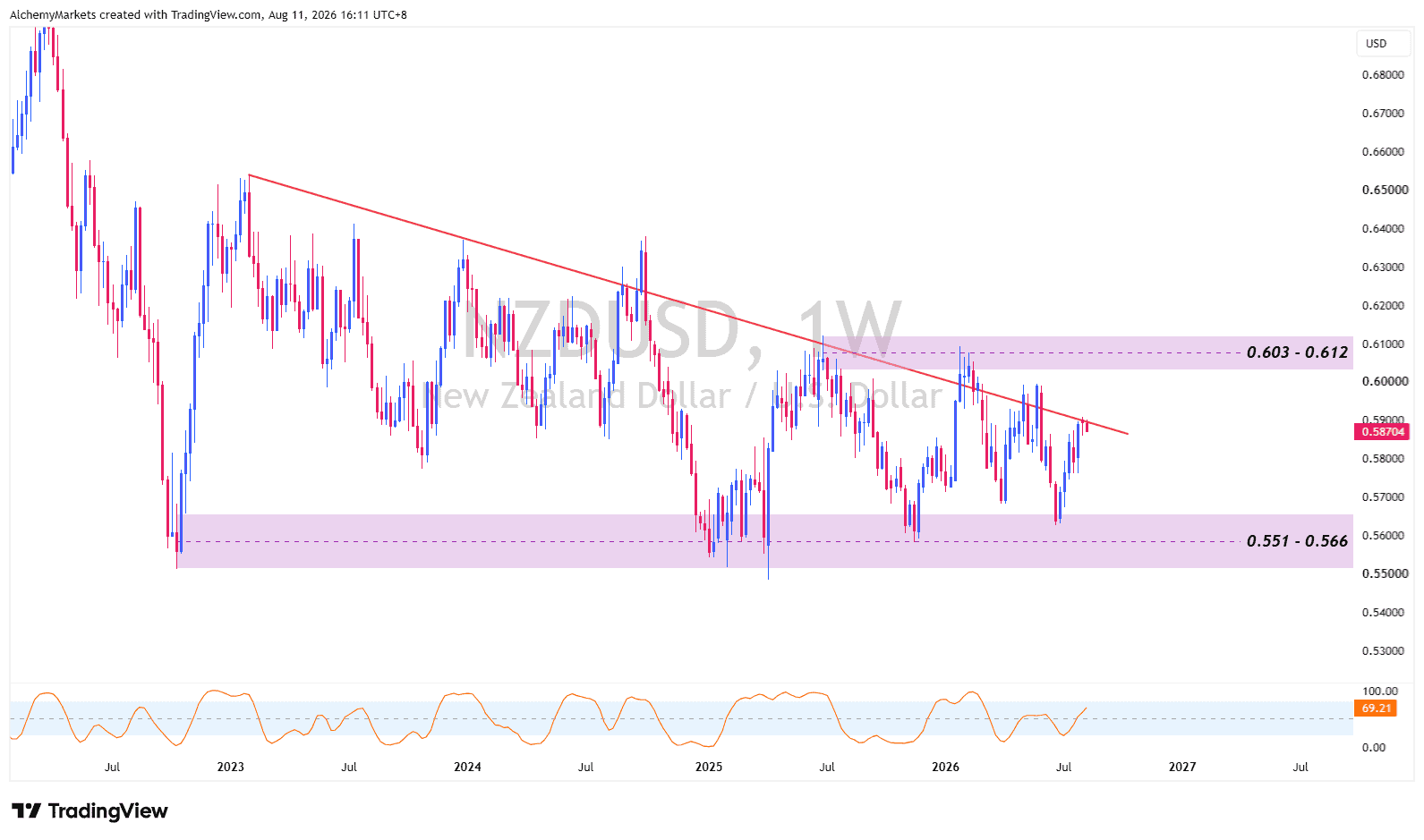
Even so, NZD/USD remains below its long-running weekly downtrend and beneath the 0.603-0.612 resistance area. The pair has not converted renewed RBNZ tightening into a structural breakout of its trendline resistance.
That makes NZD/USD a control case for the RBA story. Domestic policy can support a currency, but relative growth, commodity exposure, the US dollar and existing price structure still decide how much of that support reaches the exchange rate.
AUD/NZD may be reaching a turning point
Removing the US dollar from the equation, the RBA may finally be starting to see its aggressive tightening cycle pay off.
Housing activity and new lending have cooled, consumer spending has slowed, and labour conditions have softened, giving the Bank more reason to pause and assess the impact of the three hikes delivered between February and May.
The RBNZ, on the other hand, is at a much earlier stage. It only restarted tightening in July, raising the OCR to 2.50%, with further hikes still likely. That timing gap matters because Australia may now be moving into the later stages of its tightening cycle just as New Zealand begins applying more pressure.
If that gap starts to narrow, so could Australia’s relative rate advantage. That raises the risk that AUDNZD is approaching a turning point rather than simply extending higher.
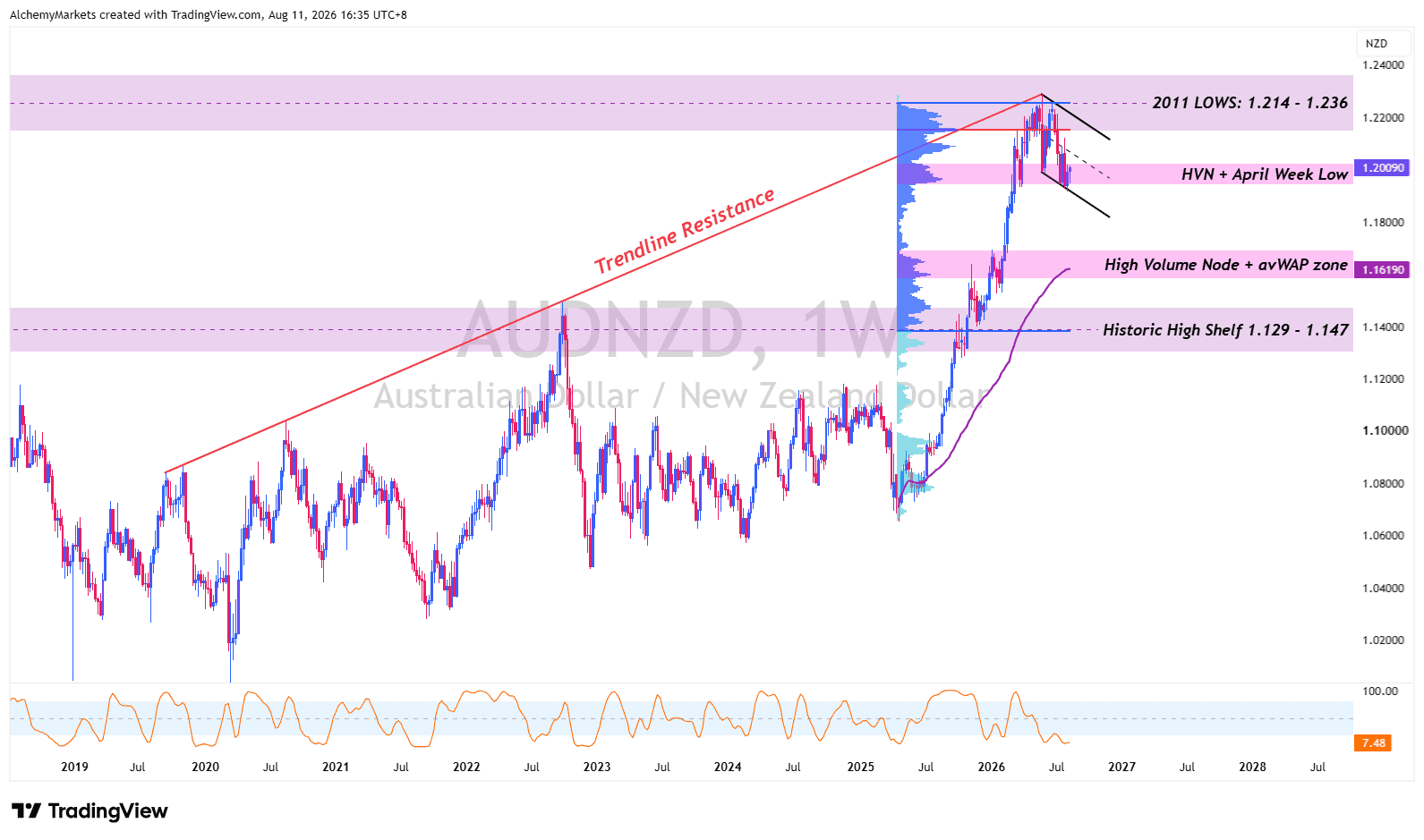
The idea that AUD may weaken against the NZD is supported technically as well.
The pair has tapped a major trendline resistance extending from 2019 with almost perfect precision. The current pullback could still form a bull-flag consolidation, but failure to recover would leave room for a deeper retracement towards roughly 1.162-1.169, where the trading volume weighted average price anchored from the start of the rally sits.
Author

Zorrays Junaid
Alchemy Markets
Zorrays Junaid has extensive combined experience in the financial markets as a portfolio manager and trading coach. More recently, he is an Analyst with Alchemy Markets, and has contributed to DailyFX and Elliott Wave Forecast in the past.