Rates spark: Late cycle already

Developed yield curves are displaying late-cycle dynamics. This is nowhere as obvious as on the GBP curve as hikes are being brought forward, and as the curve flattens. This makes it all the more difficult for long-end rates to rise.
GBP the hawkish re-pricing continues… but with a hard cap
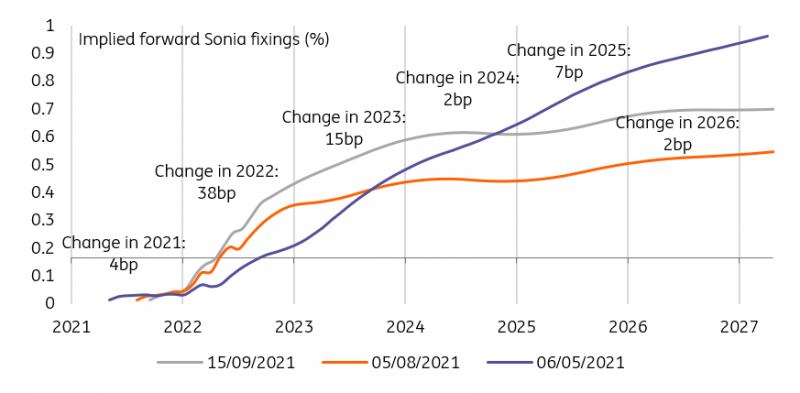
The hawkish re-pricing started earlier this month by Governor Andrew Bailey is gathering steam this week, helped by a sizeable beat in the August UK inflation print. GBP OIS forwards now imply that the Bank Rate will be hiked by almost 40bp next year. So far so logical. What’s interesting is the market’s reluctance to price much by way of hikes once the policy rate has risen to 0.5%.
The GBP curve struggles to imagine the Bank Rate rising above 0.5%
Source: Refinitiv, ING
If this number sounds familiar it is because it has been flagged by the BoE as the minimum level it wants to hike to before starting to reduce its balance sheet. The implication is that either the market thinks that the top of this cycle will be 0.5%, or that the central bank will run into some trouble when it stops reinvesting the proceeds of gilts maturing in its portfolio. It seems like an incredibly remote prospect but, for completeness, it contemplates selling gilts from its portfolio when (if) the Bank Rates reaches 1.5%.
To be fair, the BoE is further along the road to tightening than its main developed market peers. Its own version of tapering is running smoothly and should be done by the end of this year. Compare that to the Fed and ECB’s acrimonious back and forth on the date and speed of their own effort to reduce net purchases to zero (eventually in the case of the ECB). Still, the memory of the Fed’s own quantitative tightening (in 2018-2019) probably explains the market’s scepticism.
Broader curve implications: Curves to stay flat
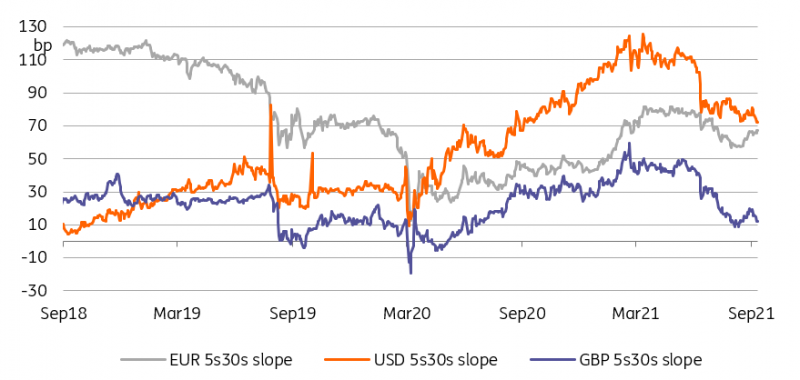
The resulting market dynamic has been one of persistent curve flattening. This is not altogether surprising for the yield curve to flatten as the end of a hiking cycle approaches but it is noticeable about one year before the date of the first hike (our economics team thinks 2023 is actually a more realistic timeframe). What’s more it jives with the theory that an unwind of the central bank’s bond portfolio should result in a build-up of term premia at the long-end.
GBP and USD curves have flattened as hiking cycles draw nearer
Source: Refinitiv, ING
There are implications for other developed rates markets in our view. Firstly, it seems that the well accepted consensus is that central banks will struggle to even match the degree of tightening achieved in the previous cycle (to 0.75% for the BoE and 2.5% for the Fed). That view, and the semi-permanent squeeze on the bond market resulting from bloated central bank portfolios means investors have little qualms in chasing yields lower.
Today’s events and market views
A possible 15y Austrian bond deal, auctions from Spain and France make up this morning’s sovereign supply schedule. Austria aside, the maturity of the bonds on offer is relatively short but EGBs have been trading heavy this week and soft demand today would add to their woes.
In the US session, much of the excitement will come from the release calendar: retail sales, jobless claims, and Philly Fed will be the highlights. There is much gloom in US markets already so the question will be whether economic expectations have adjusted to sufficiently low levels for them to ignore weak data.
From the ECB, President Christine Lagarde and Olli Rehn are scheduled. The main focus of late has been how the central bank would address inflation upside risk. Despite fairly unequivocal dovish reassurances provided by the likes of Isabel Schnabel, there is a clear hawkish tilt in the way EUR rates are trading. We think the bar is high to change the ECB’s stance but supply and inflation worries should continue to register in price action in the coming days.
Read the original analysis: Rates Spark: Late cycle already
Author

ING Global Economics Team
ING Economic and Financial Analysis
From Trump to trade, FX to Brexit, ING’s global economists have it covered. Go to ING.com/THINK to stay a step ahead.

















