|

Pressure Remains On EM Currencies

USDTRY, Daily

Although the USD weakened a touch overnight, the general risk sentiment and capital flows remain USD positive in the short to medium term, and especially against the emerging market (EM) currencies. The Mexican Central Bank yesterday raised interest rates to 7.75% as expected after 2 months of MXN depreciation. Today, the new Prime Minister of Malaysia, 92-year old Mahathir Mohamad, sees fair value for USDMYR at 3.800, it currently trades over 5% higher at 4.000, and over the weekend there are Presidential Elections in Turkey, with the Lira (TRY) under substantial pressure even after significant intervention from the central bank.

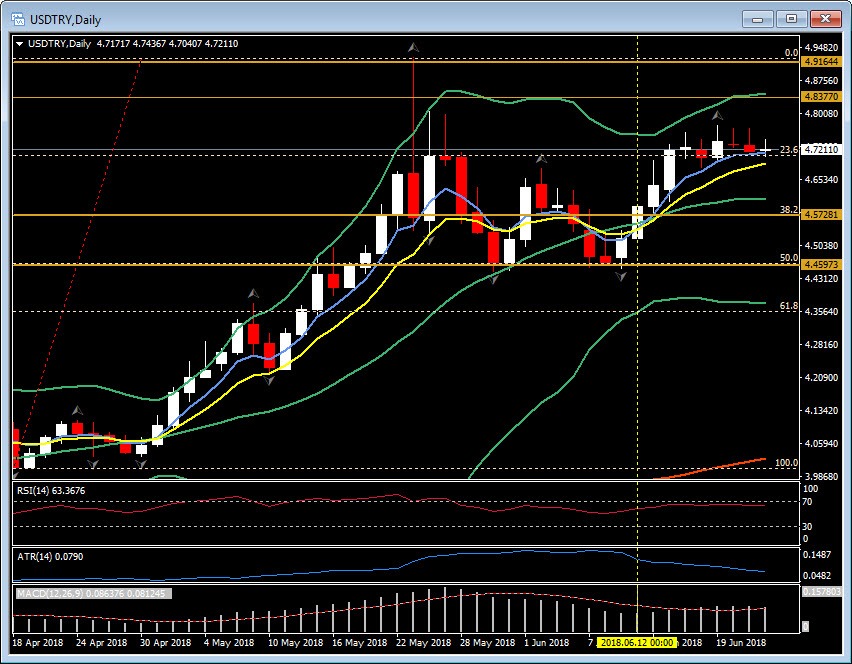
USDTRY peaked at 4.9164, and declined rapidly to the 50% Fibonacci level (4.4597) and then found support following the central bank’s intervention. Currently, the 23.6 Fibonacci level is holding at 4.7140, following the break into the upper half of the Bollinger band on June 6. RSI, at 62, and MACD both have more room to appreciate. The psychological 4.8000 and the upper Bollinger band at 4.8377 are achievable, once the resistance at the latest Fractal high is breached at 4.7750. To the downside, a break of the 4.4200 level could see the lower Bollinger band and 61.8 Fibonacci level at 4.3600 a target area. However, as Financial Times has reported this morning, “Turkey is textbook unstable,” said Ryan Gingeras, an associate professor at the Naval Postgraduate School in California. “We don’t know how society is going to react, whether the opposition wins or whether Erdogan wins… Everything is up in the air.” This alone suggests risk to the upside for USDTRY.
USDTRY

Author

Stuart Cowell

With over 25 years experience working for a host of globally recognized organisations in the City of London, Stuart Cowell is a passionate advocate of keeping things simple, doing what is probable and understanding how the news, c


More from Stuart Cowell
Share:

Editor's Picks

EUR/USD weakens to near 1.1900 as traders eye US data

The EUR/USD pair loses ground to around 1.1905, snapping the two-day winning streak during the early European trading hours on Tuesday. Markets might turn cautious ahead of the release of key US economic data, including US employment and inflation reports that were pushed back slightly due to the recently ended four-day government shutdown.

GBP/USD edges lower below 1.3700 on UK political risks, BoE rate cut bets

The GBP/USD pair trades on a weaker note around 1.3685 during the European session on Tuesday. The Pound Sterling edges lower against the US Dollar amid political risk in the United Kingdom and rising expectations of near-term Bank of England rate cuts. 

Gold drifts lower as positive risk tone tempers safe-haven demand; downside seems limited

Gold drifts lower during the Asian session on Tuesday and snaps a two-day winning streak, though it lacks strong follow-through selling and shows some resilience below the $5,000 psychological mark amid mixed cues. The outcome of Japan's snap election on Sunday removes political uncertainty, which, along with signs of easing tensions in the Middle East, remains supportive of the upbeat market mood.

Bitcoin Cash trades lower, risks dead-cat bounce amid bearish signals

Bitcoin Cash trades in the red below $522 at the time of writing on Tuesday, after multiple rejections at key resistance. BCH’s derivatives and on-chain indicators point to growing bearish sentiment and raise the risk of a dead-cat bounce toward lower support levels.

Follow the money, what USD/JPY in Tokyo is really telling you

Over the past two Tokyo sessions, this has not been a rate story. Not even close. Interest rate differentials have been spectators, not drivers. What has moved USD/JPY in local hours has been flow and flow alone.

Bitcoin Cash trades lower, risks dead-cat bounce amid bearish signals

Bitcoin Cash (BCH) trades in the red below $522 at the time of writing on Tuesday, after multiple rejections at key resistance. BCH’s derivatives and on-chain indicators point to growing bearish sentiment and raise the risk of a dead-cat bounce toward lower support levels.