Pound made gains against AUD as no-deal Brexit chances decline


Australian Dollar Highlights
- Pound strengthened against AUD
- US-China trade talks are making progress
- Australia lowest annual growth rate in 20 years
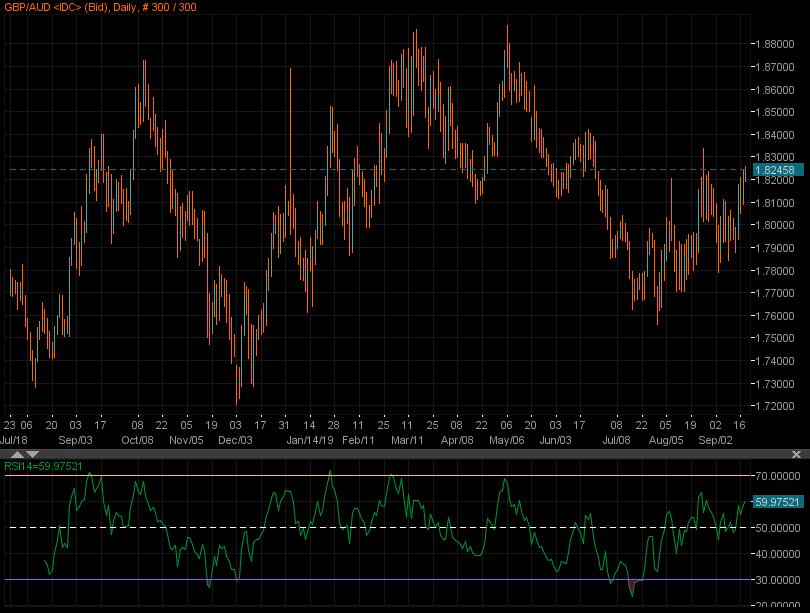
Sterling - Australian Dollar (GBPAUD) FX Technical Analysis
With hopes rising that the elusive Brexit deal can be reached, the Pound has made gains against AUD in early September. From a low of 1.78 in early September, Sterling clawed its way up to 1.817 in typical mid-market rates – and its fate going forward will be largely influenced by whether a Brexit deal can be found before the 31st October leaving date. The catalyst for the rise were reports that the UK government was considering alternative arrangements for the Irish backstop. The backstop aims to prevent a hard border between the UK and Ireland once Britain leaves the EU.
This month’s Australian Dollar Q&A with Private Client Currency Consultant, Jonathan Russel
Q. What effect has Brexit had on GBP-AUD in September?
A. With hopes rising that the elusive Brexit deal can be reached, the Pound has made gains against AUD in early September. From a low of 1.78 in early September, Sterling clawed its way up to 1.817 in typical mid-market rates – and its fate going forward will be largely influenced by whether a Brexit deal can be found before the 31st October leaving date. The catalyst for the rise were reports that the UK government was considering alternative arrangements for the Irish backstop. The backstop aims to prevent a hard border between the UK and Ireland once Britain leaves the EU.
UK Prime Minister Boris Johnson has floated the idea of an ‘all-Ireland’ solution, which would see Northern Ireland adopt some EU regulations, including those for agriculture and food. Although significant differences remain between the Europe and the UK, the proposals show signs that the UK government is willing to at least consider alternatives on the backstop. Boris Johnson insists he wants a deal and the focus is largely around a compromise similar to the one put forward by the last Prime Minister, Theresa May. Major movement on the Australian Dollar surrounds the ebb and flow of the US-China trade talks, which are scheduled to take place in October. Here, there is also optimism that a deal can be reached, following signs of concessions from both sides.
Q. So, will there be a breakthrough in the US-China trade talks?
A. It certainly looks more hopeful. The Chinese showed goodwill by leaving out agricultural products in the latest round of tariff rises and Donald Trump followed suit by delaying a planned $250 billion of tariffs for a fortnight after the 1 October deadline. The tariffs have slowed growth in many regions around the world. Europe has sited it as a major stumbling block and Australia has more than lose to most, as China its number one trading partner for imports and exports. In fact, in June 2019 – the latest report published – China received a record 40% of exports from Australia. The last time a nation had that large a share was in 1952 with Britain leading the way.
Imports from China are also growing, rising 15% in the last financial year. That is how important the relationship has become. So, it is no wonder that the Aussie Dollar is sensitive to any threat to the Chinese economy. Despite the positive signs for the Washington trade talks in early October, big differences remain between the two sides. There is still some scepticism among business leaders in the United States who say trade is the “biggest external risk factor”. For all those exchanging AUD, it is certainly another reason to obtain the latest guidance from your Halo Financial currency consultant.
Q. How much has Australia’s economy suffered?
Well, Australia has just had its slowest annual growth rate for almost 20 years. But things are not as bad as they seem. In Quarter 2, 2019, GDP increased 0.5%, which means the economy expanded 1.4% in the year. That is according to the latest Australia Bureau of Statistics data. But that is still better than the UK and Germany, which have seen quarters of retraction. Given the fact that there is an international trade war and house prices in Australia’s top cities have fallen by around 15%, economists say the result must be put into context.
ABS Chief Economist, Bruce Hockman, says, “The external sector drove GDP growth this quarter, while growth in the domestic economy remains steady”. The household sector remained relatively subdued, with a 0.4% growth in household expenditure. While dwelling investment fell 4.4% in the quarter. However, there are hopes that the property market is starting to recover. In August 2019, prices rose by an average of 0.8%, with Sydney enjoying a 1.6% uplift and Melbourne a 1.4% increase. Much of the spike was due to a relaxation in mortgage regulations, allowing applicants to borrow more. CoreLogic's head of research Tim Lawless says, "The August figures really have taken quite a step change upwards, which is much is a much stronger rate of growth than what we would have expected.”
As the market moves into Spring, listings are expected to rise, which could constrain price rises. But there is good news on the job front, with filled jobs up 0.5% in Quarter 2, 2019 and 2.4% for the year. Filled jobs increased by 67,400 in the quarter, with jobs worked as a person’s main job increasing by 101,800 and secondary jobs decreasing by 34,400 secondary jobs. The industry with the largest increase in the number of filled jobs was Education and training, followed by Administrative and support services. But there was a further softening in construction jobs, which went from the third largest sector to the fifth.
Q. How is the British economy doing in comparison?
A. With Brexit uncertainly continuing, the UK looks like it is narrowing avoiding a recession. In Quarter 2, 2019, GDP fell 0.2% after declining in Quarter 1
With Brexit uncertainly weighing on UK trade, there were concerns that the UK economy could be heading for recession for the first time in 10 years. For second quarter, there had been a 0.2% fall in output, but the data for July 2019 saw a welcome rise of 0.3% in GDP, three time higher than expectations. It doesn’t guarantee Quarter 3 won’t see an overall contraction, but it is a strong start. The result was supported by a 0.5% rise in construction and 0.3% in manufacturing. But news at the same time that the Reserve Bank of Australia would not be cutting interest rates for some time, meant the Aussie Dollar made on-the-day gains against Sterling. Whether the Pound continues to make gains in October depending largely on how the Brexit talks go.
Q. What next for the Australian Dollar?
A. The Australian Dollar was lower across the board at start of the week, after a downbeat tone from the Reserve Bank of Australia (RBA) along with well talked about nervous global backdrop. The Pound Sterling- Australian Dollar exchange rate is currently trading at around AU$1.8207 in interbank rates.
The Reserve Bank of Australia played a role in sending the Aussie lower on Tuesday 17th September, after minutes from the September policy meeting showed they are perhaps more cautious than they framed themselves a few weeks ago. CBA Economics expects the RBA to cut interest rates by 25bps in November and February.
Australia's Dollar has been forced onto the back foot this week by a steep spike in oil prices. That has raised fears about inflation and growth at a time when the global economy was already reeling from the latest escalation in the ongoing U.S.-China trade war.
"A significant spike in Australian petrol prices would pose a further threat to consumer spending and growth in Australia, adding to pressure on the RBA to ease further," says Dr Shane Oliver, chief economist at AMP Capital.
Looking ahead, it is likely the risk-sensitive Australian Dollar (AUD) could slide further against Sterling (GBP) following the Federal Reserve’s interest rate decision. If the Fed slashes rates for the second time this year, it is likely the ‘Aussie’ will be left under pressure as risk-appetite slides. Meanwhile, disappointing Australian unemployment data could cause the Australian Dollar to fall further at the start of Thursday’s session. If unemployment edges up further than expected in August, the GBPAUD exchange rate is likely to rise.
What is the guidance for Australian Dollar buyers and sellers?
A. Holding above 1.80 is good position to buy AUD, with the next target of 1.83-1.85.
Sterling will be sensitive to any Brexit news regarding no deal Brexit, so a short-term correction back to 1.78-1.80 would be a good AUD selling positon.
Commentary from the Halo Financial Team. Need a trusted FX broker? Register today for more insights and strategies.
Author
Halo Financial Team
Halo Financial