Pinch, punch, bond yields surge as FTSE 100 has bruising start to October

Stocks are sinking and global bond yields are rising in an ominous start to the quarter for financial markets. The FTSE 100 is lower by 1.7% so far this morning, and the Dax is also lower by more than 1%, as investors pull back from taking risk. The driver appears to be higher oil prices, and the Brent crude oil price is hovering around $100 per barrel this morning.
Major milestones reached for global benchmark yields
The bond market sell off is gathering pace and the UK 30-year yield is now above 6% for the first time since 1998. The 10-year Treasury yield, the world’s benchmark yield, is at its highest level since 2002. This suggests that globally, the cost of money is increasing, and it could be hard for stocks to continue to rally as we move into Q4.
The three drivers of the global bond sell off
Global bonds sold off more than 2% in September, the most since 2024, after Donald Trump was elected for a second term. Back then, bonds sold off due to Trump’s expected expansionary fiscal policy. Today, bonds are selling off on the back of his foreign policy, as well as his fiscal largess.
While bond markets are pricing in stronger growth across the developed world, there is also the realization that there is now a structural premium attached to the oil price and to refined products. This will keep prices elevated for the long term, as it does not appear that a neat diplomatic solution to the war in the Middle East will be reached any time soon.
This is playing out in the sovereign bond market, and the sell off in bonds is happening at the same time as the oil price is rising. Brent crude is back above $100 per barrel today, which is a significant psychological level, in the same way, a 6% yield on a 30-year Gilt is also significant.
French bonds now the target of vigillantes
The bond market is also being whipped around by fiscal concerns, and UK and French bonds are leading the sell off on Thursday. This comes as we lead up to the French Budget plan later today. France will need a tough Budget to placate this bond market. France is projected to have a budget deficit of 5.4% of GDP for this year, and it has a debt to GDP ratio of more than 115%. This compares to the UK, where the budget deficit is projected to be above 4% of GDP, and the debt to GDP ratio is 94%.
While the UK is in tricky fiscal waters, as we lead up to next year’s Presidential election, we think that France could become the target of the bond vigilantes. We are already seeing signs of stress in the European bond market, the French-German 10-year yield spread is more than 120bps, and is at its highest level since 2012.
The FX impact: A rush to safety
The stress in the bond market is playing out in FX. There is a rush to the safety of the dollar and the Swiss franc this morning, while the yen, the euro and the pound all sell off alongside sovereign bonds. For now, GBP/USD is trading within the $1.32- $1.33 range, but there is a risk that this pair breaches the $1.32 level if the bond sell off gets worse in the coming days.
The question now is, when will the bond market sell off come to an end? Bond markets are facing a triple threat of big government spending, strong growth and structurally higher energy prices, which could keep the pressure on bonds for some time.
The harbour in the storm
There is only one harbour in this storm: tech. The tech sector was the only sector to rally in the US equity space on Wednesday. Equity futures in the US are predicting a lower open for the Dow Jones and the Russell, which are both sensitive to bond yields. In contrast, Nasdaq futures are pointing to a higher open, after memory chip maker Micron reported stellar results and strong forward guidance for future revenues. The company said that it expects revenue to hit $61.5bn, and that is has demand visibility out to 2028, with 75% of 2027 shipments already committed.
Micron’s results suggest that the AI trade remains in strong health, and is likely to be resilient to the bond market sell off. If the bond market is to recover any time soon, a weaker payrolls report on Friday will be needed.
UK 30-year bond yield
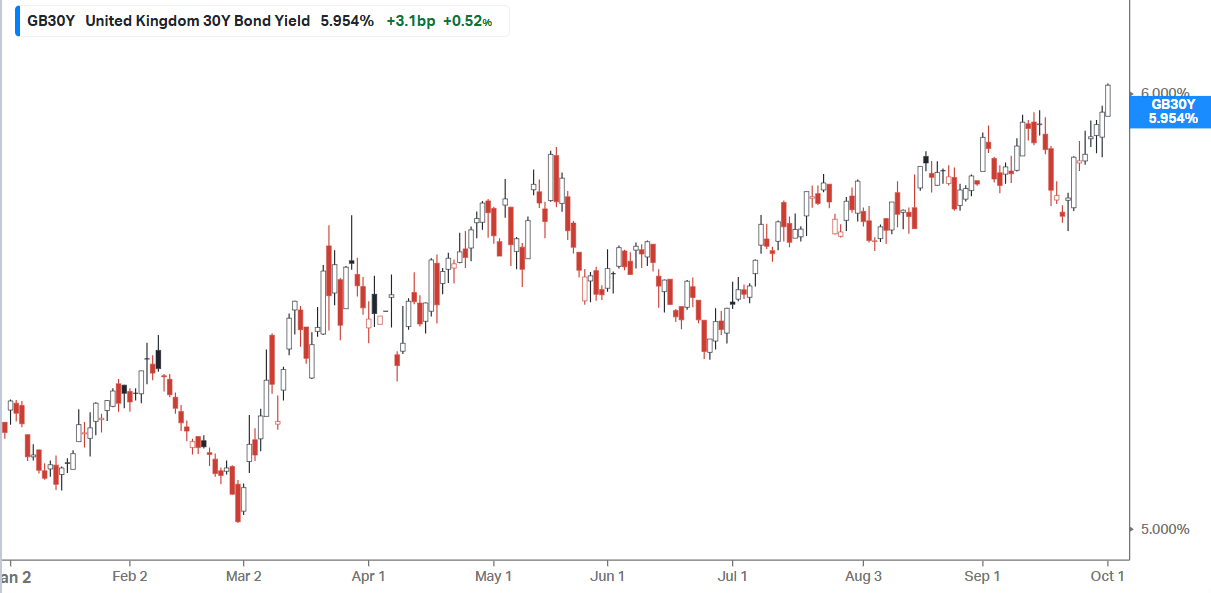
Source: Koyfin
Author

Kathleen Brooks
XTB UK
Kathleen has nearly 15 years’ experience working with some of the leading retail trading and investment companies in the City of London.