EUR/USD at new lows: Will the sell-off end?

EUR/USD fell to 1.1328 on Thursday. Support for the US currency is being generated by a sharp rise in US Treasury yields amid fears that inflation, driven by expensive energy, will require a tougher Federal Reserve policy.
The yield on 10-year bonds is holding around 5.3%, while 30-year bonds are around 5.64%. Both are at their highest levels since 2002, broadening the dollar's appeal.
At the same time, oil prices remain high: negotiations between the United States and Iran have yet to yield noticeable progress, despite signs of a recovery in Middle Eastern supplies. This leaves elevated inflation risks firmly in place.
PCE data released on Wednesday came in softer than expected. The headline price index rose 0.3% month-on-month in August against a forecast of 0.4%, while core PCE rose 0.2% against an expected 0.3%. Following the release, the probability of a Fed rate hike in October dropped to approximately 38% from 51%.
Market focus now shifts to Thursday's weekly jobless claims and Friday's September US labour market report.
Technical analysis
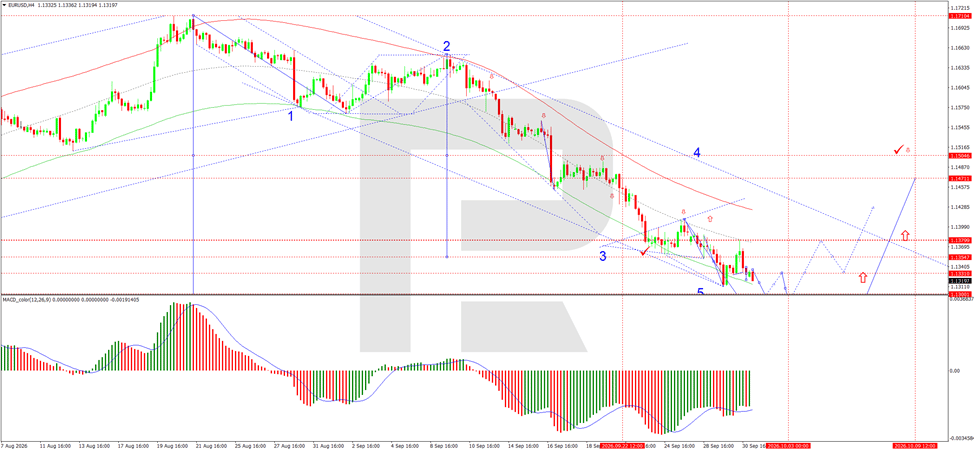
On the H4 chart, EUR/USD continues to move within a downward structure. The market ended another decline wave around 1.1313 following a corrective rise to 1.1379. The subsequent momentum returned quotes to 1.1330, with current consolidation forming below this resistance. The price remains inside the downward channel and noticeably below the moving average, so the main direction for the coming day remains downward. The immediate target is 1.1300, and securing below this level would open up space towards 1.1290–1.1283. The 1.1355 level is the first significant resistance; a return above it could delay the bearish scenario and lead to a retest of 1.1379.
The MACD remains below its zero line, confirming continued bearish momentum. At the same time, the shrinking negative histogram indicates a slowdown in the decline, suggesting that the market may form an additional correction or consolidation before continuing its move.
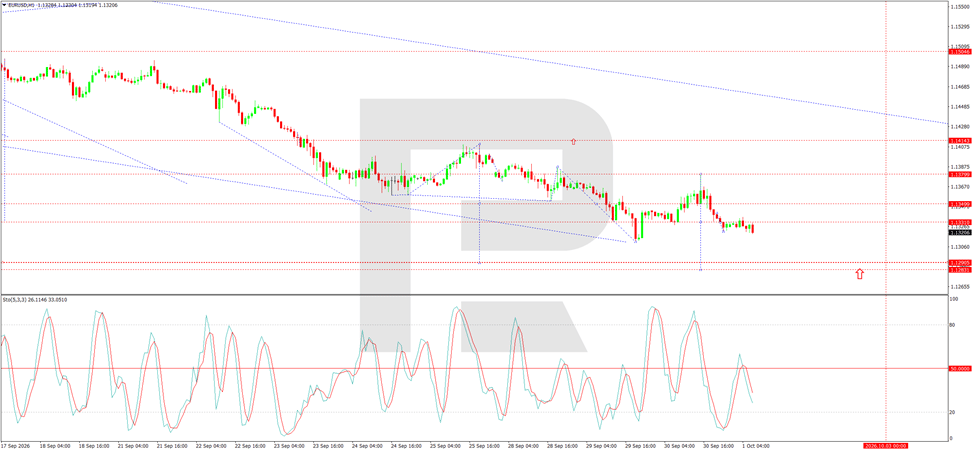
On H1, the structure confirms continued selling pressure. After the wave ended at 1.1330, the market moved into a narrow range, but recovery attempts remain limited. The Stochastic oscillator sits below the 50 level and is turning downwards, indicating that short-term momentum towards the oversold zone may continue. While EUR/USD trades below 1.1330–1.1355, the continuation of the fifth downward wave towards 1.1300 and then 1.1290 remains the priority scenario. An additional confirmation is the sequence of declining local highs and lows, which retains a bearish structure.
Conclusion
EUR/USD has fallen to new lows as surging US Treasury yields, driven by inflation concerns linked to expensive energy, continue to bolster the dollar. While softer-than-expected PCE data has reduced October rate hike odds to 38%, the broader inflation picture and stalled US-Iran talks keep risks tilted towards further Fed tightening. Technically, the pair remains firmly bearish, with the next targets at 1.1300 and 1.1290–1.1283. A recovery above 1.1355 would be needed to delay the bearish scenario, though the prevailing structure of lower highs and lows suggests the sell-off is not yet over. Friday's US jobs report will be the key catalyst for the next directional move.
Author

RoboForex Analysis Department
RoboForex
RoboForex Analysis Department provides timely market insights, expert technical analysis, and actionable forecasts across forex, commodities, indices, and equities.