PetroYuan is a Huge US Success Story, Not a Chinese One

Ignore the hype about the death of the dollar and currency whales. The PetroYuan is a US success story.
Bloomberg reports As Trade War Heats Up, Biggest Currency Whales Make Their Move.
“A lot of countries around the world are turning to Europe for increased partnership in trade,’’ said Jens Nordvig, who was Wall Street’s top-ranked currency strategist for five years running before setting up Exante Data a little over a year ago. “It’s not crazy to think that’s also going to be happening in the area of capital markets and reserve allocations. The bottom line is, this trade stance the U.S. has now is not helpful in terms of making the dollar attractive” for central banks that hold billions in reserves.
Nordvig estimates a half-trillion dollars could flow into the euro in the next two years, equal to a 25 percent boost in the currency’s share of reserves.
Developing countries and oil-exporting nations in the Middle East, which rely heavily on international trade, are the most likely to lift their euro allocations, he said. Six emerging economies -- China, Saudi Arabia, Taiwan, India, South Korea and Brazil -- hold almost half the world’s reserves, data compiled by Bloomberg show. China alone has amassed over $3 trillion in foreign exchange -- primarily as a result of its cheap exports to the U.S.
Trade Whale "Buying Opportunity" Silliness
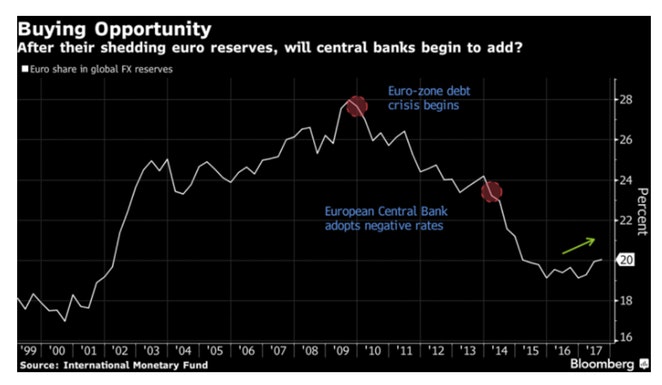
It does not matter whether countries like the dollar or like euros. Reserves are a mostly a function of trade math.
As the US deficit increases, and it will, foreign countries will accumulate more US assets.
It's a mathematical necessity that has nothing to do with likability.
From time to time, countries like China may sell treasuries or other US dollar denominated assets to stop capital flight.
Death of the Dollar?
Death of US dollar? China launches petro-yuan to challenge greenback’s dominance says RT.
PetroYuan futures started trading today. I am amused by the hype.
Energy Independence
The PetroYuan is not about the likability of dollars, nor does it represent a desire by China to dethrone the dollar.
Recall that the US is on the verge of energy independence. As a result, the US will buy less oil from the Mideast .
China runs a huge trade surplus with the US, but also a big deficit with the Mideast energy producers. Those producers will now accumulate Yuan.
PetroYuan Represents US Success
Three weeks ago, I reported US will Overtake Russia to Become Top Oil Producer by 2023.
As a direct result, the Saudi trade surplus with the US will crash. Those oil exporters are finally ready to hold yuan.
The huge irony in all the petroyuan hype is that it is a direct result of forthcoming US energy independence. That's a US achievement, far bigger than the symbolic gain by China.
No Dollar Dethrone: Three Reasons
The idea that the yuan will soon replace the dollar as the world's reserve currency is ridiculous for currency reasons, political reasons, and economic reasons.
For further discussion, please see Gold-Backed Petro-Yuan Silliness: Reserve Currency Curse?
Author

Mike “Mish” Shedlock's
Sitka Pacific Capital Management,Llc
Mike “Mish” Shedlock is a registered investment advisor for SitkaPacific Capital Management.
















