|

OPEC agrees to the cuts and yet the price is going down. Why?
OPEC extended the production cut so why we are see the price tumbling? As Alpari Research and Analysis we say that for quite a long time. Cuts won't help much and cannot strongly influence the price of the OIL. In addition to that, we are just witnessing typical market mechanics, which we will describe further on.

Extension of the cut in the oil output was expected for a long time. Traders used that reason to but Oil and because of that, the price climbed sharply in the first half of May. When the rumour becomes a truth, you sell - that what usually happens. That is why traders often repeat: buy the rumours and sell the facts. Current situation on the Oil is just another example of this old school quote.

Second thing is the cut itself. We said that before and we will repeat that again. If some countries cut the output, other will increase it in order to close the gap and gain market shares. Shale producers, non-OPEC countries, they all are happy with the cuts as it helps their business and the overall supply-demand situation stays the same.
WTI

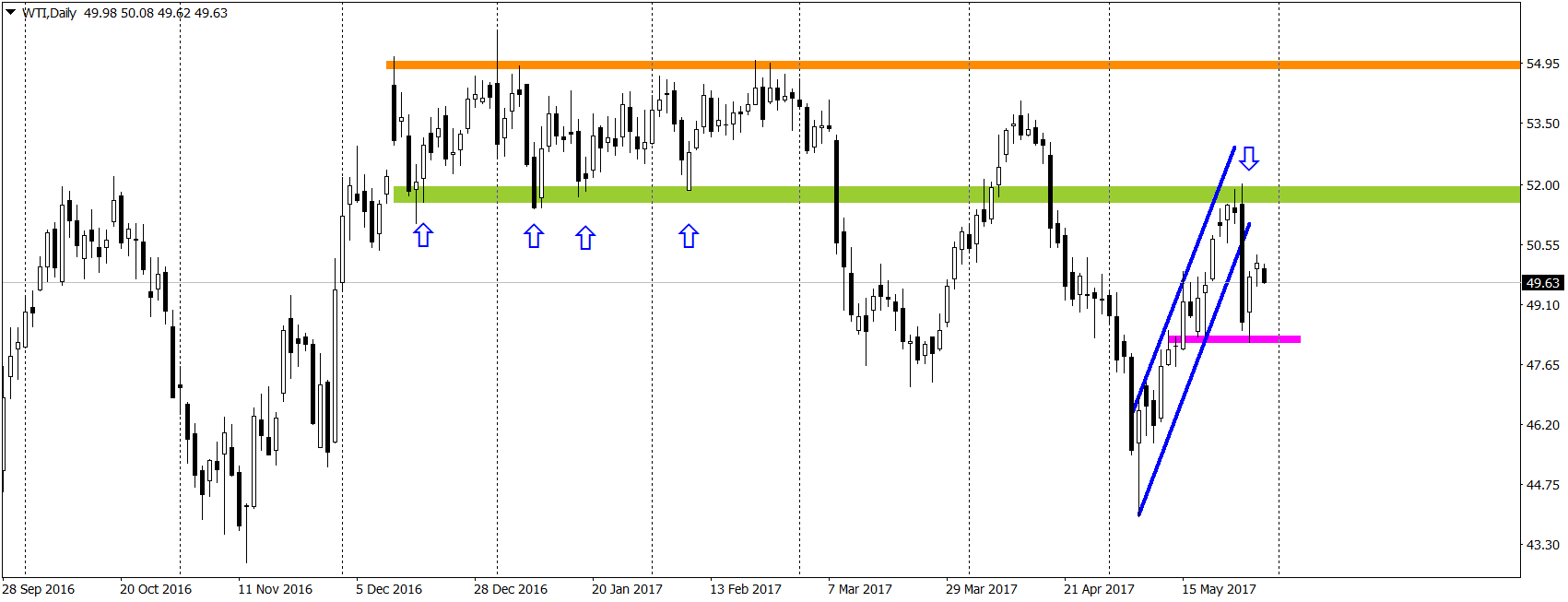
Last but not least we have a bearish technical situation here. Price did not manage to break the resistance on the 52 USD/oz (WTI) and broke the lower line of the flag (blue lines), which is a strong negative signal. Bearish reaction followed, driven by the convergence of the fundamental and technical factors. The beginning of the new week just proves my point, we are going down. Buyers do not even have enough strength to test the lower line of the flag as a closest resistance.

So what are the perspectives? Not very bright. When we look at the indexes we can see that we are in times of the prosperity and yet the demand for the Oil is low. I do not see a reason why this demand should increase in next few years especially when we should see a global recession/correction at some point this or the next year.


Author

Tomasz Wisniewski

Tomasz Wisniewski

Axiory Global Ltd.

Tomasz was born in Warsaw, Poland on 25th October, 1985.

More from Tomasz Wisniewski
Share:

Editor's Picks

EUR/USD flirts with daily highs, retargets 1.1900

EUR/USD regains upside traction, returning to the 1.1880 zone and refocusing its attention to the key 1.1900 barrier. The pair’s slight gains comes against the backdrop of a humble decline in the US Dollar as investors continue to assess the latest US CPI readings and the potential Fed’s rate path.

GBP/USD remains well bid around 1.3650

GBP/USD maintains its upside momentum in place, hovering around daily highs near 1.3650 and setting aside part of the recent three-day drop. Cable’s improved sentiment comes on the back of the Greenback’s  irresolute price action, while recent hawkish comments from the BoE’s Pill also collaborate with the uptick.

Gold clings to gains just above $5,000/oz

Gold is reclaiming part of the ground lost on Wednesday’s marked decline, as bargain-hunters keep piling up and lifting prices past the key $5,000 per troy ounce. The precious metal’s move higher is also underpinned by the slight pullback in the US Dollar and declining US Treasury yields across the curve.

Crypto Today: Bitcoin, Ethereum, XRP in choppy price action, weighed down by falling institutional interest 

Bitcoin's upside remains largely constrained amid weak technicals and declining institutional interest. Ethereum trades sideways above $1,900 support with the upside capped below $2,000 amid ETF outflows.

Week ahead – Data blitz, Fed Minutes and RBNZ decision in the spotlight

US GDP and PCE inflation are main highlights, plus the Fed minutes. UK and Japan have busy calendars too with focus on CPI. Flash PMIs for February will also be doing the rounds. RBNZ meets, is unlikely to follow RBA’s hawkish path.

Ripple Price Forecast: XRP potential bottom could be in sight

Ripple edges up above the intraday low of $1.35 at the time of writing on Friday amid mixed price actions across the crypto market. The remittance token failed to hold support at $1.40 the previous day, reflecting risk-off sentiment amid a decline in retail and institutional sentiment.














