|

Online shopping takes up more space in retail spending than it did before Covid

  • Online retail spending made up a bigger share of total retail spending over the past 12 months compared to 2019. However, in-store retail spending still accounted for around 3/4 of total retail spending over the past year.

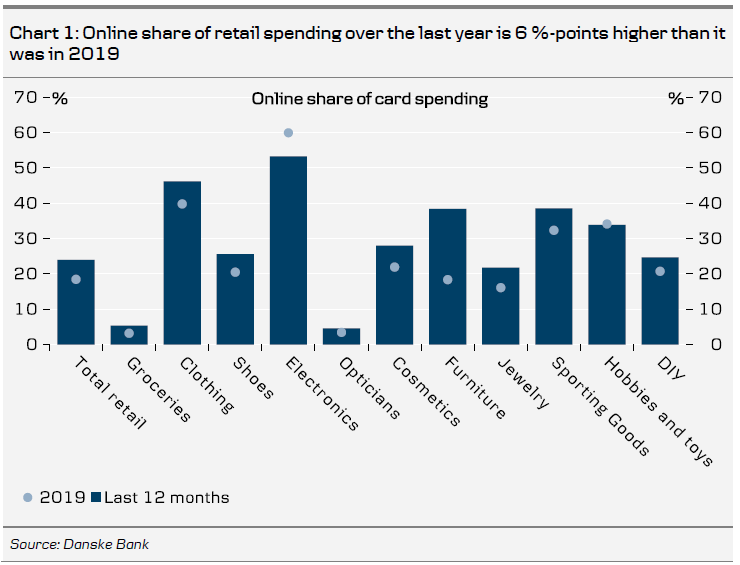
  • We observe that a bigger share of spending stems from online trade for most types of goods post Covid. Furniture is the consumption group where there has been the biggest shift from in-store spending to online spending.

  • All age groups have increased their share of online spending over the past 12 months compared to 2019.

Danish card data suggests that a bigger share of retail spending took place online over the past 12 months compared to 2019. That said the vast majority of retail trade still takes place in physical stores.

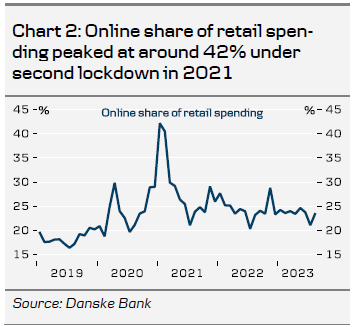
Over the past 12 months 24 percent of retail spending took place online compared to 18.5 percent before Covid in 2019 (see Chart 1). Online consumption shares peaked during the second lockdown in the first months of 2021 (see Chart 2). This is not surprising due to the large-scale lockdowns in 2021, where more retail stores had to remain closed than the first lockdown in 2020. Since data only dates back to 2019, we cannot reject that the increased online spending share is a part of a trend development stemming back from already before Covid.
Chart
fxsoriginal

Download The Full Spending Monitor

Author

Danske Research Team

Danske Research Team

Danske Bank A/S

Research is part of Danske Bank Markets and operate as Danske Bank's research department. The department monitors financial markets and economic trends of relevance to Danske Bank Markets and its clients.


More from Danske Research Team
Share:

Editor's Picks

GBP/USD hits multi-week tops around 1.3560

GBP/USD gathers fresh steam and advances to new three-month peaks near the 1.3560 zone on Friday. Cable’s sharp move higher comes after three daily drops in a row and follows the increasing selling pressure hurting the Greenback.

EUR/USD pops to fresh two-month highs, targets 1.1600

EUR/USD advances markedly, revisiting the upper 1.1500s for the first time since mid-June. The pair’s sharp uptick comes on the back of a strong retracement in the US Dollar amid BoJ intervention chatter and despite steady uncertainty in the Middle East.

Gold picks up pace, approaches $4,400

Gold rebounds toward the $4,400 mark per troy ounce on Friday, reversing the previous day’s pullback. The precious metal’s recovery comes as fresh and intense weakness keep weighing on the US Dollar, while traders keep assessing easing expectations of an imminent Fed interest rate hike and the situation from the Middle East.

Pi Network Price Forecast: PI extends consolidation as bulls eye $0.10
Pi Network (PI) price holds steady on Friday, maintaining a consolidating tone for three consecutive days. Mild retail strength in the PI token remains stable, with Open Interest above $9 million, while social buzz eases. PI token’s technical outlook is mixed, as bearish momentum wanes to neutral, with bulls eyeing the $0.1000 psychological level.
 Weekly focus: Some relief in US inflation concerns

Actual inflation data for July came out as expected with a 0.1% m/m increase in headline CPI and 0.2% excluding food and energy. Annual headline inflation remains too high at 3.4% and means that wage earners are experiencing stagnating spending power at best, and core inflation is a bit higher than the inflation target of two percent would suggest.

Why is Crude Oil priced for a reopening the ships haven't made?
Fourteen vessels crossed the Strait of Hormuz on Tuesday. Before the war, the count ran near 120 a day. In the sessions since the waterway was publicly declared open, Brent has drifted back to $87 and West Texas Intermediate (WTI) to $81, both a little lower again on Wednesday, with daily momentum on each unwound from the top of its range in late July to the low twenties now.














