Oil prices retreat even as hedge fund bullish bets rise

US and global stocks retreated today as investors waited for the upcoming bank earnings. In Europe, the DAX and FTSE 100 indices declined by more than 0.30% and 0.70% while in the US, futures tied to the Dow Jones and S&P 500 index declined by 0.35% and 0.55%, respectively. Top companies like JP Morgan, Citigroup, and Goldman Sachs are set to publish their results this week. Analysts expect that these banks revenues will have been affected by the recent poor volatility in the market and weak loan growth. Big banks like JP Morgan and Citi have already said that their trading revenue will fall by about 30% from the same quarter in 2020. Still, according to Wall Street Journal, analysts expect that bank earnings will be 40% higher than in the same period in 2020. Other companies set to release their earnings this week are UnitedHealth, Delta Airlines, and Blackrock.
Global equities also declined as China intensified its crackdown on technology companies. According to the Wall Street Journal, companies like Bytendance, which owns TikTok, have been forced to scrap their IPOs. The company put its plan to list in the US on hold indefinitely. This is after the government asked the company to address its data security risks first. The company was last valued at more than $180 billion. The news came a week after DiDi stock crashed after the country’s regulator launched an expanded review. It also banned the apps from app stores and barred the firm from adding new customers. The implications of this crackdown could be significant because there are hundreds of large Chinese shares listed in the US.
The price of crude oil declined sharply as the number of the Delta variant of the virus continued rising. That pushed more countries to add some restrictions. In Australia, the New South Wales government has already put in place restrictions as the number of cases rose by more than 110. In Japan, the government announced a new state of emergency that will run until August. Similarly, in Europe, countries like Germany have placed restrictions on movements to countries like Spain and Portugal. As a result, Brent and West Texas Intermediate (WTI) prices dropped by more than 1%. Still, investors are optimistic about oil prices. According to the COT report, the ratio of bullish bets has risen to 23 to 1 in the week of June 15. That was the highest level since the summer of 2018.
EUR/USD
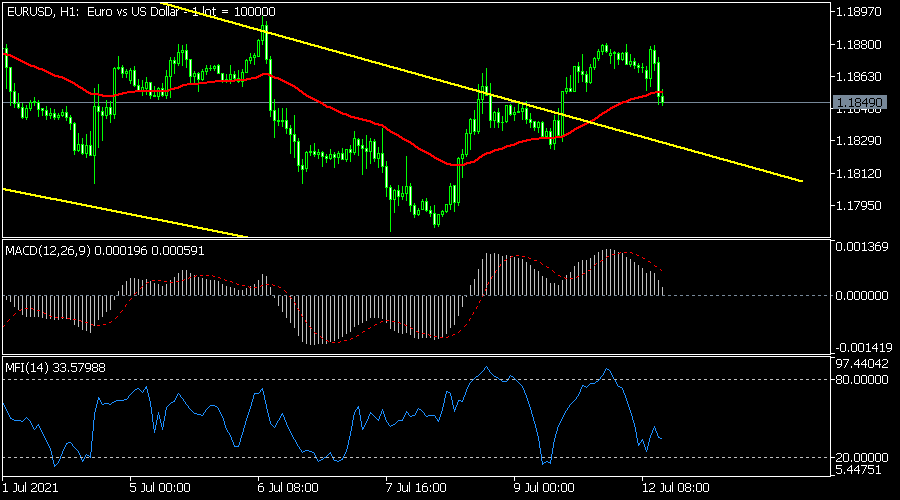
The EURUSD pair declined to 1.1850 as traders started focusing on the upcoming US inflation data. On the hourly chart, the pair formed an important resistance at last week’s high of 1.1880. It is also approaching the upper side of the descending channel shown in yellow. The signal and histogram of the MACD have formed a bearish divergence pattern while the money flow index (MFI) has dropped. Therefore, the pair is to likely do a break and retest pattern, where it retests the upper side of the channel and then resume the upward trend.
US30
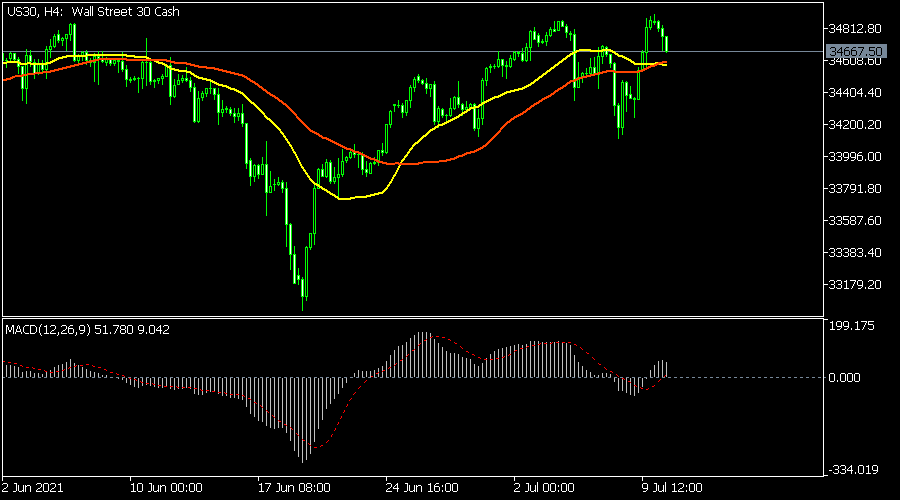
The Dow Jones futures declined ahead of the latest earnings. It fell to a low of $34,672, which was slightly below last week’s double-top at $ 34,909. The neckline of this pattern is at $34,106. The index is also being supported by the 25-day and 50-day moving averages while the MACD has moved above the neutral level. Therefore, since the double-top is a bearish pattern, there is a possibility that it will keep falling.
UK100
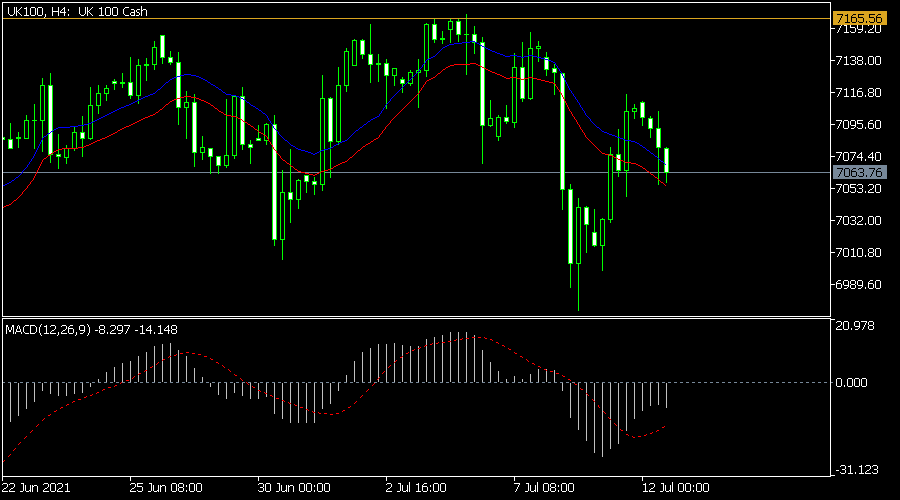
The UK100 index declined to £7,063 as the global stock sell-off accelerated. On the four-hour chart, the index is at the same level as the envelopes indicator. The price is also below the important resistance level at £7,165. It has also formed a head and shoulders pattern signalling that the stock could keep falling later this week.
Author

OctaFx Analyst Team
OctaFX
OctaFX is a market-leading forex broker, providing personalised forex brokerage services to customers in over 100 countries worldwide.