Oil outlook: The Oil battlefield takes shape

WTI appears to have reversed its downwards trajectory since our report last week. In today’s report we are to have a look at the recent announcement by the US that it has imposed sanctions on Russian oil companies, the ongoing tensions between the US and Venezuela and lastly the upcoming trade talks between the US and China. The report is to be concluded with a technical analysis of WTI’s daily chart for a rounder view.
US takes aim at Russian Oil companies
The US has imposed sanctions on Russia’s two biggest oil companies, notably Rosneft and Lukoil in an apparent attempt to increase pressure on the Russian Government to come to the negotiation table in regards to the ongoing war in Ukraine. It appears that the US is making good on their promise to attempt to curb Russian oil flows into the international market, in an attempt to further weaken their economic standing which in turn may increase pressure on Russian President Putin to enter viable peace talks with Ukraine in order to enter the war. Moreover, the sanctions on Russian oil companies could restrict the supply of Russian oil into the market, which could aid oil prices. Furthermore, according to Reuters, India is poised to sharply reduce their imports of Russian oil in order to comply with new US sanctions and could thus further reduce the supply of Russian oil into the global market. In our view, this is not just to comply with the sanctions but also a play to appease Washington, which has threatened India with a 50% tariff on its exports to the US in part as a result of their purchasing of Russian oil. Nonetheless, in our view, the sanctions and reduction of Russian oil in the market may continue as the US continues to pressure Russia economically. Yet, a main hurdle will be China and whether the US will be able to convince the economic behemoth to reduce their oil imports. In conclusion, as a result of the recent developments, oil prices could potentially move higher for the time being, although we should note that in the event of possible peace talks being announced, oil prices may face renewed bearish tendencies.
The Donroe Doctrine
As the paragraph headline states, the Donroe Doctrine is a twist on the Monroe Doctrine aimed at showcasing President Trump’s foreign policy agenda in the America’s. Particularly in Venezuela, where the US military buildup continues, with the US continuing their strikes on alleged cartel members in the region. Nevertheless, tensions are still elevated in the region with The Guardian reporting that another special unit of the US military has been deployed to the region. In turn, should a full-scale military operation occur in Venezuela or should they attempt to overthrow the incumbent government oil prices may find some support as the tensions could also spill over into the oil producing nation of Guyana. Overall, we remain vigilant to developments in the region and how they may play out.
US-China to discuss trade on Friday
The US’s and China’s very public trade spat has moved into the shipping world as we had mentioned in last week’s oil report edition. According to a news flash by Bloomberg, China has stated that trade talks with the US have been set for Friday in Malaysia. In turn, the developments that trade talks between the two nations may occur, could ease market worries about the international maritime world as was seen following the imposition of port fees from both sides. However, we are slightly pessimistic as to what actually can be achieved between the two nations on their talks on Friday, with our view being that they may agree to an extension of their existing trade truce that was signed in Switzerland earlier on this year.
Technical analysis
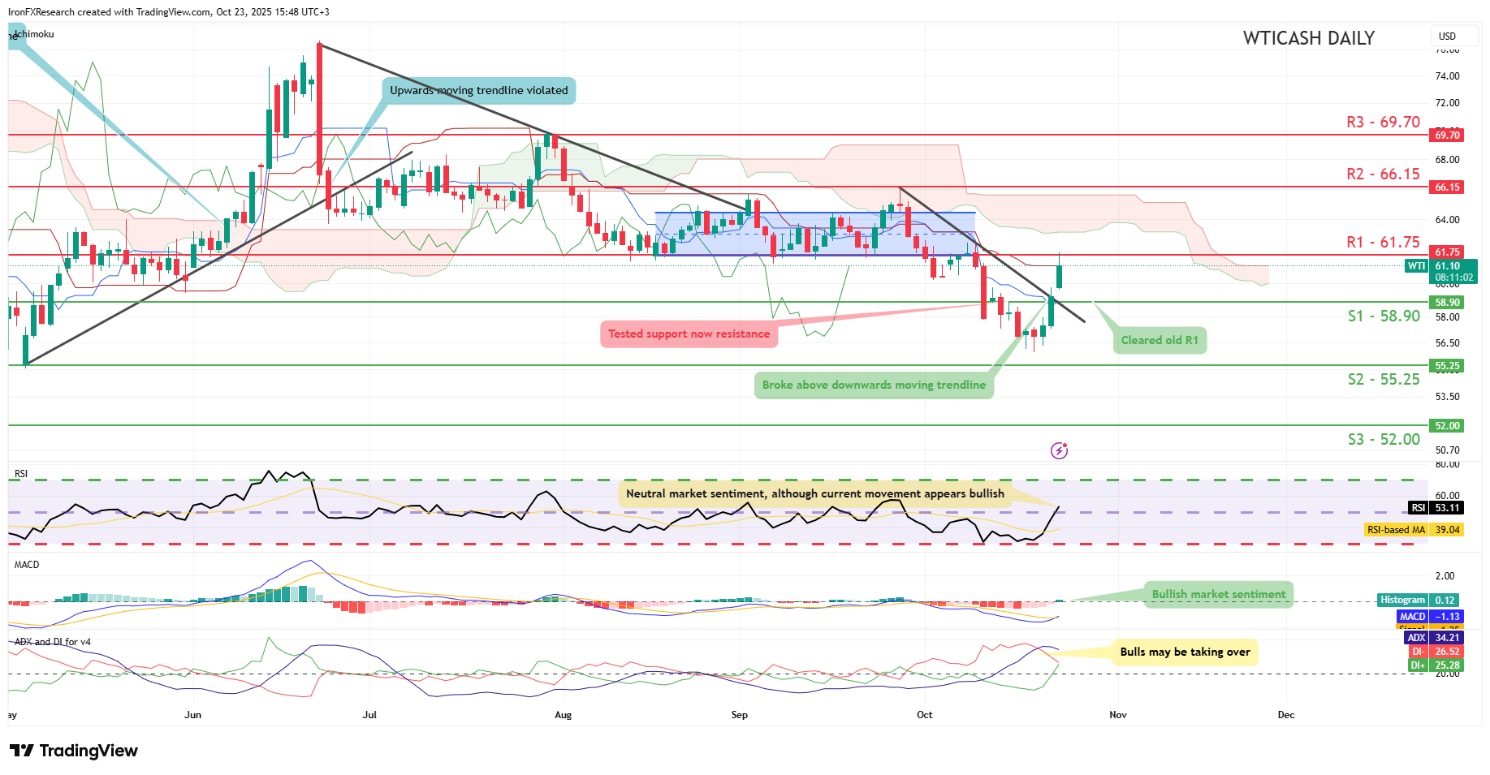
WTI cash daily chart
-
Support: 58.90(S1), 55.25 (S2), 52.00 (S3).
-
Resistance: 61.75 (R1), 66.15 (R2), 69.70 (R3).
Since our last report the WTI appears to have reversed trajectory with the commodity’s price having currently tested our 61.75 (R1) resistance level, which we had noted in last week's report as R2. We now change our outlook for the commodity in favour of a bullish one, and supporting our case is the MACD indicator, in addition to the RSI indicator below our chart, which currently registers a figure near 50, yet considering it was near to 30 the recent rise may showcase that the bearish momentum could have faded away. For our bullish outlook to continue we would require a clear break above our 61.75 (R1) with the next possible target for the bulls being our new 66.15 (R2) resistance level. On the other hand, for a sideways bias we would require the commodity’s price to remain confined between our 58.90 (S1) support level and our 61.75 (R1) resistance line. Lastly, for a sideways bias we would require a clear break below our 58.90 (S1) support level with the next possible target for the bears being our 55.25 (S2) support line.
Author

Phaedros Pantelides
Independent Analyst
Mr Pantelides has graduated from the University of Reading with a degree in BSc Business Economics, where he discovered his passion for trading and analyzing global geopolitics.
















