Oil market analysis: Navigating price dynamics amid geopolitical tensions


While the immediate market reaction to the weekend's events in the Middle East has been relatively muted, the complex interplay of geopolitical stability, supply risks, and strategic reserves continues to shape the global oil markets. The situation remains fluid, with potential for significant market shifts depending on the evolution of the geopolitical landscape.
Market reaction to Middle East developments
The global oil markets, influenced by the intricate balance of geopolitical stability, supply risks, and strategic reserves, have shown a relatively muted reaction to recent events in the Middle East. The situation is evolving, and significant market shifts could occur depending on changes in the geopolitical climate.
Oil market dynamics: The impact of geopolitical tensions
Following an attack by Iran on Israel, the oil markets have stabilized despite rising geopolitical tensions. Early in the trading week, oil prices fell as traders evaluated the risk posed by the conflict. Although the attack caused limited damage, it underscores the ongoing risks in major oil-producing regions. Iran, a key member of OPEC, produces over 3 million barrels of oil per day. The potential supply risks include stricter oil sanctions and possible retaliatory actions targeting energy infrastructures, which could profoundly impact global oil supply.
In response, the U.S. might release more crude from its strategic petroleum reserves, and OPEC could leverage its spare production capacity of over 5 million barrels per day to stabilize the market. Despite a price spike on Friday due to anticipatory concerns, the impact was mitigated by the limited damage from the attack. For a lasting effect on oil prices, significant disruptions, such as those affecting critical shipping routes like the Strait of Hormuz, would be necessary.
Technical analysis of WTI Crude: Trends and future projections
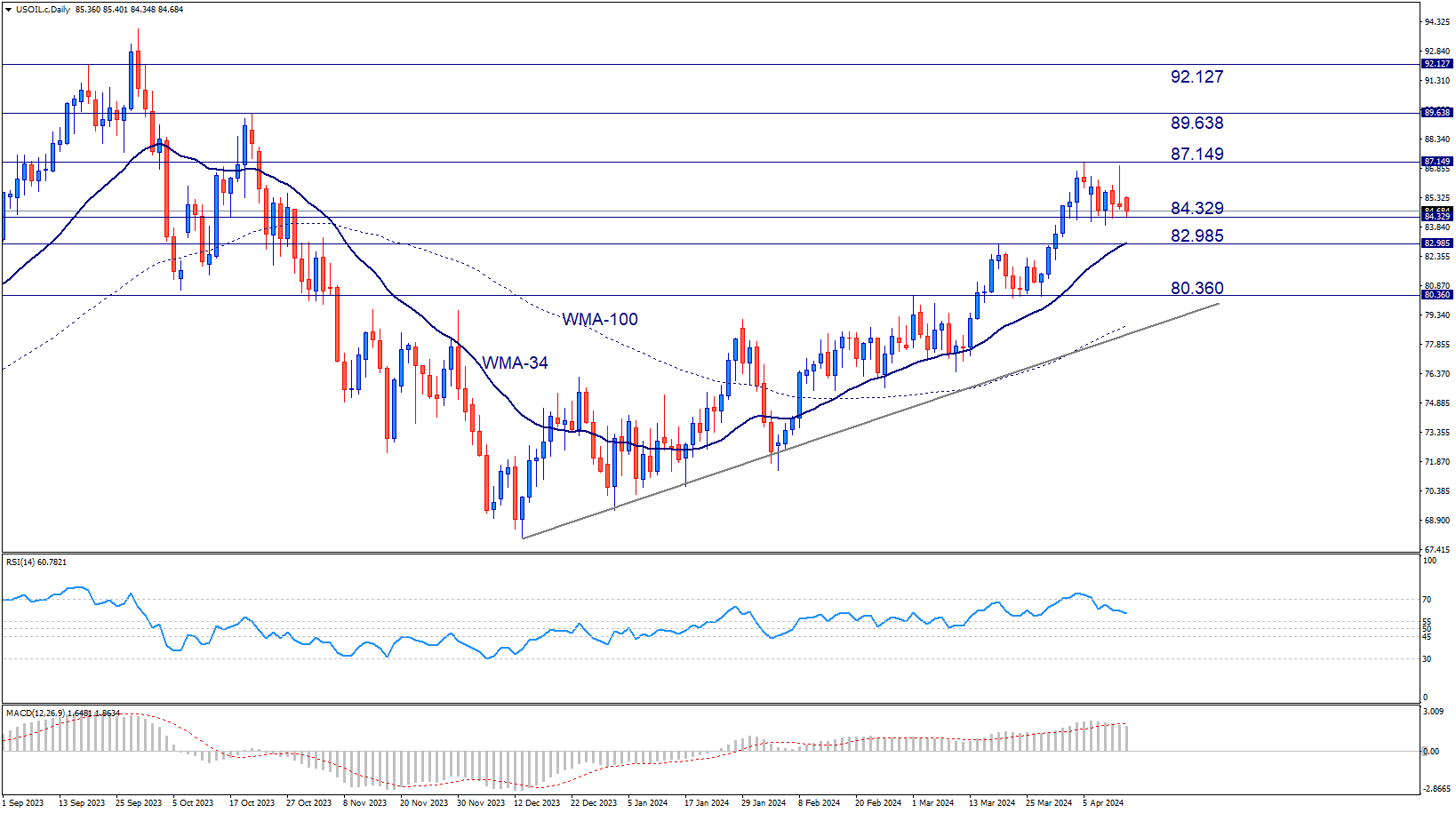
WTI crude oil has shown a consistent upward trend since mid-December, remaining above the 100-day and 34-day moving averages, signaling strong market bullishness. However, recent price movements suggest volatility and a crucial testing point ahead.
Current price trends and support levels
WTI has recently retracted from a peak of $87.149, approaching a critical support level at $84.329. A break below this level could push prices towards the 34-day moving average at $82.985, which may provide substantial resistance to further declines.
If the downward trend persists, the next significant support would be at the intersection of the 100-day moving average and an ascending trendline near $80.360. This area could attract substantial buying interest.
Potential for recovery
Conversely, increasing supply concerns might motivate buyers to defend the $84.329 level and push towards previous highs at $87.149. Surpassing this resistance could open the path to higher targets at $89.638 and $92.127.
Market sentiment and momentum indicators
Despite the prevailing bullish trend, short-term momentum indicators like the Relative Strength Index (RSI) and the Moving Average Convergence Divergence (MACD) suggest a cooling in buying pressure, indicating a possible near-term price correction.
Broader market influences and strategic outlook
The balance between supply and demand has kept WTI prices within a specific range, but new sanctions or an escalation in regional tensions could prompt a short-term rally. Additionally, economic indicators such as China's recovery and U.S. oil inventory reports could influence market dynamics.
In conclusion, while the daily chart suggests a fundamentally bullish stance for WTI crude, emerging technical resistances and signs of fatigue in momentum indicators advise traders to brace for potential volatility. The oil market's complexity requires continuous vigilance and adaptability to leverage trading opportunities effectively.
Author
Ali Mortazavi
Errante
BEc, CMSA, Member of IFTA - International Federation of Technical Analysis, Associate Member of STA - Society of Technical Analysis (UK).