Oil and Gold: Price review for the week ahead

This preview of weekly data examines USOIL and XAUUSD, with economic data expected later this week as the primary market drivers of the near-term outlook.
Highlights of the week: FOMC minutes, Canadian unemployment rate
Monday
- US Services PMI at 14:00 GMT for September. The consensus is for a slight increase of 0.3 points reaching 55.7. This could be bullish news for the dollar, as it would mean the services sector in the US is still expanding for more than two consecutive years.
Wednesday
- FOMC Minutes at 18:00 GMT where investors and traders will be paying close attention to any hints from the Federal Reserve in terms of future developments on the monetary policy. The weaker than expected NFP figure of last week has completely reversed the expectations of a rate cut in October’s meeting and now the most probable scenario is for a hold. Currently, the probability of a rate hold at the next meeting is more than 80%, according to the Fedwatch tool.
Thursday
- German Balance of trade at 06:00 AM GMT, where the expectations are for a decline reaching €119.2 billion in trade surplus. This may not have a significant impact on the Euro, as the data are for August and may already be factored into the price however if there is significant deviation from the expected number there might be some slight increase in volatility around publication time.
Friday
- Canadian unemployment rate at 12:30 GMT. The market is expecting a slight increase to around 0.1% for September. This might have a minor negative effect on the loonie if the expectations are confirmed.
USOIL, daily
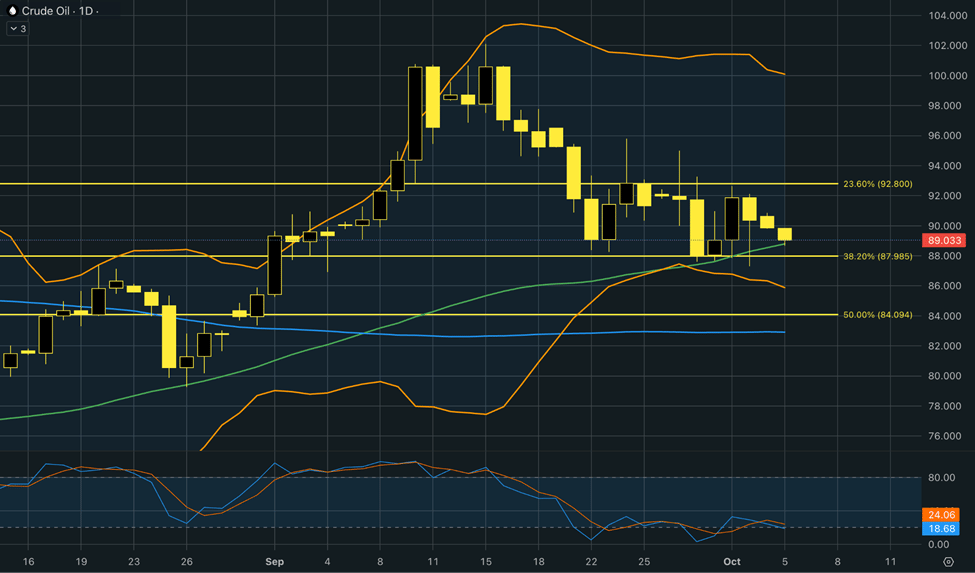
Oil prices fell as Saudi Arabia sharply cut its November crude prices for Asian buyers, signaling that supply flows are recovering. The price cut came despite renewed fighting in Yemen, where Saudi-backed forces are targeting the Iran-supported Houthis and risks to energy infrastructure and shipping remain elevated. Oil flows have been moving closer to pre-war levels, while G7 emergency stockpile releases are adding further supply to the market. OPEC+ also agreed to keep production quotas unchanged for November. However, continued attacks around the Strait of Hormuz and Bab el-Mandeb remain key upside risks, leaving prices vulnerable to renewed supply disruptions.
From a technical perspective, crude oil is showing short-term bearish pressure, with price falling back toward the 38.2% Fibonacci level at $88 after failing to break above the 23.6% resistance at $93. Price remains above the rising 50-day moving average, which currently sits around the $88 area, making this a key support zone. The Stochastic oscillator is also near oversold territory, suggesting downside momentum may be becoming stretched. A hold above $88 could trigger a rebound toward $93, while a decisive break below it would expose the 50% Fibonacci level at $84.
Gold-Dollar, daily
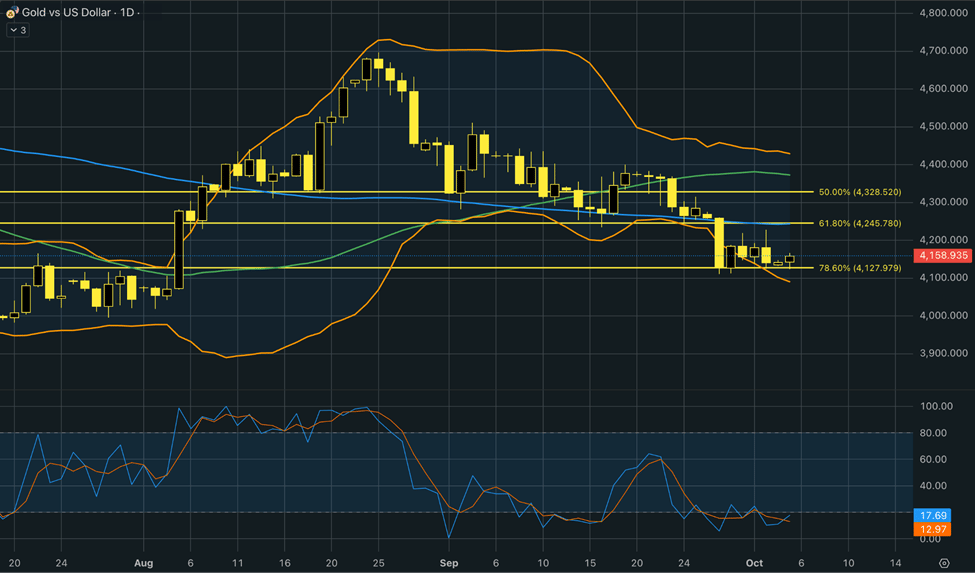
Gold held near $4,150 after its biggest weekly decline since June, as weaker US jobs data reduced expectations of another near-term Fed rate hike. September payrolls rose by just 29,000, pushing the market-implied probability of an October hike down to around 20%, from 70% a week earlier. However, elevated Treasury yields, persistent inflation, fiscal concerns, and a stronger US dollar continue to pressure gold. The market is now awaiting the Fed’s September meeting minutes for further clues on the future rate path.
From a technical point of view, gold remains under bearish short-term pressure, trading around $4,160 after breaking below the 61.8% Fibonacci level at $4,245. Price is now hovering just above the 78.6% Fibonacci support at $4,130, which is the key level to watch. The Stochastic oscillator is deeply oversold, suggesting downside momentum may be becoming stretched and leaving room for a technical rebound. However, the broader structure remains weak, with price below the moving averages and the midpoint of the Bollinger Bands. A sustained break below $4,130 could expose the $4,000 area, while a recovery above $4,245 would be the first sign of improving momentum, potentially targeting $4,300.
Author

Antreas Themistokleous
Exness
Antreas has been trading CFDs since 2018 using a combination of fundamental and technical analysis.