|

October CPI preview: Disinflation is getting harder
Summary

The October Consumer Price Index will likely show that progress in wringing out the last bit of inflation remains frustratingly slow. We look for headline CPI to have advanced 0.2% in October, which would bump up the 12-month change in consumer prices to 2.5%. Excluding food and energy, prices are likely to have increased 0.3% for a third consecutive month as another increase in goods prices coincides with glacial easing in services inflation.

Glacial slowing in services and firmer Goods prices bode poorly for overall inflation progress

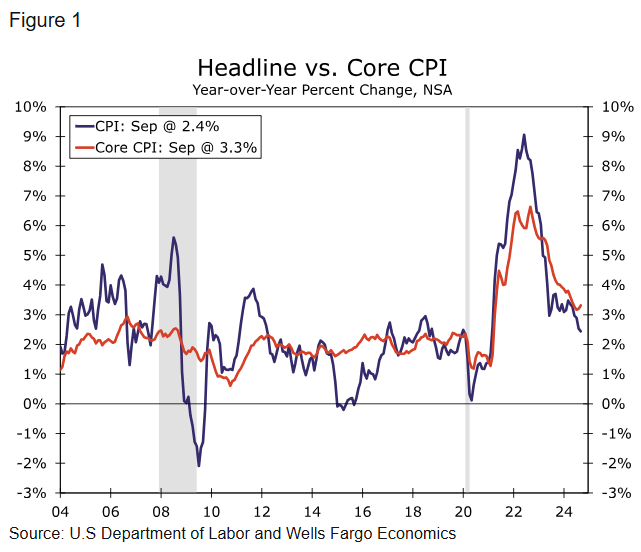
The October CPI report will likely support the notion that the last mile of inflation's journey back to target will be the hardest. We look for the Consumer Price Index to have advanced 0.2% (0.21% unrounded) in October, causing the year-over-year rate to edge back up to 2.5% from 2.4% last month (Figure 1). Excluding food and energy, a third consecutive 0.3% monthly increase is expected to keep the core index up 3.3% year-over-year—still about one percentage point higher than its pre-pandemic pace.
Chart

A more temperate gain in food prices likely helped to keep October's headline gain in check. After grocery prices leapt 0.4% in September, we expect a slower rise in October (0.1%). About one-third of September's increase in food at home could be traced to eggs, but wholesale prices have eased in recent weeks, pointing to some giveback from September's hot reading. Amid a trend-like 0.3% rise in food away from home, we estimate the 12-month change in overall food inflation edged back down to 2.2%. Further offering consumers some reprieve was the continued easing of gas prices last month. We estimate energy goods prices fell roughly 1.4% in October and 13% from this time last year. However, the downdraft to overall inflation from energy is waning, and the risks to energy costs, at least for the time being, lie to the upside given geopolitical tensions in the Middle East.

Download The Full Special Commentary

Author

More from Wells Fargo Research Team
Share:

Markets move fast. We move first.

Orange Juice Newsletter brings you expert driven insights - not headlines. Every day on your inbox.

By subscribing you agree to our Terms and conditions.

Editor's Picks

EUR/USD recovers to 1.1750 region as 2025 draws to a close

Following the bearish action seen in the European session on Wednesday, EUR/USD regains its traction and recovery to the 1.1750 region. Nevertheless, the pair's volatility remains low as trading conditions thin out on the last day of the year.

GBP/USD stays weak near 1.3450 on modest USD recovery

GBP/USD remains under modest beairsh pressure and fluctuates at around 1.3450 on Wednesday. The US Dollar finds fresh demand due to the end-of-the-year position adjustments, weighing on the pair amid the pre-New Year trading lull. 

Gold retreats to $4,300 area, looks to post monthly gains

Gold stays on the back foot on the last day of 2025 and trades near $4,300, possibly pressured by profit-taking and position adjustments. Nevertheless, XAU/USD remains on track to post gains for December and extend its winning streak into a fifth consecutive month.

Bitcoin, Ethereum and XRP prepare for a potential New Year rebound

Bitcoin, Ethereum, and Ripple are holding steady on Wednesday after recording minor gains on the previous day. Technically, Bitcoin could extend gains within a triangle pattern while Ethereum and Ripple face critical overhead resistance. 

Economic outlook 2026-2027 in advanced countries: Solidity test

After a year marked by global economic resilience and ending on a note of optimism, 2026 looks promising and could be a year of solid economic performance. In our baseline scenario, we expect most of the supportive factors at work in 2025 to continue to play a role in 2026.

Crypto market outlook for 2026

Year 2025 was volatile, as crypto often is.  Among positive catalysts were favourable regulatory changes in the U.S., rise of Digital Asset Treasuries (DAT), adoption of AI and tokenization of Real-World-Assets (RWA).














