EUR/USD: Waiting for Fed Minutes


EUR/USD stabilised at 1.1234 on Wednesday. Investors are awaiting the release of the minutes from the Federal Reserve’s latest meeting, hoping for fresh signals on the future path of monetary policy.
Comments from Fed officials also remain in focus. Following weaker-than-expected PCE inflation and labour market data, the Fed’s rhetoric has become less hawkish. Markets now put the probability of rates remaining unchanged in October at almost 80%.
Meanwhile, investors continue to monitor the bond market following the recent sell-off. Pressure on Treasuries is being compounded by concerns over persistent inflation, growing fiscal risks and significant debt issuance linked to funding AI projects.
Oil, meanwhile, is rising amid increased Iranian attacks on tankers in the Strait of Hormuz and clashes between Saudi and Houthi forces. This is adding to inflation risks and sustaining concerns that the Fed may maintain a hawkish policy stance for longer.
Technical analysis
On the H4 chart, EUR/USD remains in a steady downtrend. Earlier, the pair staged a corrective recovery to 1.1275, after which a new downward move developed, taking the price back to the 1.1244 area. The price remains below the descending resistance line, keeping the bearish scenario intact. Local consolidation is currently forming below 1.1244. The nearest downside target is 1.1210. A close below this level would open the way for a further decline towards 1.1173 and, within the broader structure, towards 1.1129. The MACD indicator remains in negative territory: the histogram is below zero despite the local weakening of downward momentum.
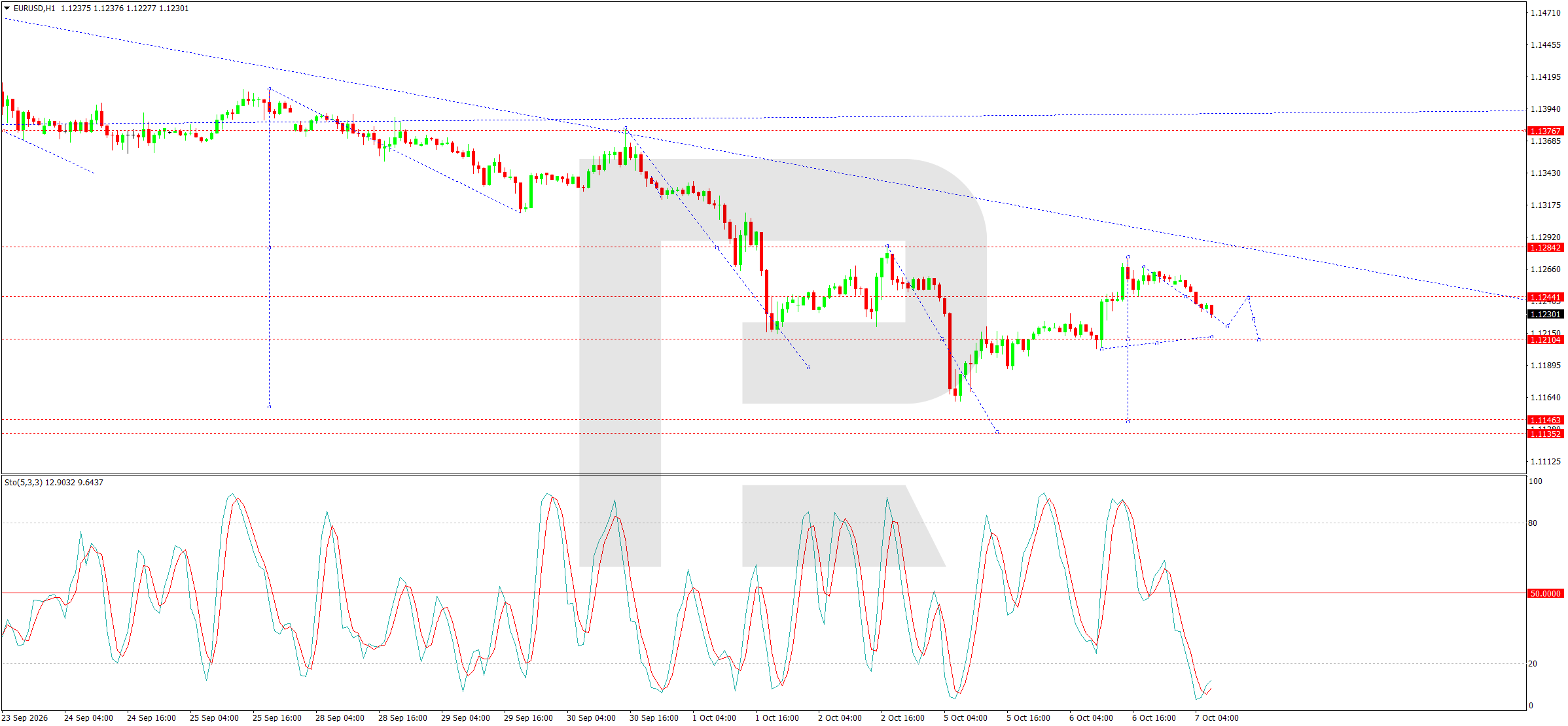
On the H1 chart, the corrective move ended around 1.1275, where buyers could not push the price above local resistance. The subsequent decline took the pair back to 1.1230, confirming continued selling pressure. The Stochastic oscillator is in the oversold zone below 20, so a short-term correction is possible before the decline resumes. As long as the price remains below 1.1244–1.1275, the main scenario today is a move towards 1.1210. A break below this support would strengthen downward momentum and open the way towards 1.1173. A return above 1.1275 would temporarily invalidate this short-term scenario. Selling remains the priority while the price holds below the descending resistance line.
Conclusion
EUR/USD is holding steady as markets await the Fed’s meeting minutes for further policy clues. Recent weak PCE inflation and labour market data have softened the Fed’s tone, with the probability of rates remaining unchanged in October now at nearly 80%. However, persistent inflation concerns, fiscal risks and heavy debt issuance tied to AI funding continue to pressure Treasuries, while rising oil prices amid Middle East tensions add to inflation risks. Technically, the pair remains bearish below 1.1244–1.1275, with the next downside targets at 1.1210, 1.1173 and potentially 1.1129. A short-term correction is possible given oversold conditions, but the broader trend remains downward as long as the price holds below the descending resistance line.
Author
RoboForex Analysis Department
RoboForex
RoboForex Analysis Department provides timely market insights, expert technical analysis, and actionable forecasts across forex, commodities, indices, and equities.