Nonfarm Payrolls Preview: It is all about the money, three scenarios for wage growth and the dollar
- Any higher-than-expected wages increase would boost the dollar, in this high-probability scenario.
- Slower salary gains would send the greenback down.
- An as-expected outcome would create an opportunity to go against the trend.

"It's all 'bout the money, it's all 'bout the dum dum da da dum dum" – the 1990s song by Meja is humming in my mind as I await the Nonfarm Payrolls report for May. How high were Americans' pay raises last month? That is a critical question for investors.
Fed focus
The Federal Reserve is laser-focused on depressing rising inflation, prioritizing the price stability side of its mandate over employment – the opposite of what it stated in its grand policy review in 2020. The focus has changed as price rises have grabbed the psyche of the world's largest economy in mid-2021 and the problem has only exacerbated since then.
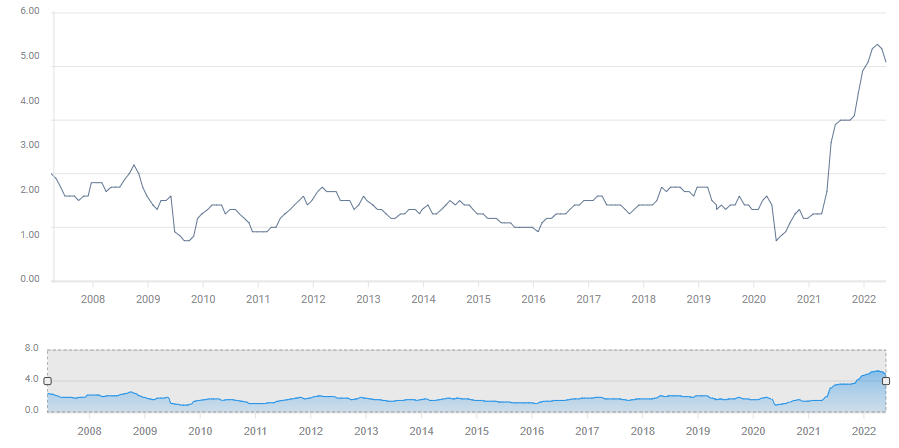
Not only has the price at the pump pushed higher, but also the costs of a broad basket of goods. The Core Personal Consumption Expenditure (Core PCE) is the Fed's preferred gauge of inflation, and it stands at 4.9% as of April – more than double the bank's 2% target.
Core PCE is off the highs, but it is too early to say it has peaked:
Source: FXStreet
While energy and food prices are influenced by global markets, broad inflation is fueled by demand from American workers. A low unemployment rate of 3.6% is set to make way to an even lower level of 3.5%. After an increase of 420,000 jobs in April, May's report is set to show a somewhat lower advance of 325,000 according to the economic calendar.
Money matters
However, even if these two figures stray away from forecasts – even significantly – what matters more is how much money these workers earn. If labor shortages continue and force employers to raise salaries, the extra cash will go to spend, fueling inflation. In turn, the Fed will have to raise rates at a faster pace, trying harder to cool the economy. Higher borrowing costs make the dollar more attractive.
If some moderation is seen in wages, that would imply softer price pressures and an economy that is already moderating and does require intervention from the central bank to cool off. Talking heads on financial media would say that inflation has peaked, which would result in a sell-off of the dollar.
As with the recent Consumer Price Index (CPI) release, base effects from last year make the yearly figures less significant than usual, putting the focus on the monthly figure.
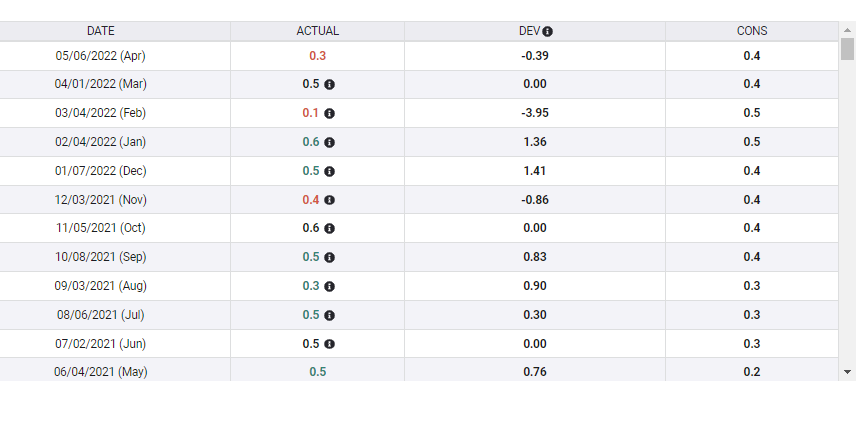
Economists forecast Average Hourly Earnings MoM to have risen by 0.4% in May, in the middle between 0.3% recorded in April and 0.5% in March. Any minor deviation from 0.4% is set to make a substantial difference to the dollar.
Average Hourly Earnings MoM
Source: FXStreet
Three scenarios
1) Above expectations: A rise of 0.5% or more in monthly salaries would undoubtedly boost the dollar. It would show that employers are willing to cough up higher pay to attract workers, and perhaps even that they could pass these higher costs to consumers. That means more inflation in the pipeline.
In my opinion, this scenario has the highest probability. Wage growth has tended to alternate between beating estimates and missing them. After last month's disappointment, we could see an upswing now. Moreover, most recent economic indicators such as the ISM Manufacturing PMI, have pointed to an economy that is on fire.
2) Below expectations: Wage growth of 0.3% or lower would send the greenback lower. It would imply that faint signs of peak inflation were, perhaps, more significant. It would allow the Fed to stick to its plan of raising rates by 50 bps in June and July – but moderating its moves afterward.
I think that this scenario has a medium probability, as it is backed by some signs of weakness in the housing sector, that may imply worries about spiraling costs.
3) Within expectations: Meeting economists' forecasts has not been common in this indicator for some time, so there is a low chance it would happen this time. However, in this scenario, we could see other factors come into play, such as monthly revisions for April and March, the yearly number and the headline NFP.
I think that this would be a scenario in which the dollar jumps to one direction in the initial, knee-jerk reaction, and then later corrects – an opportunity to go contrarian.
Final thoughts
Nonfarm Payrolls remain significant despite the focus on inflation – it just means that this pivot puts the spotlight on wage data rather than the headline change in jobs.
Author

Yohay Elam
FXStreet
Yohay is in Forex since 2008 when he founded Forex Crunch, a blog crafted in his free time that turned into a fully-fledged currency website later sold to Finixio.

















