Nonfarm Payrolls Preview: Dollar selling opportunity? Low expectations to trigger temporary bounce
- Investors expect a gain of 200,000 workers in November, down from 261,000 in October.
- Weak ADP data have lowered real estimates even further.
- Massive Dollar selling in response to the Fed's dovish message may need a correction.
- A satisfactory NFP may trigger a bounce in the Dollar, only temporarily, given the broader trend.

A flashback to 2019 just before 2022 ends? The last Nonfarm Payrolls release is set to show a pre-pandemic level of job gains, around 200,000. Or maybe lower. However, I expect another positive surprise – triggering a temporary Dollar bounce.
‘Real’ expectations are lower after Wednesday when ADP reported a disappointing increase of only 127,000 private-sector positions. America's largest payrolls provider's data turned out to be accurate for October, and its data impacts expectations. The "whisper number" is probably around 150,000.
Further, there is the downbeat employment component in the ISM Manufacturing PMI to consider – it dropped further within contraction territory, to 48.4 points.
Nevertheless, it’s worth considering that the NFP usually beats expectations. The figure has had a winning streak against economists' expectations – seven in a row, and eight out of ten times this year, figures beat estimates.
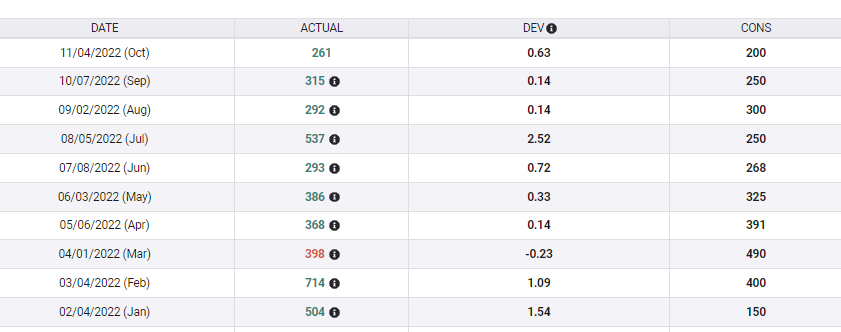
Source: FXStreet
Yet, even if the outcome falls short of 200,000 or 150,000, I argue that the outcome would be temporarily positive for the Dollar.
Why positive? The Greenback has been tumbling in recent days, due mostly to dovish comments by Chairman of the Federal Reserve Jerome Powell. He said that the Fed does not want to crash the economy nor overtighten monetary policy. While that justifies a weaker Greenback, the move may have gone too far.
To me, that implies the beckoning of an upside correction in the Dollar – assuming the NFP is not too low. I only see a read of under 100,000 as being adverse for the Dollar
Why temporary? The broad trend in the world's reserve currency is to the downside, on the notion that inflation has already peaked – and the Fed acknowledges this development.
Scenarios
My baseline scenario is for the NFP to be somewhere between 150,000 and 200,000, above real expectations, thus triggering a short-lived upward move in the Dollar. From there, it could turn down and resume its decline. Even a read of 250,000 would likely trigger such a two-sided move. This outcome has a high probability.
An alternative scenario is an increase of fewer than 100,000 positions, resulting in an outright decline of the Dollar. It has a medium probability.
I see sustained Dollar strength only if the NFP smashes estimates with over 300,000 positions, a figure which would undermine the Fed's dovish stance. This outcome has a low probability.
What happens if the US reports job losses? Seeing a negative sign on the NFP would be alarming, and could trigger worries about global growth, thus resulting in the Dollar receiving safe-haven flows. I see this outcome as having a low probability.
Final thoughts
Markets are seeing the glass half full – optimism that weighs on the Dollar. Nevertheless, the NFP could trigger a temporary correction before the next move down. The Saturday after the NFP is the last day Fed officials can publically comment before their pre-decision "blackout period." That will likely result in more volatility.
Author

Yohay Elam
FXStreet
Yohay is in Forex since 2008 when he founded Forex Crunch, a blog crafted in his free time that turned into a fully-fledged currency website later sold to Finixio.
















