Nonfarm Payrolls preview: A timely test on the impact of tariffs


The financial markets are jittery as we lead up to this payrolls report. Phone calls between President Trump and President Xi are moving markets, and a public feud between Elon Musk and the President has left the former with a $39bn reduction in his net worth, and the latter with more questions about his conduct in office and professionalism at the White House. There are signs that Musk is open to a cooling off period with the President, and reports suggest that China and the US are willing to commit to more trade talks, which could help risk sentiment as we lead up to this payrolls report.
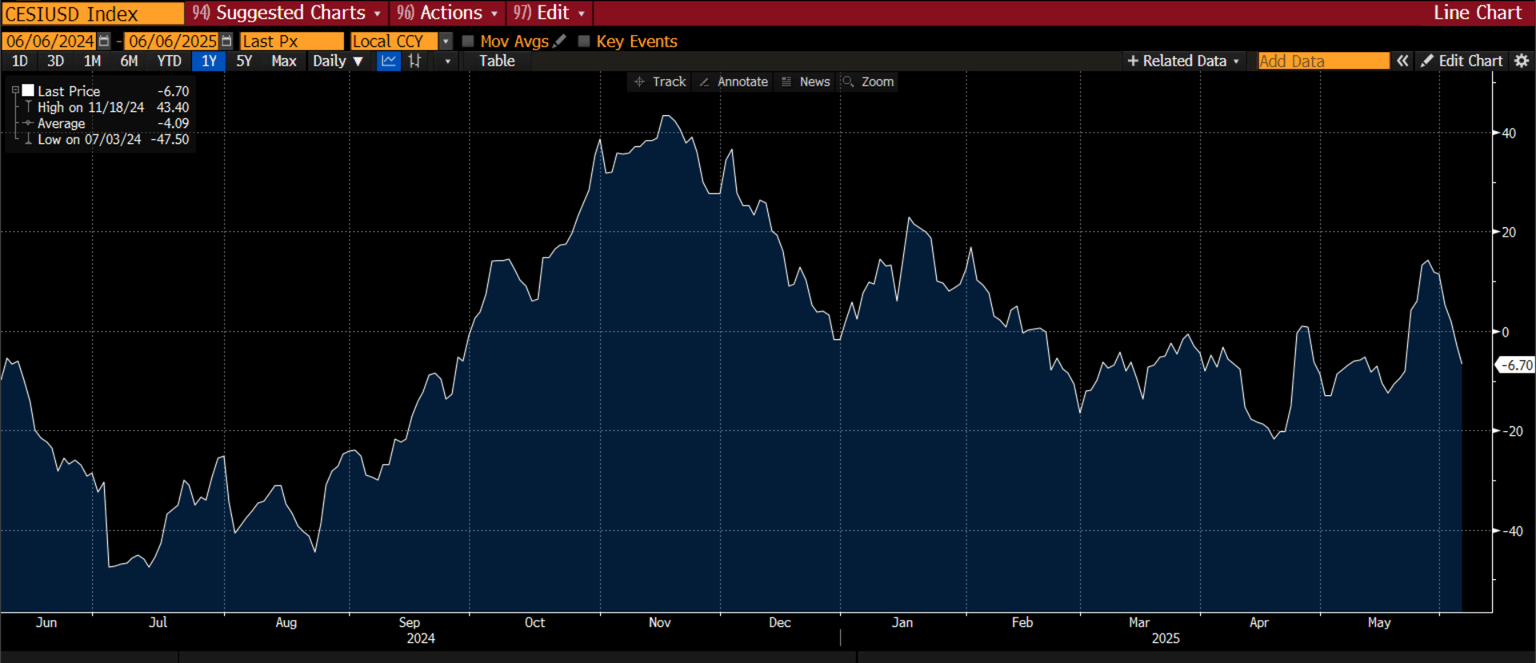
Growth fears have been on investors’ minds in recent months, after a spate of weaker than expected economic data. This has led to a sharp decline in the Citi economic surprise index, as you can see below. There are signs that a slowdown in the economy is starting to impact the labour market. The employment component of the ISM manufacturing survey is deep in contraction territory. Private sector payrolls expanded at their lowest level since March 2023, and initial jobless claims are also at an 8-month high.
Chart 1: Citi US economic surprise index
Source: XTB and Bloomberg
Analysts are expecting non-farm payrolls to increase by 126k for last month, down from 177k in April. The unemployment rate is expected to remain steady at 4.2%, and wage growth is expected to moderate a notch and expand at a 3.7% annual rate. There is a wide variation in expectations for NFPs, the highest economist estimate recorded by Bloomberg is 190k, the lowest is 75k. This reflects how hard it is to predict the outcome for the US economy in an uncertain economic environment.
The US economy needs to create approximately 200k jobs per month for the unemployment rate to remain stable, likewise, initial jobless claims need to stay below 260k-270k per week for the unemployment rate not to rise. The question is, will job growth slow to such an extent that the unemployment rate rises? The consensus is no, not yet. It is worth considering the economic backdrop, to determine if a downside surprise in the labour market data could materialise on Friday. Consumer sentiment has picked up in recent weeks, although it remains at low levels, business confidence has also picked up from the lows, and the layoff rate, as calculated by the Jolts survey, remains stable.
Thus, while we expect a soft May payrolls report, we do not think that it will show the labour market falling off a cliff. The de-escalation in the US/ China trade war may have helped sentiment. There remains a huge amount of uncertainty caused by the US trade tariffs, and if the US economy can generate decent jobs growth in this environment it would suggest an underlying resilience, which could boost stock markets, the dollar and overall risk sentiment.
Anything under 100k for May payrolls would be considered weak, and it may also be a sign of worse to come. Thus, Friday’s report is all about the trajectory of the US labour market and what this means for the Federal Reserve.
When will the Fed cut rates?
The Fed has a dual mandate; one is to maintain full employment. While one month of weak labour market data may not force the Fed into cutting rates, two or three consecutive months of weak jobs growth could force the Fed into cutting interest rates.
There has been a recalibration in interest rate expectations for the Fed this week. The market is now fully pricing in 2 rate cuts for this year, as the economic data starts to show signs of deterioration, and interest rates are expected to end the year at approx. 3.8%.
The market view
Fears about the US economy is playing out in the FX market. The US dollar is limping into this payrolls report; although it is higher on Friday, the dollar is still one of the weakest currencies in the G10 FX space so far this week along with the yen and the Swissie. The dollar index is looking particularly vulnerable, in part because the ECB sounded unconcerned about euro strength. The DXY is fast approaching the 98.00 low from mid-April, a move below here could signal another 2-3% leg lower for the broad-based dollar index.
Although the dollar has weakened while US Treasury yields have been rising this year, the recent pull back in yields has not offered any respite to the beleaguered dollar. Unless we get a large upside shock in the labour market report on Friday, we do not see a dollar recovery materialising from here.
US stocks have been on a roller coaster ride. The Trump/ Musk feud triggered a 14% drop in the Tesla share price late on Thursday. Tesla has been leading the Magnificent 7 higher in recent weeks, and the tech sector has also been a key driver of the S&P 500 during its recent recovery since mid-April. There were fears that an escalation in the feud could weigh on the entire US stock market on Friday, however, Elon Musk has already signalled that he is open to a cooling off period with Trump, and stock market futures are higher on Friday morning. Thus, the risk could be more localised with Tesla shares in the short term. The dollar index is also rising as we wait for the payrolls report, however, we think that the longer-term trend remains lower.
Author
Kathleen Brooks
XTB UK
Kathleen has nearly 15 years’ experience working with some of the leading retail trading and investment companies in the City of London.

















