|

New Zealand Dollar under pressure as services data disappoints

The New Zealand dollar is lower on Monday. In the European session, NZD/USD is trading at 0.6082, down 0.44%.

Services PMI contracts for seventh straight month

New Zealand’s economy has been struggling, and a key factor has been the contraction in the services sector. The services PMI remained steady in September at 45.7 following an upward revision in August. The PMI has now been stuck in contraction for seven straight months, with readings below the neutral 50 level.

The Reserve Bank of New Zealand chopped interest rates by 50 basis points last week, as the weak economy is in danger of tipping into a recession due to elevated rates. The RBNZ has been hawkish and even warned at recent meetings about possibly raising rates, but pivoted sharply in delivering an oversized cut.

The RBNZ had projected that it would not start lowering rates until mid-2025 but the weak economy and falling inflation were the drivers behind the rate cut. New Zealand releases third-quarter inflation on Tuesday with a market estimate of 2.3% y/y, compared to 3.3% in the second quarter.

Lower inflation is welcome news for the RBNZ, but weak inflation in China is not. In September, inflation dropped to 0.4% y/y, down from 0.6% in August and below the market estimate of 0.6%. Monthly, inflation eased to 0.0%, down from 0.4% and below the market estimate of 0.4%. Core CPI rose only 0.1%, its lowest level since February 2021.

China has a deflation problem, which could result in weaker economic growth and higher unemployment. That would dampen consumer demand and New Zealand would feel the pinch, as China is New Zealand’s largest export market.

NZD/USD technical

  • NZD/USD has support at 0.6051 and 0.5991.

  • There is resistance at 0.6112 and 0.6172.
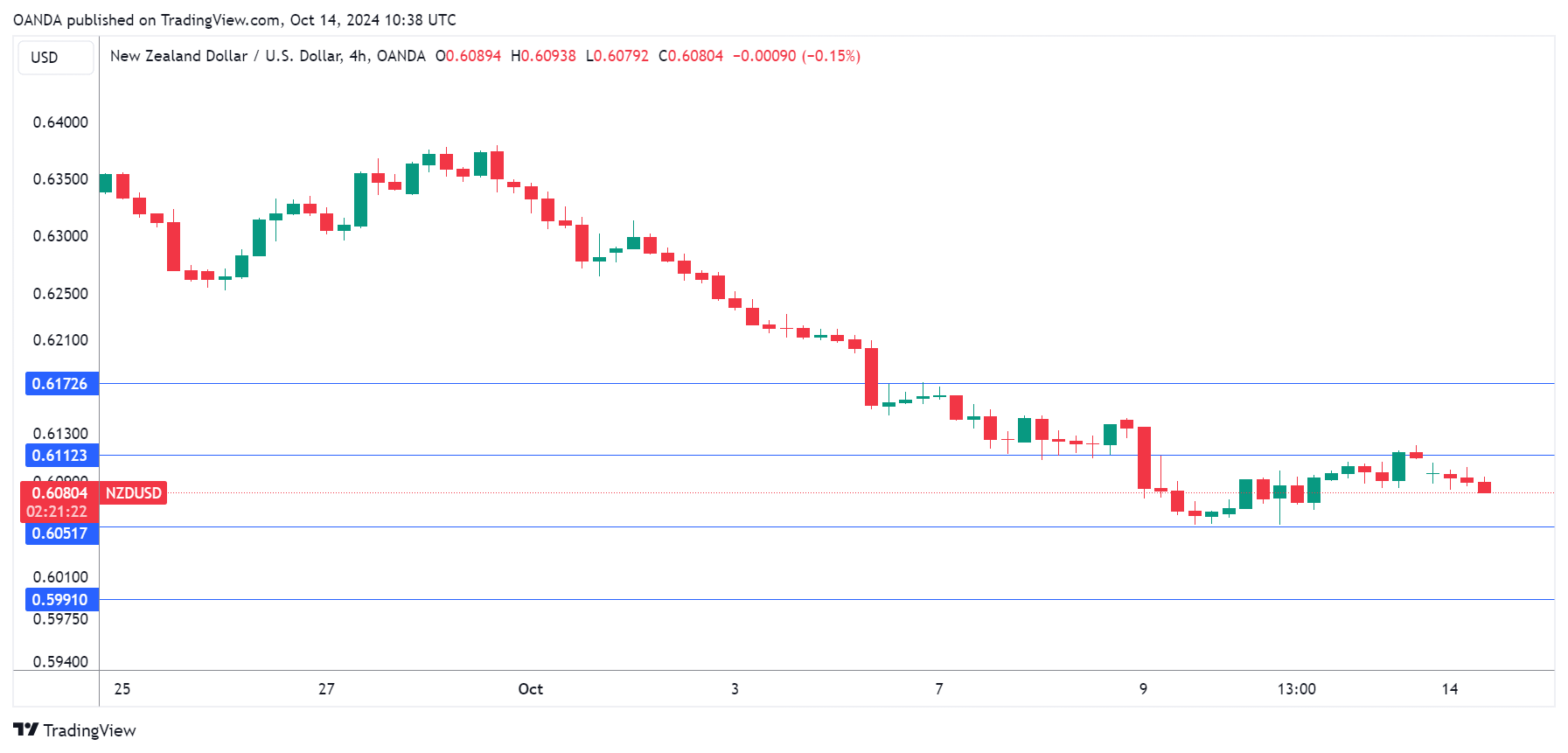
Chart

Author

Kenny Fisher

Kenny Fisher

MarketPulse

A highly experienced financial market analyst with a focus on fundamental analysis, Kenneth Fisher’s daily commentary covers a broad range of markets including forex, equities and commodities.


More from Kenny Fisher
Share:

Editor's Picks

AUD/USD sits at two-month lows near 0.6950 after Australian CPI data

AUD/USD is sitting at two-month lows near 0.6950 in the Asian session on Wednesday, as below-expectations August Australian underlying CPI data pours cold water on expectations for further RBA interest rate hikes. Chinese PMI data also fail to inspire the Australian Dollar, despite a pause in the US Dollar advance.

USD/JPY stays weak below 157.00 amid Japanese intervention risks

USD/JPY keeps losses below 157.00 in the Asian session on Wednesday, as hawkish BoJ expectations, along with intervention risks, underpin the Japanese Yen, countering dismal domestic factory output and retail sales data. Meanwhile, a broad US Dollar retreat also collaborates to the pair's downside.

Gold returns below $4,200 after a short-lived recovery

Gold tested $4,220 early in the American session after softer-than-expected US inflation figures. Encouraging US data weighed on the odds of a Federal Reserve rate hike in October, as employment and growth data beat expectations. Still, the precious metal was unable to retain its momentum and trades flat around $4,180

Crypto Today: Bitcoin holds $83K as Ethereum remains below $2,700 and XRP consolidates

Bitcoin trades lethargically on Wednesday, with bulls battling to defend the immediate $83,000 level as immediate support. Ethereum trades in tandem with Bitcoin, holding below key levels of $2,700 on the upside and $2,600 on the downside. Ripple, meanwhile, hovers near $1.50,

The Euro is near a one-year low: Inflation could trigger its rebound, not its fall

EUR/USD has fallen to its lowest level since May 2025, but a fresh inflation shock in the Eurozone could give the Euro an unexpected lifeline. The pair hit 1.1312 on Wednesday and trades well below the January peak of 1.2082. The decline reflects a powerful combination of US Dollar strength, geopolitical uncertainty and renewed concerns about Europe's exposure to higher energy prices.

The Euro is near a one-year low: Inflation could trigger its rebound, not its fall

EUR/USD has fallen to its lowest level since May 2025, but a fresh inflation shock in the Eurozone could give the Euro (EUR) an unexpected lifeline. The pair hit 1.1312 on Wednesday and trades well below the January peak of 1.2082.














