|

New Zealand Dollar surges on strong employment data

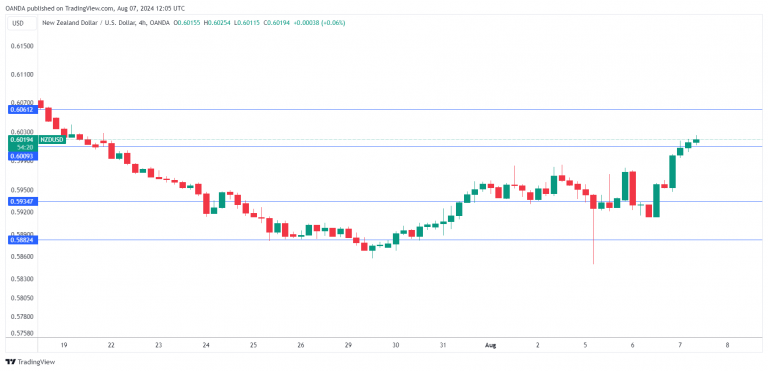
The New Zealand dollar has soared today. In the European session, NZD/USD is trading at 0.6018, up an impressive 1.1% at the time of writing.

New Zealand job growth surprises on the upside

New Zealand’s labour market has been cooling off due to elevated interest rates and the markets were braced for a soft jobs report for the second quarter. Instead, job growth rebounded and unemployment was lower than expected, sending the New Zealand dollar sharply higher.

Job growth expanded by 0.4% in the second quarter, up from -0.2% in Q1 and above the market estimate of -0.2%. The unemployment rate rose from 4.4% to 4.6%, a notch under the market estimate of 4.7%. This is the highest level since Q1 of 2021 but investors were pleased that it was lower than expected.

The positive employment report has reduced market expectations of a rate cut from the Reserve Bank of New Zealand, which has driven the New Zealand dollar sharply higher today. Inflation has fallen to 3.3%, its lowest level in three years and close to the upper level of the central bank’s target range between 1% and 3%. A weak employment report could have cemented a rate cut at next week’s meeting but the job data was better than expected, which will complicate the rate decision.

The final tier-1 release before the August 14 meeting is Inflation Expectations on Thursday. This indicator is closely followed by the central bank and will be a factor in the rate decision. Inflation Expectations has been on a steady downtrend and is expected to ease to 2.33% in the second quarter, compared to 2.5% in the first quarter.

NZD/USD technical

  • NZD/USD is testing resistance at 0.6009. Above, there is resistance at 0.6061.

  • There is support at 0.5934 and 0.5882.
Author

Kenny Fisher

Kenny Fisher

MarketPulse

A highly experienced financial market analyst with a focus on fundamental analysis, Kenneth Fisher’s daily commentary covers a broad range of markets including forex, equities and commodities.


More from Kenny Fisher
Share:

Markets move fast. We move first.

Orange Juice Newsletter brings you expert driven insights - not headlines. Every day on your inbox.

By subscribing you agree to our Terms and conditions.

Editor's Picks

EUR/USD retreats toward 1.1700 on modest USD recovery

EUR/USD stays under mild bearish pressure and trades below 1.1750 on Friday. Although trading conditions remain thin following the New Year holiday and ahead of the weekend, the modest recovery seen in the US Dollar causes the pair to edge lower. The economic calendar will not feature any high-impact data releases.

GBP/USD struggles to gain traction, stabilizes near 1.3450

After testing 1.3400 on the last day of 2025, GBP/USD managed to stage a rebound. Nevertheless, the pair finds it difficult to gather momentum and trades marginally lower on the day at around 1.3450 as market participants remain in holiday mood.

Gold climbs toward $4,400 following deep correction

Gold advances toward $4,400 and gains more than 1.5% on the day after suffering heavy losses amid profit-taking heading into the end of the year. Growing expectations for a dovish Fed policy and persistent geopolitical risks seem to be helping XAU/USD stretch higher.

Cardano gains early New Year momentum, bulls target falling wedge breakout

Cardano kicks off the New Year on a positive note and is extending gains, trading above $0.36 at the time of writing on Friday. Improving on-chain and derivatives data point to growing bullish interest, while the technical outlook keeps an upside breakout in focus.

Economic outlook 2026-2027 in advanced countries: Solidity test

After a year marked by global economic resilience and ending on a note of optimism, 2026 looks promising and could be a year of solid economic performance. In our baseline scenario, we expect most of the supportive factors at work in 2025 to continue to play a role in 2026.

Crypto market outlook for 2026

Year 2025 was volatile, as crypto often is.  Among positive catalysts were favourable regulatory changes in the U.S., rise of Digital Asset Treasuries (DAT), adoption of AI and tokenization of Real-World-Assets (RWA).