|

Narrow import surge behind July widening in US trade balance

Summary

The large widening in the trade balance can mostly be traced to just two import categories: nonmonetary gold and computers. While this may again partially reflect businesses pulling forward demand ahead of hiked tariff rates, it also reflects monthly volatility as well as a budding transition to a high-tech future. Trade flows remain a far cry from normal, and will remain in flux until trade policy finds a bottom.

There's Gold in them thar imports

Another pop in imports caused the U.S. international trade balance to widen to $78.3 billion in July (chart). The $18.4 billion gain in goods imports was due to a renewed jump in industrial supplies, which rose 26% after five-consecutive monthly declines following an initial pull-forward at the start of the year.
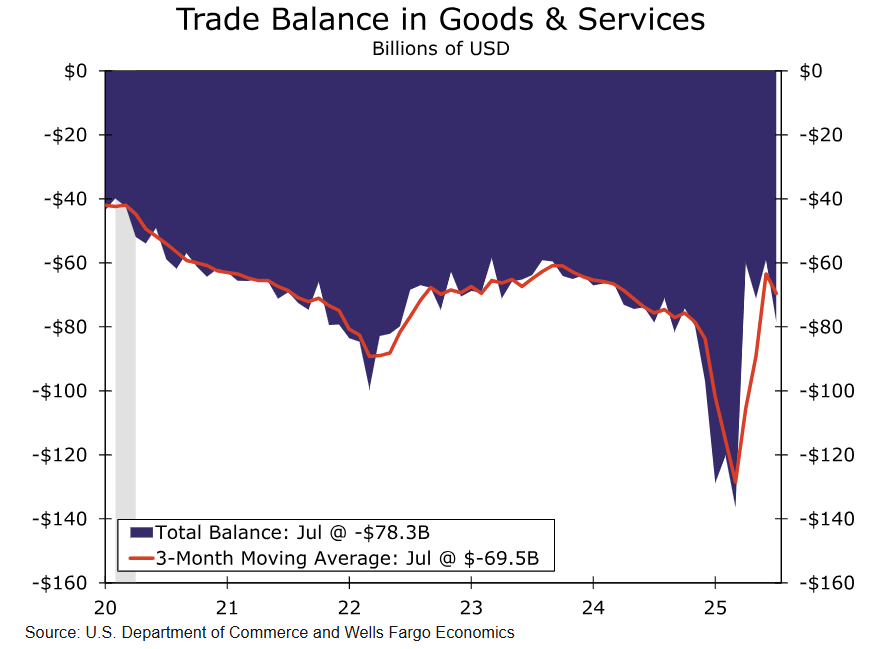
It is tempting to look at this development and conclude that the businesses are returning to some semblance of normal after tariff disruptions earlier this year. That explanation is made all the more compelling when seeing an import surge alongside the sharp rebound in durable goods orders in July. Yet when we look at the details of what is really driving trade it becomes obvious that things are anything but normal.

We have been on the record that the import trade over the past year is best understood when viewed through the lens of high-tech imports. Consider the nearby chart that plots the annual change in goods imports for a just five high-tech items (blue line) vs. literally all other capital goods (red line). When it comes to imports, it is tech's world.
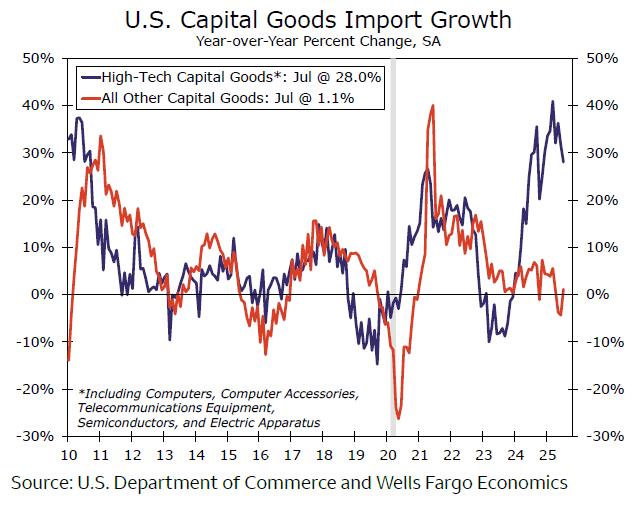
While the trend still favors a massive import surge in tech-related components, July's import surge was also driven by one other category that technically is considered an industrial supply, but might be considered in a different light in the context of rising uncertainty: non-monetary gold. Of the overall $18.4 billion increase in goods imports, $9.5 billion was increased imports of gold. Combine gold with imports of computers (+$1.5B) and you have accounted for about 60% off the import surge with just two import categories. This is not in any way a return to normal for trade.

Download The Full Economic Indicator

Author

More from Wells Fargo Research Team
Share:

Editor's Picks

EUR/USD stays well offered below 1.1800

The selling pressure on EUR/USD is picking up pace, with the pair slipping decisively below the key 1.1800 level and sliding to fresh two week lows as Wednesday’s session draws to a close. The move lower comes as the US Dollar finds renewed strength after the latest round of US data and the release of the FOMC Minutes. Next of note on the docket will be the US weekly Initial Jobless Claims.
 

GBP/USD reaches multi-day lows near 1.3500

GBP/USD reverses its initial upside momentum and is now adding to previous declines, approaching the 1.3500 region on Wednesday. Cable’s downtick comes on the back of decent gains in the Greenback and easing UK inflation figures, which seem to have reinforced the case for a BoE rate cut in March.

Gold battle to regain $5,000 continues

Gold is back on the front foot on Wednesday, shaking off part of the early week softness and challenging two-day highs near the $5,000 mark per troy ounce. The move comes ahead of the FOMC Minutes and is unfolding despite an intense rebound in the US Dollar.

Australia unemployment rate set to edge up within overall strong labor market

The Australian monthly employment report is scheduled for release on Thursday at 00:30 GMT, and market participants anticipate a modest increase in jobs in January. The Australian Bureau of Statistics is expected to announce that the country added 20K new jobs in the month, while the Unemployment Rate is forecast at 4.2%, up from the 4.1% posted in December.

Mixed UK inflation data no gamechanger for the Bank of England

Food inflation plunged in January, but service sector price pressure is proving stickier. We continue to expect Bank of England rate cuts in March and June. The latest UK inflation read is a mixed bag for the Bank of England, but we doubt it drastically changes the odds of a March rate cut.

Sui extends sideways action ahead of Grayscale’s GSUI ETF launch

Sui is extending its downtrend for the second consecutive day, trading at 0.95 at the time of writing on Wednesday. The Layer-1 token is down over 16% in February and approximately 34% from the start of the year, aligning with the overall bearish sentiment across the crypto market.