Markets lose faith with Donald Trump as we approach Easter week
- Markets immune to Donald Trump speak.
- UK government to blame for surging UK yields.
- Investors face mounting losses on portfolios as war grinds down risk assets.
- 3 reasons why tech stock are coming under pressure.
- Big tech’s big tobacco moment weighs on Mag 7.
- Markets lose faith with Donald Trump as we approach Easter.

As we move to the end of the fourth week of this war, markets are once again nervous about the potential for oil to remain elevated for the long term. Brent crude is above $110 a barrel on Friday, which is still a 1% drop on the week, but the rise in the oil price in the last two days is a sign that the market is not buying hopes for a quick resolution to this conflict.
Markets immune to Donald Trump speak
It is worth noting that once the oil price reaches $100 a barrel, historically it remains sticky above triple figures for a prolonged period, for example back in 2022. After falling to as low as $96 per barrel earlier this week on comments from President Trump that the war could soon be over, oil traders are now discounting the daily torrent of posts and incoherent press conferences from the White House, as the war rages on. On Friday, investors are facing the facts: the Strait of Hormuz is effectively closed and it does not appear that there is a real end in sight to the war.
Not even news that Trump would avoid striking Iranian energy targets for a further 10 days helped to calm markets. Effectively, this is just another 10 days where nothing will be achieved and 20% of the world’s oil supply will remain constrained. This is why traders have failed to react to this ‘positive news’ and instead the sell-off continues.
UK government to blame for surging UK yields
This is the last full trading week for two weeks due to Easter, so today’s selloff gives you some idea of investors’ mindsets. They don’t want to hold risk going into the holidays. Although European stocks are currently posting a slim gain for this week in dollar terms and are outpacing their US counterparts, the Eurostoxx index is still down just under 1% today. Bonds are also selling off and yields are up sharply. UK 10- year Gilts are higher by 11bps and are leading the sell off. So far this week, UK yields are higher by another 17bps, since the onset of this crisis, UK 2-year yields are higher by 110bps.
This is an astonishing move, and the government is partly to blame. It is unwilling to cut fuel duty or VAT on fuel in this environment. Instead it is blaming price gouging by petrol forecourt owners. There is absolutely no evidence of this, and the RAC has reported that forecourt owners only make a slim 6% profit margin on a liter of fuel. It is the government’s coffers who line their pockets during an energy price shock. Businesses are now calling this out, and we shall see if this causes the government to act to cut fuel taxes. If they do this, it would immediately lower inflation expectations and bring down bond yields. Until then, higher yields are here to stay for the UK, with implications for a weaker sterling and lower equity prices as domestically-focused firms like Next, M&S and the FTSE 250, which is underperforming the FTSE 100 this week and is lower by 12% on a currency adjusted basis since the onset of this crisis, get sold off on the prospect of rising borrowing costs later this year.
Investors face mounting losses on portfolios as war grinds down risk assets
As we end the week, we are faced with mounting losses on portfolios. The gold price is lower by 1.6%, the Nasdaq is down by 3% and the S&P 500 is lower by nearly 2%. There is no clear trigger that could boost sentiment as we move to end of the week. In the UK, weak retail sales from before the onset of the crisis are adding to stagflation fears.
The peace trade seems like a long way off, and it is no wonder that investors are paring back risk today: this weekend could see events in the Middle East get much worse, or better, no one knows which.
The tech sector in the US is walking to the beat of its own drum, and although it has experienced a steep selloff this week and is experiencing a deeper decline than the broader S&P 500, it has been the most resilient of the main US indices since the onset of this war. There are some themes that are not related to the conflict which are driving US tech stocks:
Three reasons why tech stock are coming under pressure
1. Memory makers are in decline after Google released an update that means AI tools can run with less memory requirements, this is hurting the S&P 500’s best performing stock this year, memory chip maker Sandisk. However, this is giving respite to tech companies that require memory chips to run their systems, as it could reduce future costs. Sandisk’s stock price is lower by 21% this week.
2.There has been a rotation in the AI trade, with the makers of central processing units like Dell in more demand than Nvidia, which specializes in graphic processing units. As AI gets more complex and agentic AI comes to the fore, CPU demand is likely to remain robust. This is why Dell is outperforming Nvidia since the onset of the Middle East war. Dell’s share price is higher by 45% in the past 4 weeks, compared to a 10% decline for Nvidia. Because Nvidia has a monster market cap, its decline weighs heavily on US indices.
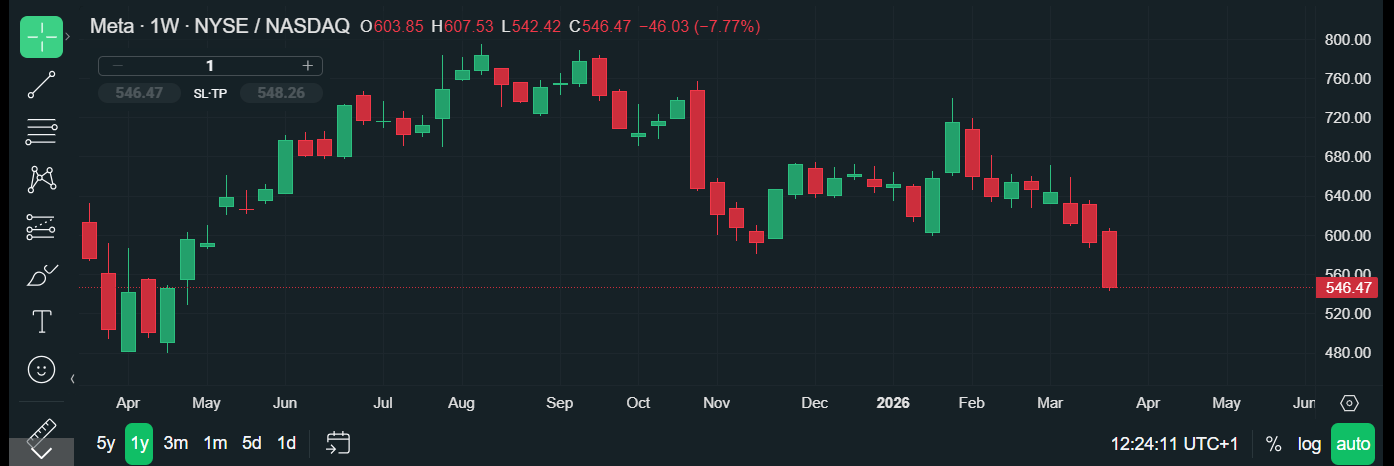
3. Meta and Google have seen large losses in their share prices this week after a pivotal court case where they were found liable for intentionally building addictive social media platforms that harmed a 20-year old user’s mental health. This could open the door to billions of dollars’ worth of damages payments. Of course, these trillion-dollar companies can afford to pay damages of this scale, but this seems like big tech’s big tobacco moment. Meta’s share price is lower by 10% this week, and it’s worth noting that big tech, and social media giants in particular, are out of favour with investors, Meta’s market cap has fallen by nearly 40% since peaking last year.
Markets lose faith with Donald Trump
Overall, markets feel more panicky this week, and Friday’s price action suggest that investors are losing faith in Donald Trump’s ability to end this war and reach a deal with the Iranians. This comes at a bad time for central banks, who typically intervene when the markets get too fearful during a crisis. Bond yields are surging giving them less room for maneuver and giving investors less confidence to buy the dip. A recovery will happen, but the conditions are not right yet.
Chart 1: Meta, one-year chart
Author

Kathleen Brooks
XTB UK
Kathleen has nearly 15 years’ experience working with some of the leading retail trading and investment companies in the City of London.