Making Strides: Women-Owned Businesses on the Rise


Despite starting with less capital and higher cost of capital, women-owned firms are growing faster than men's. Women's increased experience in the workforce and a fast-growing service sector are supporting ownership.
Higher Hurdles for Women-Owned Firms to Get Off the Ground
New businesses serve as a vital driver of innovation in the economy. By bringing novel or improved processes and products to the market, entrepreneurs help foster productivity growth, which is pivotal in producing real income gains. Supporting the growth of new, and thus typically small, businesses is therefore a key ingredient in a dynamic economy. Yet women account for only a fraction of business owners (20% in 2016), leading to missed opportunities in bringing new and diverse ideas to the market.
Finding the initial capital to start a business can be daunting for all entrepreneurs, but women-owned firms typically start with less capital and/or rely more heavily on higher-cost forms. Women are more likely to run balances on personal and business credit cards, which come at higher costs than traditional business loans—used more commonly among men to get their businesses off the ground (top chart). Survival rates can suffer as a result of undercapitalization and the use of more-expensive credit.1
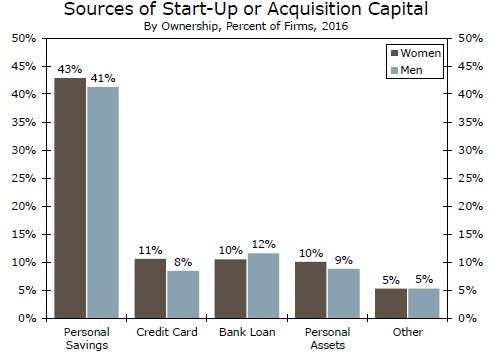
According to the Federal Reserve Banks of New York and Kansas City, women-owned firms are more likely to face financial challenges, and are more likely to skip seeking credit due to discouragement. Women-owned firms are more likely to use personal/family savings, assets or home equity lines to get off the ground than men.
Rise of the Service Sector Chipping Away at the Ownership Gap
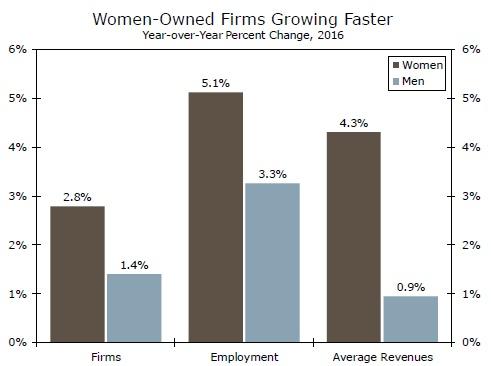
Despite these challenges, women are making inroads into business ownership. Although women own only a minority of businesses, their fraction is growing. According to the latest Annual Survey of Entrepreneurs, the number of women-owned businesses increased 2.8% in 2016, double the rate of men-owned businesses (middle chart). That increase builds on a decade-long trend, which has helped the share of women-owned businesses grow from 16% of firms in 2007 to 20% in 2016.
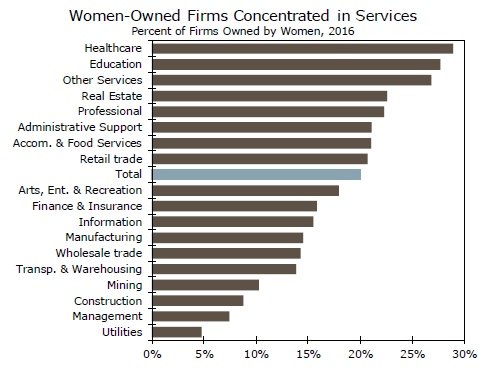
The economy's shift toward service industries has likely helped to underpin these gains. Women own a higher share of businesses in some of the fastest growing industries over the past decade, like education, healthcare and accommodation & food services (bottom chart). Employment among women has been disproportionately skewed towards these industries, and industry expertise is positively associated with ownership and survival rates.
Women-owned firms tend to be smaller in terms of revenues and employment, but their forays into these fast growing fields have made them an increasingly important source of employment. Jobs at women-owned firms have grown 11% since 2012 compared to 3% among men-owned firms. With the secular rise in the service sector and women's job experience more closely mirroring that of men's after decades of rising labor force participation, we would expect women to make further inroads into ownership in the coming years. There remains a long way to go, however, before closing the gap with men.
Author
Wells Fargo Research Team
Wells Fargo

















