Long-Term Unemployment: The Labor Market’s Achilles’ Heel


Despite steady job gains, long-term unemployment remains well above levels typically seen this far into a recovery. Structural changes in the labor market have changed the nature of full employment.
Long-Term Unemployment Casts a Shadow Over Recovery
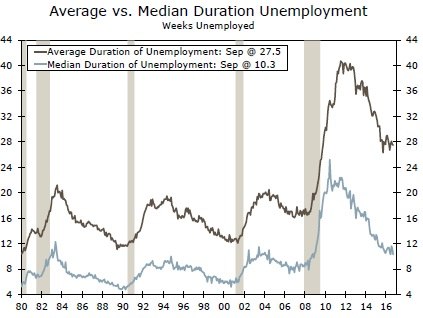
Long-term unemployment has been a significant challenge in the recovery from the Great Recession. At the peak, nearly 7 million people were unemployed for 27 weeks or longer, more than double the previous record. Today, both the median and average duration of unemployment have fallen, but they remain elevated relative to even previous cycle highs (top chart). The average duration of unemployment has been much slower to recover in this expansion compared to the median. Shaking the rust off from high school math, you will recall that averages can diverge from medians as a result of outliers. In this case, the striking divergence between the median and average duration indicates that a subset of workers continue to face severely long spells of unemployment.
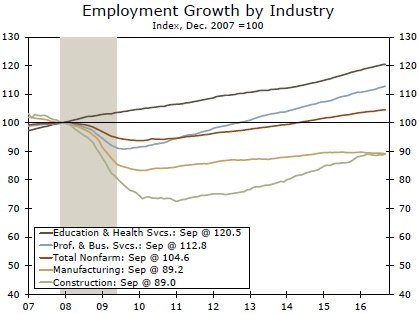
If the economy is nearing full employment, why does long-term unemployment remain such a problem? One reason is that low levels of job turnover in this expansion have limited the opportunities for unemployed workers to find new jobs. Another key reason has likely been the composition of job growth in this expansion. Although the economy is nearing full employment in the aggregate, job growth by sector has varied significantly. Job growth in private services, led by sectors such as education & health and professional & business services, has roared ahead in this recovery. However, other sectors, such as manufacturing and construction, remain well short of their pre-recession peaks (middle chart).
Cyclical Improvement but Ongoing Structural Challenges
For the long-term unemployed, this creates multiple challenges. First, there is no guarantee that the loss of jobs in one sector will be replaced by gains in another sector in the geographic areas most plagued by long-term unemployment. Second, even when employment growth returns to these regions, workers who were previously employed in a different industry may not have the skills or education required for the new jobs. Third, a prolonged stretch of unemployment can result in skill atrophy and the deterioration of social networks. Workers may be hit with the doublewhammy of a decaying social network that is also more suited to an industry in which there is a dearth of openings. While there have been numerous drivers of slow productivity growth in this cycle, the challenges created by long-term unemployment during the last recession have likely contributed to sluggish labor productivity.
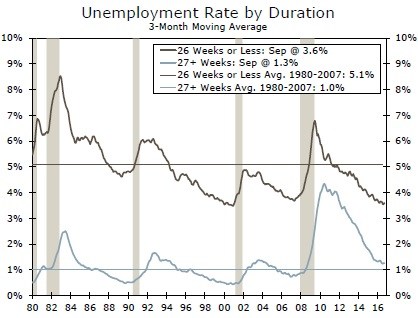
Steady job gains have brought the number of long-term unemployed down to about 2 million. Continued job growth should help whittle away at those remaining unemployed and possibly draw individuals back into the labor force. Even with this cyclical improvement, however, elevated long-term unemployment explains, in part, why today's labor market does not exhibit all the traditional hallmarks of full employment (bottom chart).
Author
Wells Fargo Research Team
Wells Fargo

















