Liquidity drains and silicon storms as the market braces for the New York open


Bracing for the New York open
The market is about to test its nerve, and the real exam begins at the New York open.
What we have seen so far is a prelude. Futures softer, Nasdaq 100 leaning heavy, Treasuries quietly bid, AND precious metals counterintuitively slipping. But all of it has unfolded in the shallow end of the pool. Lunar New Year closures across Asia and the US President’s holiday have drained depth from the book. Price has moved, yes, but conviction has not yet fully reported for duty.
Now the lights are about to switch on.
The Nasdaq complex is likely to be the pressure point. AI enthusiasm built the tower, but now the market is stress testing the foundations. This is no longer about who has the best model or the largest capex budget. It is about second-order consequences. If artificial intelligence boosts productivity while cooling wage pressure, that is a Goldilocks extension. If it accelerates labour displacement and dents consumption, that is margin compression dressed up as innovation. The equity market is trying to discount both futures simultaneously, which creates a volatility loop in leadership.
Treasuries edging higher into the open is not random. Bonds are acting as shock absorbers. With Fed minutes, PCE inflation and growth data ahead, duration is being accumulated as optionality, with AI still the defining market force right now, capturing every cross-asset trader’s attention.
Then there is positioning. When gold and silver slide alongside equities, it smells less like macro clarity and more like portfolio recalibration. Late January’s cross-asset wobble left scars, and a few risk managers clearly tightened the leash. This feels less like a view on inflation and more like VaR discipline asserting itself. When bullion cannot catch a bid on a soft equity tape, that is not a thesis shift; it is balance sheet maintenance.
Frankly, with China absent from the gold bid today, the tone changes materially. When Shanghai is not leaning into dips, and the usual physical flow is missing, liquidity thins and conviction fades. The marginal buyer matters in this market, and without that steady Eastern sponsorship, traders look to one another rather than step forward. It becomes a game of who blinks first.
Bitcoin hovering rather than ripping reinforces that message. If speculative capital truly believed this was a clean macro hedge moment, you would see aggressive upside extension. Instead, crypto is idling. That tells me hot money is cautious, not emboldened.
Put it together, and it feels like traders are reluctant to get back in the saddle. After a cross-asset jolt in which gold, equities, and even parts of credit wobbled in tandem, muscle memory shifts. Nobody wants to be first back into size without confirmation that the plumbing is stable. Until China reappears on the physical bid and real money steps in with authority, rallies in precious metals will feel more tactical than structural.
This is not capitulation. It is hesitation. And in thin liquidity, hesitation can look a lot like weakness.
And hovering over all of it is geopolitics. Iran tensions sit like dry tinder in the oil markets. In a deep market, that risk gets absorbed. In a thin one, it can ignite quickly. The open in New York will tell us whether US real money steps in to stabilize or whether systematic flows lean into weakness.
This is the key. Thin holiday trading can distort. The New York open restores liquidity and reveals intent. If Nasdaq weakness accelerates with volume, then the AI repricing theme has more room to run. If buyers absorb supply and Treasuries hold their bid without panic, then we could see a decent open.
The market is not collapsing. It is recalibrating under structural pressure. AI is no longer a headline trade; it is a macro variable. Labour data, Fed rhetoric and growth prints now intersect with silicon in a way that forces investors to rethink duration, margins and multiples simultaneously.
As the bell approaches, this is less about noise and more about nerve. The plumbing will matter more than the pundits. Liquidity will matter more than the headlines. And the New York open will decide whether this is just another shallow dip in a structural bull market, or the early stages of a deeper repricing of the AI era.
Record highs, record doubt and a tape i still do not trust
I do not have a crystal ball, but I do know this: there are not enough good reasons to like this tape yet.
We are trading within a few 100 points of record highs. The index closes unchanged day after day. If you only look at the Dow or the headline S&P, you would think we are coasting. But beneath that calm surface, sectors are being put through a wood chipper. The disparity between asset prices at their highs and money manager sentiment at its lows is as wide as I can remember seeing.
That divergence is not a footnote. It is the story.
The last five full liquid sessions have been a surgical seek-and-destroy campaign against anything perceived as exposed to AI obsolescence. Justified or not has not mattered. The market is operating on a guilty-until-proven-innocent framework. Software, workflow platforms, certain brokers, and parts of tech services. If there is even a hint that code can eat the margin, the multiple gets repriced immediately.
What worries me is not just the speed of the move, but the structure underneath it.
Options markets are telling you that single stock volatility is not about to cool off. The 1m to 3m surface is still elevated. That raises the key question. Does single stock volatility spill into index volatility, and from there into cross-asset and macro volatility? So far, the answer has been no. Credit spreads are calm. Bond volatility is contained. Liquidity is functioning. That is the good news.
But here is the problem. There is no obvious macro catalyst to blame. This is not tariffs that can be walked back. It is not a central bank surprise that can be clarified in a press conference. This is structural repricing tied to perceived terminal value across a meaningful slice of the equity market. The US software index alone has a market cap of roughly $5.1 trillion, about 8.5 percent of the S&P. Even if volatility is confined to one industry group, that is an enormous pool of capital being stress-tested.
Prime brokerage data is finally showing signs of de-grossing. US long-short gross leverage has fallen for two consecutive weeks and is down meaningfully month-to-date. When managers get nervous, they cut gross, not just net. It is the difference between trimming exposure and actually slowing the car down. Until recently, gross exposure had been insatiable and sat near the 98th percentile on a five year lookback. That tide has started to turn, but positioning is still heavy.
Flows confirm the shift. Long-only and hedge funds were net sellers last week. Asset managers sold significant NQ futures into software weakness. Fast money desks are active on the short side.
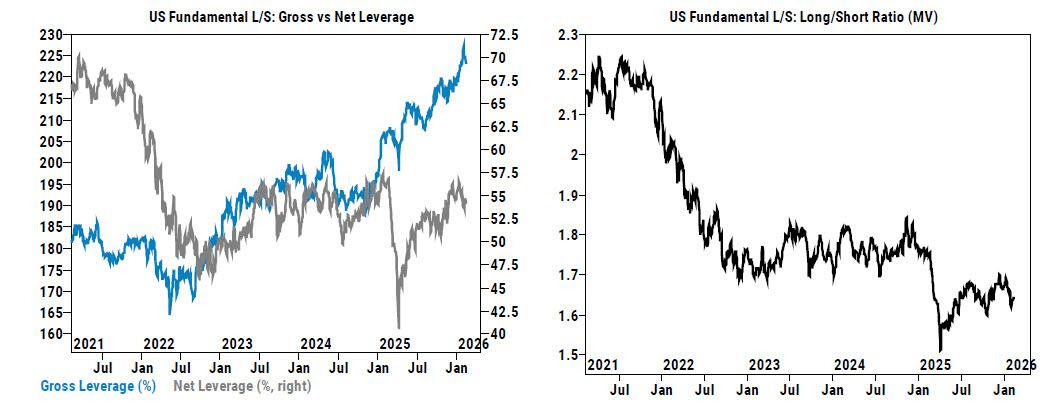
Yet CTAs remain long a very large slug of global equities, with left tail asymmetry if downside accelerates.( Goldman's CTA data suggests the Chicago Mob is still long $155bn of global equities) Trend signals are turning negative in US indices while remaining broadly positive globally. That creates a fragile equilibrium. Baseline selling pressure could continue for a week or two, and if we breach key levels, systematic supply grows.
The derivatives backdrop adds another layer. The vol stress index printed 9 out of 10 into the long weekend. Historically, readings above 9 have been buying opportunities. But this time feels different because the spike in panic has not come with a commensurate drop in spot.
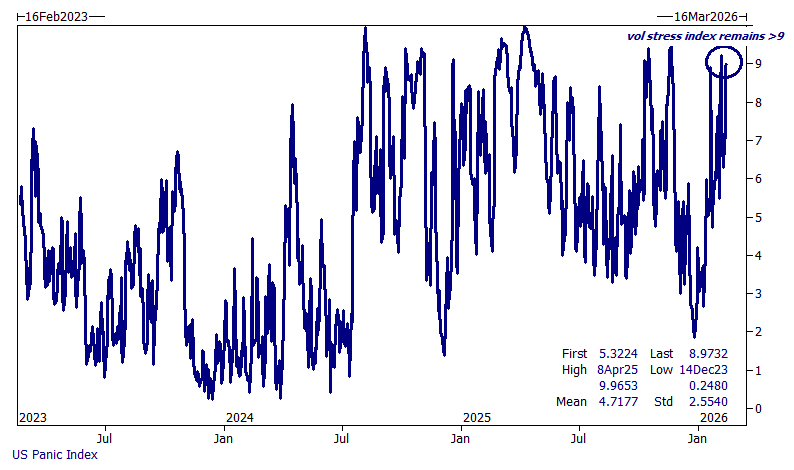
In other words, institutions are hedging aggressively even as the index sits near highs. Downside protection on the average Nasdaq stock traded at multiples of index protection earlier this month. That tells you fear is concentrated in the trenches, not the headlines.
Buybacks are active, running well above recent average volumes as blackout windows reopen. That is supportive at the margin. The Fear and Greed index has slid into Fear territory even with the S&P near records.
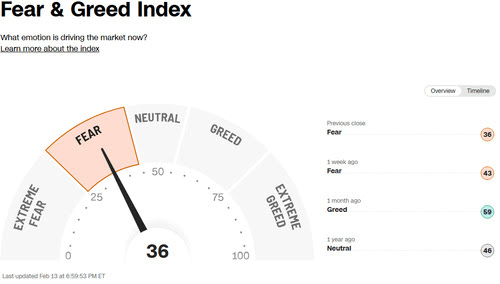
Again, price says calm. Positioning and hedging say caution. Via Goldman PB Data
So what makes this different is that the index is not crashing. It is that confidence is.
This is being treated as an equity-specific and model-specific problem for now. Credit is not cracking. Funding markets are stable. That is constructive. But without a clear catalyst to reverse the narrative, there is no obvious short circuit to stop the selling if it spreads beyond software. Structural fear is harder to soothe than event-driven fear.
In that context, I understand the preference for equal-weight exposure over crowded mega-cap concentration. I understand caution on small caps and semis where positioning is heavy. I understand owning convexity through VIX call spreads rather than assuming calm persists. I understand selective long exposure in areas less exposed to AI displacement and in large-cap financials where buybacks and balance sheets provide ballast. Gold upside as a hedge against policy error and running the balance sheet too hot, and biotech as idiosyncratic alpha both make sense in a dispersion regime.
But the broader point is this.
We are near record highs with record skepticism. Gross is high. Single stock volatility is elevated. Gamma support is rolling off. Systematics are long. And the market is repricing perceived terminal value in real time.
That is not the backdrop for blind optimism.
Until I see single stock volatility compress, de-grossing stabilize, and leadership broaden without being driven by forced rotation, I remain cautious. The surface may look calm. The currents underneath are anything but.
FX Alert: To Love or Not to Love
The dollar walked into a holiday week without much drama, finding modest support not because of some grand macro shift but because positioning was stretched and oil decided to remind everyone that geopolitics never really goes on vacation.
Let’s call it what it is. The greenback has been trading slightly below its short-term fair value due to a Warsh hawkish repricing in the Fed curve and quiet conditions; undervaluation alone can be enough to attract opportunistic buying. But the real pulse came from crude. Reports of Iranian military exercises around the Strait of Hormuz injected a risk premium into energy markets, and when oil prices stiffen, the dollar often follows. The market is now assigning roughly a 40 percent probability to a US strike on Iran by the end of March. That number may ebb and flow, but the message is clear. Any escalation feeds oil, and oil feeds the dollar. The energy channel is the transmission mechanism for the Greenback.
Yet this does not feel like a week where the dollar writes a clean, one way narrative. It feels more like a tape that drifts, where the bigger action shifts to domestic battlegrounds across G10. US data will hit the screens, ADP payrolls after a soft late January window and the Empire survey expected to cool toward the low sixes, but unless equities lurch violently, the data risk may play second fiddle to positioning and volatility. In this market, equity tremors matter more than incremental macro tweaks. If stocks wobble, the dollar gets a bid. If they steady, we are back to relative stories elsewhere.
Europe is one of those stories. Germany’s ZEW survey is expected to show a further lift in sentiment, with expectations potentially pushing above 60 for the first time since mid 2021. That would reinforce the sense that the cyclical trough in Europe is behind us. Overlay that with the European Central Bank’s steady expansion of its EUREP repo facilities and you begin to see the architecture of a more internationalized euro. Call it quiet statecraft. A broader global euro footprint strengthens its reserve and trade role and subtly signals that Frankfurt is not overly anxious about currency strength. That said, tactically I still lean toward EUR/USD downside in the near term. The dollar has room to mean revert on short term fundamentals, and a probe toward 1.1800 remains a realistic waypoint before this leg is done. Loving the euro structurally does not mean marrying it tactically.
Then there is the antipodean axis. The Reserve Bank of New Zealand is widely expected to hold, but tone is everything. A steady hand with a hawkish eyebrow could give the kiwi a lift in a week where direction is scarce. By contrast, sterling and the Australian dollar look more vulnerable to softer domestic prints. When the global tide is flat, local currents decide which boats drift and which scrape the harbor wall.
So, to love or not to love the dollar. That is the question. In a week stripped of heavy US flows and decisive catalysts, the answer is conditional. Love it on oil spikes and equity stress. Respect it when positioning is stretched. But do not expect it to carry the whole show. This is a market rotating on local narratives, where domestic data, central bank tone, and fiscal nuance in places like Wellington and Budapest can steal the spotlight.
The dollar may be the protagonist, but this week it shares the stage.
Author
Stephen Innes
SPI Asset Management
With more than 25 years of experience, Stephen has a deep-seated knowledge of G10 and Asian currency markets as well as precious metal and oil markets.