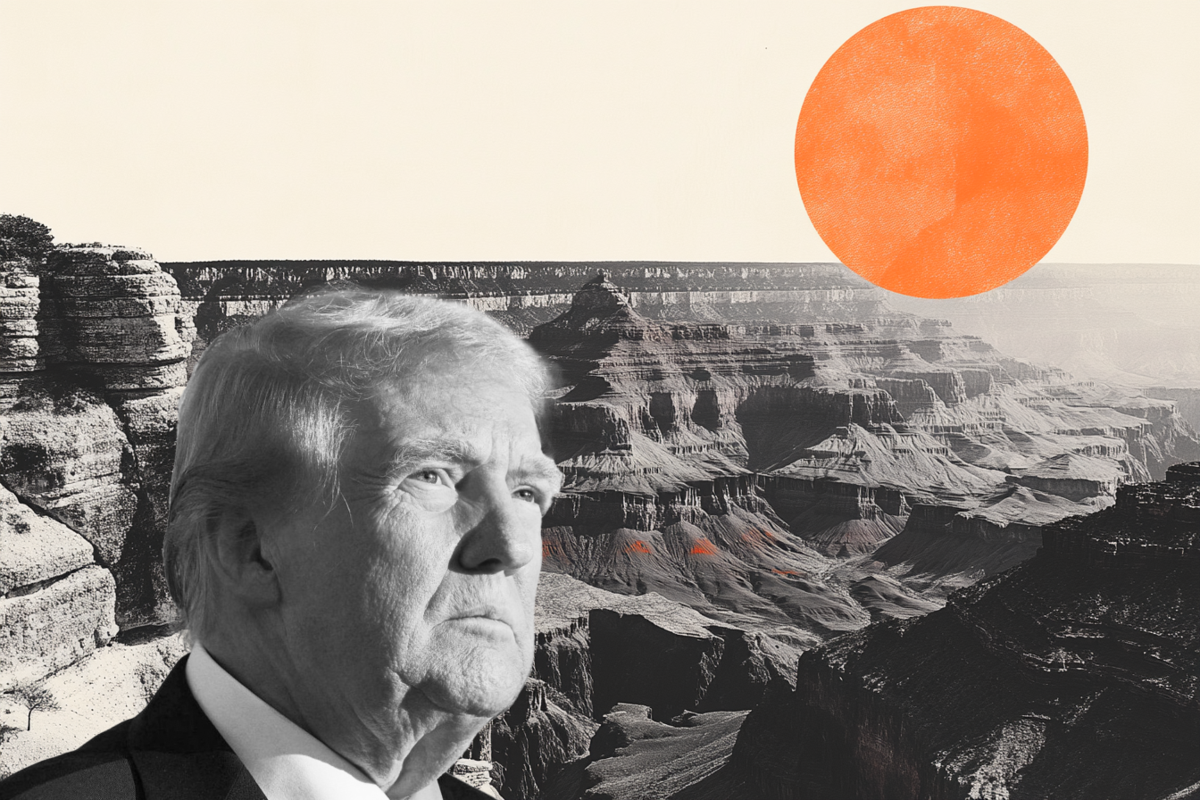
Last week’s chaos: Trump fought back against markets that so obviously disliked his announcements

Tomorrow has a juicier plate—US retail sales (probably big on stocking up) plus eurozone CPI.
If we are looking to yields to guide FX trading, it ain’t easy. We saw a nearly 50 bp gain last week, the most in almost 20 years. Flying around like a kid’s out of control drone were many stories about deleveraging and capital flight. Then the yield rose, if only a little, on Trump relenting on electronics and then auto tariffs due May 3, maybe.
Ahead of expected central bank rate cuts in Canada, the eurozone, and the UK (in May), Fed Gov Waller said the tariff polices are “a major shock to the economy that could lead the Federal Reserve to cut interest rates to head off a recession even if inflation remains high” (Reuters). This is a case in which a rate cut is a good thing, if hardly adequate for companies struggling to review their capital spending plans in the current environment of high uncertainty and anxiety.
The Waller statement: "With a rapidly slowing economy, even if inflation is running well above 2%, I expect the risk of recession would outweigh the risk of escalating inflation, especially if the effects of tariffs in raising inflation are expected to be short lived."
Short-lived? Also known as “transitory”? Oh, dear. We have no evidence the effects will be short0lived, unless that means 3+ years and the next guy in the White House reverses all tariffs on day one. Atlanta Fed Bostic said it better: "The fog has just gotten really, really thick."
Still, any kind of statement from the Fed alleviates what is the loss of confidence in US policy and its incompetent policy-makers. This is, of course, a mistake, because the problem is the US tariff war and there is nothing the Fed can do about that. Its institutional heft is weakened to the vanishing point. A rate cut soon can too easily be interpreted as bowing to the king and nothing to do with the economy.
Analysis of the Trump see-saw on “policy” indicates he knows he is at the mercy of the markets, and willing to try to game them.
During last week’s chaos, Trump fought back against markets that so obviously disliked his announcements. S&P down into a bear market? Offer a 90-day pause. Bond market yields dramatically higher? Trump says they got the “yips,” a fairly insulting downgrade to the quality of the thinking of the bond gang. The response? Exempt some big stuff. We got more this pushyou/pullme yesterday.
The Fox fan club says everything is working exactly as Trump planned. The rest of the world saw Trump backing down because of pressure from financial markets—and entirely unforeseen as well as certainly not planned. No one plans to trash the stock market, at least not anyone sane.
Here’re some ideas about the end of it all. First, there will be no end for years. The 90 day pause is just the start of more flip-flops, reckless initiatives that have to be withdrawn, and deals in which many a trade partner lies to the Liar in Chief about what they will do for him. This is exactly what China did in his first term in promising to buy hundreds of millions of goods from the US and then buying precisely none, while the revenue from US tariffs on China went almost entirely to buck up the soybean and other farmers who lost that market (mostly to Brazil).
Bottom line, there is no end-game, any more than there is a plan. Trump is winging it on his “instinct.” It remains to be seen whether Trump can soften each new blow with exemptions and concessions so that the equity and bond gangs postpone Armageddon—full-blown bear markets and acknowledgement of capital flight.
They don’t want to go there. They cling to every Trump pullback as a lifeline. And indeed it is likely that every time they freak out, Trump responds again with a candy bar. Earnings season will be interesting—is there real food on that table? Any plans would have been made before Trump and we await the extent to which they have been withdrawn or reduced. In a period of intense uncertainty with no end in sight, no one can realistically plan much of anything.
So, a lot rests on the consumer, whose confidence is the second lowest (after Covid) since 1952. Then there is the unknown crack in the banking system, both regulated and shadow, where somebody can go under in a nonce and take who-knows how many others with it. Nobody knows if we are near a Lehman moment. What if the Big Shorts take hold? Or are the arithmetic boys done?
Larry Kotlikoff (at Substack) writes “To summarize, no one in or outside government knows, for sure, what parts of the financial system can fail, what would make them fail, and when they might fail. In recent exchanges with some of the most knowledgable financial players in the country, including former top-level government officials, the message is clear: “I can’t say who, what, where, or when, but something will break.”
This is not the blow-by-blow Trump responses to financial markets responses to Trump, an endless circle of panicky but reasonable responses to stupid initiatives. It’s more of a judgment on the sub-system we now have overlaid on top of a decently structured system that is vulnerable in some places. Trump doesn’t know the underlying system in the first place, let alone how his sub-system interacts with it.
That’s why he can’t take Larry Summers’ advice—“the first rule of holes is stop digging.” He cannot resist. So something will break. We guess it will be bonds, already up enough to have taken the standard 30-year mortgage to 7%. Since markets like round numbers, we’ll go to 4.75% in the 10-year, and then if Trump does not relent on some sizeable things, 5%. Prices will fall pretty hard to get those yield levels.
Bottom line: capital flight is a process, not a one-time thing. It can stop-and-go, and pretty much has to because of the absence of viable alternatives, as in bonds. That doesn’t mean investors and reserve fund managers are stuck with the US no matter what. They have just begun restructuring…
Forecast
Remember that Good Friday on April 18 will close most European and the US stock and bond markets. FX trading desks will be thinly manned. The implication is that traders will square up ahead of the 3-day holiday, meaning they will get less long the currencies and less short the dollar. This is a standard move and barely nudged by whatever small moves in sentiment come along. Don’t be fooled.
Tidbit: Not directly pertinent to financial markets is Trump thumbing his nose at the federal courts and even the Supreme Court, which told him 9-0 to bring home the poor guy who was departed to the El Salvador prison on an error. He says no, not happening. In fact, he says he can do the same thing to a natural born citizen if he wants to. Important legal grandees say this is the authentic Constitutional crisis that has been in the works for a while.
The Supreme Court uses the Justic Dept to enforce its rulings. The Justice Dept is now headed by a bottle blonde acolyte who is pretty enough that Trump likes to show her off like a trophy.
We say some retired Navy Seals should get together and go get the guy.
Gone are the days when a president would send in the National Guard to enforce the Supreme Court ruling that Southern schools must be integrated, but the governors refused to obey.
It seems logical that tourism will drop to near zero and anyone with plans to build something in the US is going to think twice. We don’t have 2024 data but in 2023, tourism brought in $2.36 trillion. Foreign direct investment is also outdated but 2022 brought in $177.5 billion. The total in 2023 is $5.5 trillion. Gee, do you think foreigners will want to travel to the US to visit their investments? Or maybe just dump them.
This is an excerpt from “The Rockefeller Morning Briefing,” which is far larger (about 10 pages). The Briefing has been published every day for over 25 years and represents experienced analysis and insight. The report offers deep background and is not intended to guide FX trading. Rockefeller produces other reports (in spot and futures) for trading purposes.
To get a two-week trial of the full reports plus traders advice for only $3.95. Click here!
This is an excerpt from “The Rockefeller Morning Briefing,” which is far larger (about 10 pages). The Briefing has been published every day for over 25 years and represents experienced analysis and insight. The report offers deep background and is not intended to guide FX trading. Rockefeller produces other reports (in spot and futures) for trading purposes.
To get a two-week trial of the full reports plus traders advice for only $3.95. Click here!
Author
Barbara Rockefeller
Rockefeller Treasury Services, Inc.
Experience Before founding Rockefeller Treasury, Barbara worked at Citibank and other banks as a risk manager, new product developer (Cititrend), FX trader, advisor and loan officer. Miss Rockefeller is engaged to perform FX-relat