US Dollar Weekly: Will Kevin Warsh please President Trump?
United States President Donald Trump’s nominee to succeed Jerome Powell as Federal Reserve Chair, Kevin Warsh, faced senators, and there was no subtlety. When directly asked if he believes his nomination was directly linked to Trump’s “obsession” with lower rates, the answer was no surprise: he dodged that question – and many others – like a champion.
Why Kevin Warsh?
An educated guess would suggest that US President Trump chose Warsh because of his criticism of current Chair Jerome Powell.
“Inflation is a choice, and the Fed’s track record under Chairman Jerome Powell is one of unwise choices,” Warsh stated in an essay titled “The Federal Reserve’s Broken Leadership,” published last November. “Americans would have higher pay and greater purchasing power if the Fed got its act together,” Warsh added. Not bad for a Trump-ish start.
He also put the focus on the massive Fed balance sheet, now running at around $6.7 trillion. Warsh believes the Fed has injected unnecessary liquidity into the economy, pumping up the stock market and boosting deficit spending, while crowding out private investment. Warsh wants to reduce it significantly, that’s out of question.
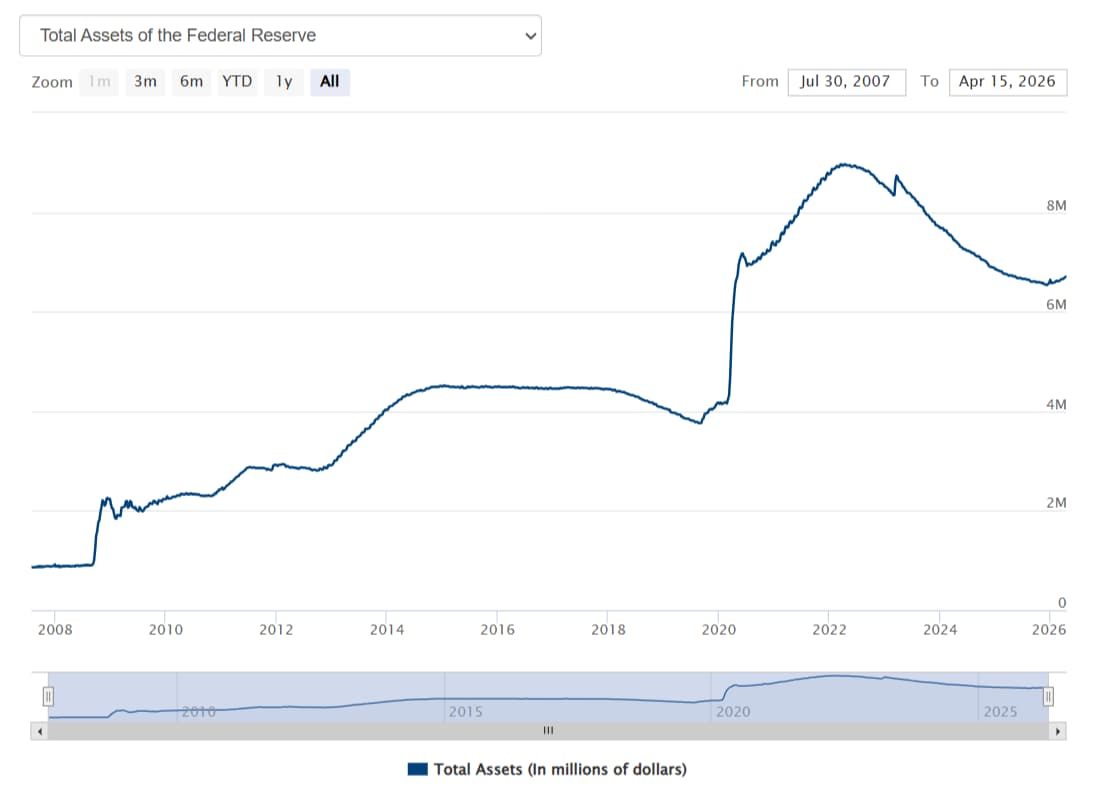
Source: Federal Reserve
But Warsh also pushed against the Fed’s narrative of “transitory” inflationary pressures in 2021. “Jerome Powell’s Fed believes the party is just getting started and won’t remove the punch bowl until the fun is in full swing and the neighbors know it,” he noted back then.
Indeed, Warsh has not saved any criticism of Powell, and that was one major factor tipping the scale in his favor.
But don’t be fooled. Warsh is not getting the chair position just because of his criticism of Powell’s actions. He has an extensive background that supports the nomination, including acting as Fed Governor between 2006 and 2011, when the mortgage crisis hit the global economy.
He is also a tech-geek, with strong ties to Silicon Valley monsters, and if confirmed, he will be the wealthiest chair ever. Warsh is also an advocate of the free market, having an anti-regulatory view of the world.
What we learned so far about Kevin Warsh
Warsh's prepared statement before the Senate Committee gave some discrete hints on where he is heading. Warsh defended the Fed’s independence, but also noted he doesn’t believe that dynamic is endangered when the central bank’s actions are questioned by elected leaders.
So let me be clear: monetary policy independence is essential.
Monetary policymakers must act in the nation’s interest.
The Fed should not act as some general-purpose agency of the US government or as an appellate court for matters that are rightly debated and decided elsewhere.
I believe that monetary policy independence is earned—and better policy decisions crafted—by steering clear of distractions.
I am committed to ensuring that the conduct of monetary policy remains strictly independent.
I am equally committed to working with the Administration and Congress on non-monetary matters that are part of the Fed’s remit.
And I commit to accountability in all the Fed’s functions.
In a time that will rank among the most consequential in our nation’s history, I believe a reform-oriented Federal Reserve can make a real difference to the American people.
Starting with the wrong foot
It’s well known that Fed chairs over the last few decades have respected continuity. His criticism of Powell and focus on reducing the balance sheet already suggest continuity won’t be as strong as it had been in the past.
President Trump also demands lower rates and even told CNBC on Tuesday that he will be disappointed if Warsh doesn’t cut interest rates “right away” after being confirmed as the next Fed chair. When asked whether he is here to work for the people or for Trump, Warsh said that “all presidents” tend to favor lower interest rates, and that the Fed’s independence is up to the Fed. He also dismissed inflationary pressures related to tariffs, adding that his broad sense is that inflation risk has improved somewhat.
In fact, he claimed that a smaller balance sheet would mean rates could be lower, inflation would improve, and the economy would get stronger. Warsh also claimed he told President Trump that using rates is better than buying bonds.
Warsh added that he does not believe in forward guidance and that “too many” Fed officials opine in advance on the rate path.
On the Fed, he noted that the central bank needs many changes: new tools and new communications, a new inflation framework, given that the data used to judge inflation is “quite imperfect,” according to him.
Warsh proved he is a politician, but it is still unclear whether he is the perfect fit for the Fed’s Chair.
Dollar Index Technical Outlook
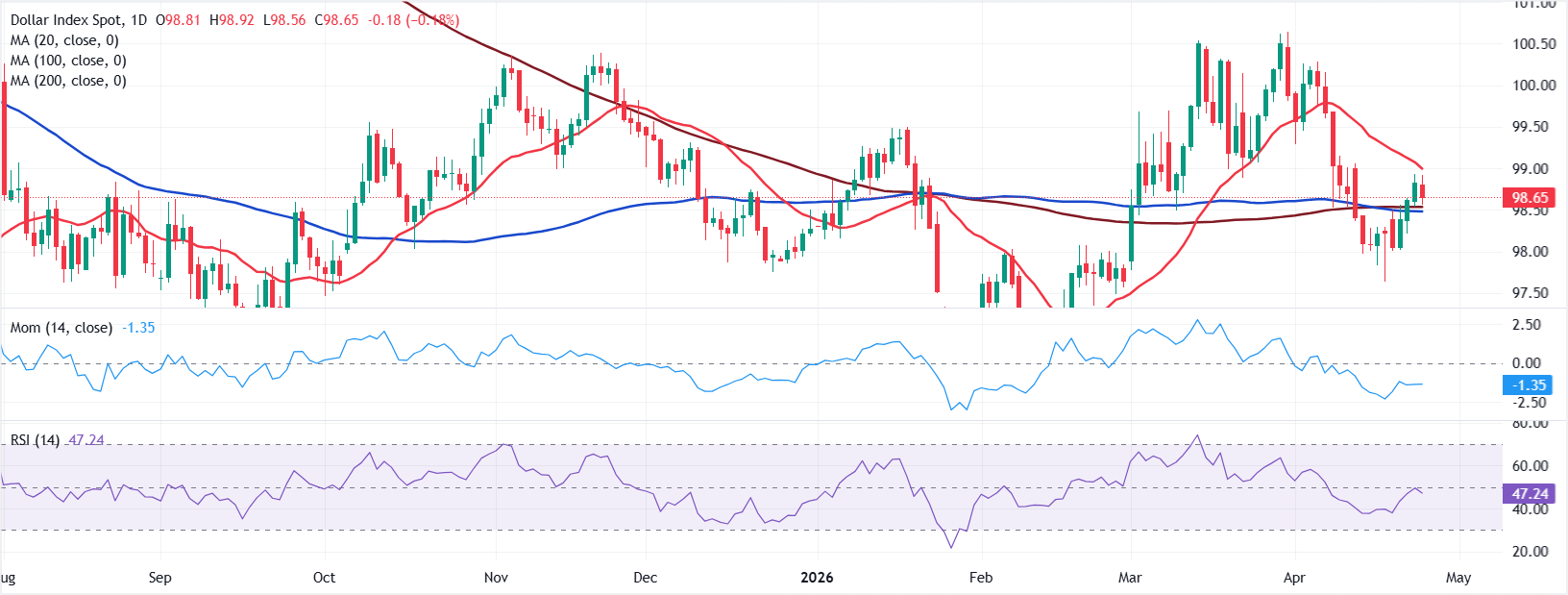
The US Dollar Index (DXY) hovers around 98.60, down on Friday but holding on to modest weekly gains. From a technical point of view, however, the risk remains skewed to the downside. The daily chart shows that the index develops below a firmly bearish 20-day Simple Moving Average (SMA), which limits advances at around 99. The DXY is currently resting above converging and directionless 100- and 200-day SMAs at around 98.50, providing near-term support ahead of the April monthly low at 97.63.
The same chart shows that, while the Momentum indicator lacks directional strength, it still holds below its midline, skewing the risk to the downside. Finally, the Relative Strength Index (RSI) indicator failed to recover beyond its 50 level, and heads marginally lower at around 47.
Looking further ahead, the weekly chart for DXY offers a neutral stance. The index seesaws around a directionless 20-week SMA while technical indicators are stuck around their midlines for a second consecutive week, reflecting the lack of directional conviction.
A slide below the aforementioned April low exposes the multi-month bottom set last January at 95.56. A recovery beyond 99, on the other hand, exposes the 99.30 region, while steady gains beyond the latter could signal an extension towards the March peak at 100.54.
Economic Indicator
Fed Interest Rate Decision
The Federal Reserve (Fed) deliberates on monetary policy and makes a decision on interest rates at eight pre-scheduled meetings per year. It has two mandates: to keep inflation at 2%, and to maintain full employment. Its main tool for achieving this is by setting interest rates – both at which it lends to banks and banks lend to each other. If it decides to hike rates, the US Dollar (USD) tends to strengthen as it attracts more foreign capital inflows. If it cuts rates, it tends to weaken the USD as capital drains out to countries offering higher returns. If rates are left unchanged, attention turns to the tone of the Federal Open Market Committee (FOMC) statement, and whether it is hawkish (expectant of higher future interest rates), or dovish (expectant of lower future rates).
Read more.Next release: Wed Apr 29, 2026 18:00
Frequency: Irregular
Consensus: 3.75%
Previous: 3.75%
Source: Federal Reserve
Author

Valeria Bednarik
FXStreet
Valeria Bednarik was born and lives in Buenos Aires, Argentina. Her passion for math and numbers pushed her into studying economics in her younger years.

















