USD/COP: Peso returns to 2019 levels, time to rethink Colombia's inflation
USD/COP trades at 3,204.9, a level the pair last held in July 2019. The Fed decides tomorrow and BanRep on Friday. The market is reading Colombia's inflation as an energy story. DANE's own release says otherwise, and that changes the odds on Friday.
When a wise man points at the moon…
Last week I laid out two paths for USD/COP. The base case was a recovery toward 3,400-3,700 into year-end, on the assumption that carry returns would lose their appeal and fiscal concerns would come back into focus. The alternative was that the peso rally extends into 2,800-3,000, with long-term support near 2,600.
The alternative is running the show, and the reason the base case has not engaged is worth stating plainly.
Carry has not become less attractive. BanRep took the policy rate to 12.00% on 1 July, the third hike of a cycle that has added 275 basis points since February. The condition that would have produced the recovery moved further out of reach.
Where the pair is
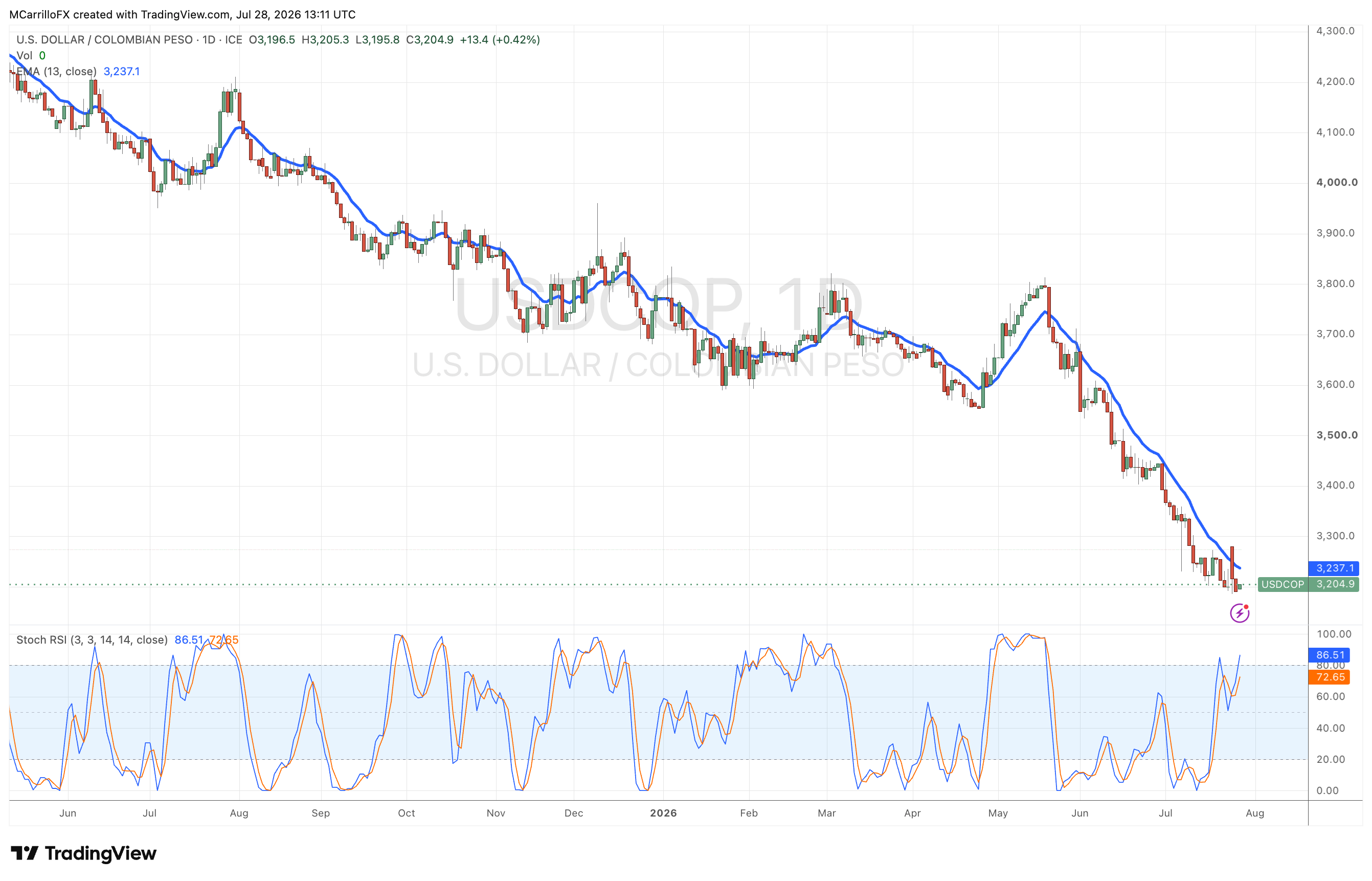
The 2026 high was 3,800.73 on 19 May. Monday closed at 3,191.5, a 16% decline in roughly ten weeks, with July's low at 3,186.3. Tuesday brings a modest bounce to 3,204.9, up 0.42%.
The descent has been orderly. No capitulation candle, and the 13-day EMA at 3,237 has capped every rally attempt since mid-May. The daily Stoch RSI has climbed to 86.51 against price lows, which is the divergence now producing this bounce.
Here comes the Fed, tomorrow
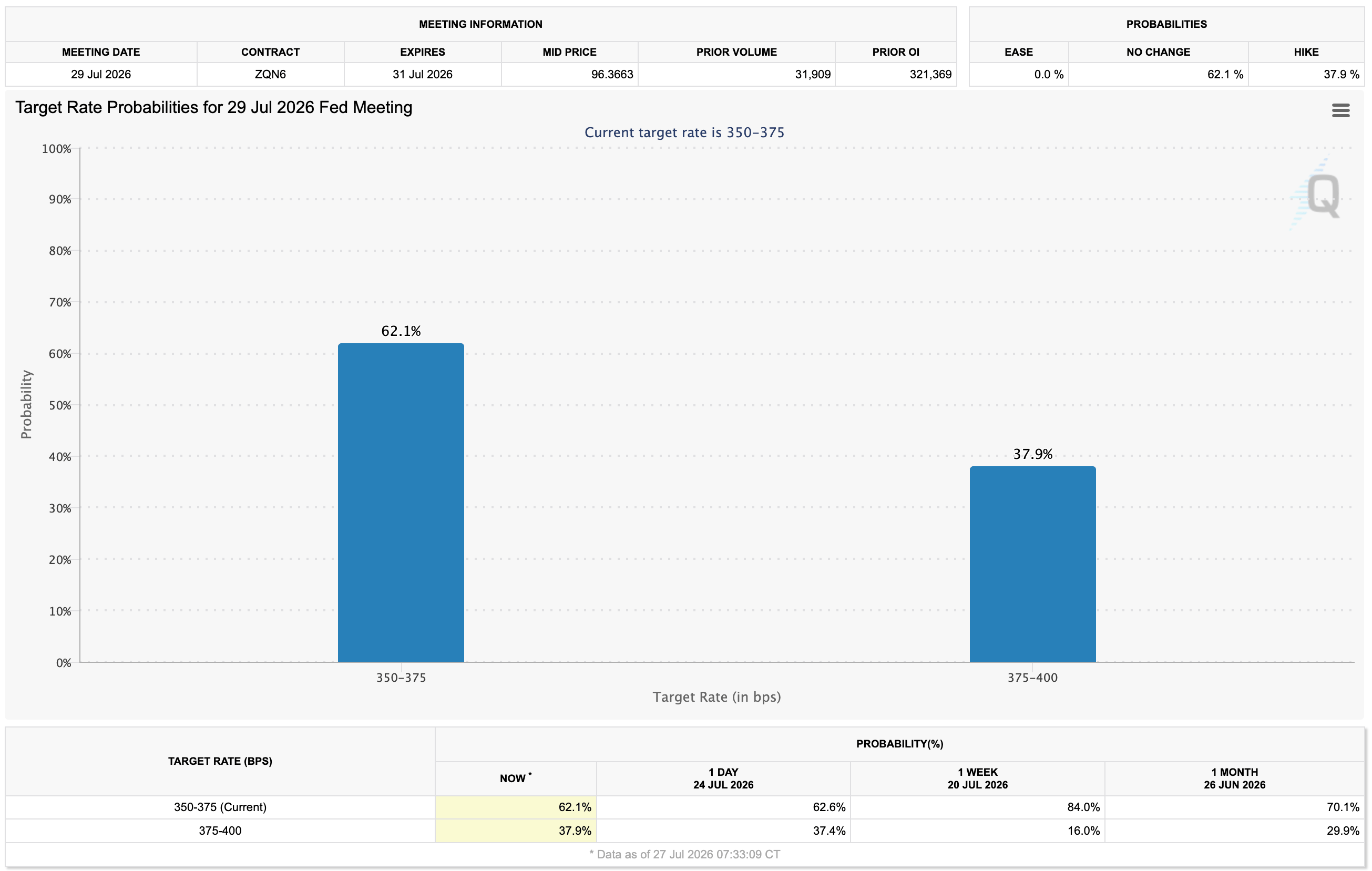
The funds rate sits at 3.50-3.75%. CME FedWatch shows roughly a two-thirds probability of a hold and about one-third on a move to 3.75-4.00%. BNY's Geoff Yu reads close to two hikes priced by year-end.
The data underneath conflicts. Headline CPI fell to 3.5% in June with core at 2.6%, while core PCE, the Committee's actual target measure, printed 3.4% in May, its highest since October 2023. June PCE lands Thursday, a day after the vote.
Colombia's entire bid rests on a differential above 800 basis points. A hawkish Wednesday compresses it, and the Dollar Index is already coiled for that outcome. DXY sits at 101.511, having marked a fresh high at 101.640, with the Stoch RSI at 99.89.
What the market is missing on BanRep
Yu flags a risk that BanRep goes reactive on Friday rather than delivering the expected 50 basis points to 12.50%. His evidence is Bank Indonesia and the SARB, both hawkish, both of which held last week. His stated reason for their caution was that inflation prints carry little information value if headline CPI is mostly an energy story.
In Colombia it is not, and DANE's June release proves it.
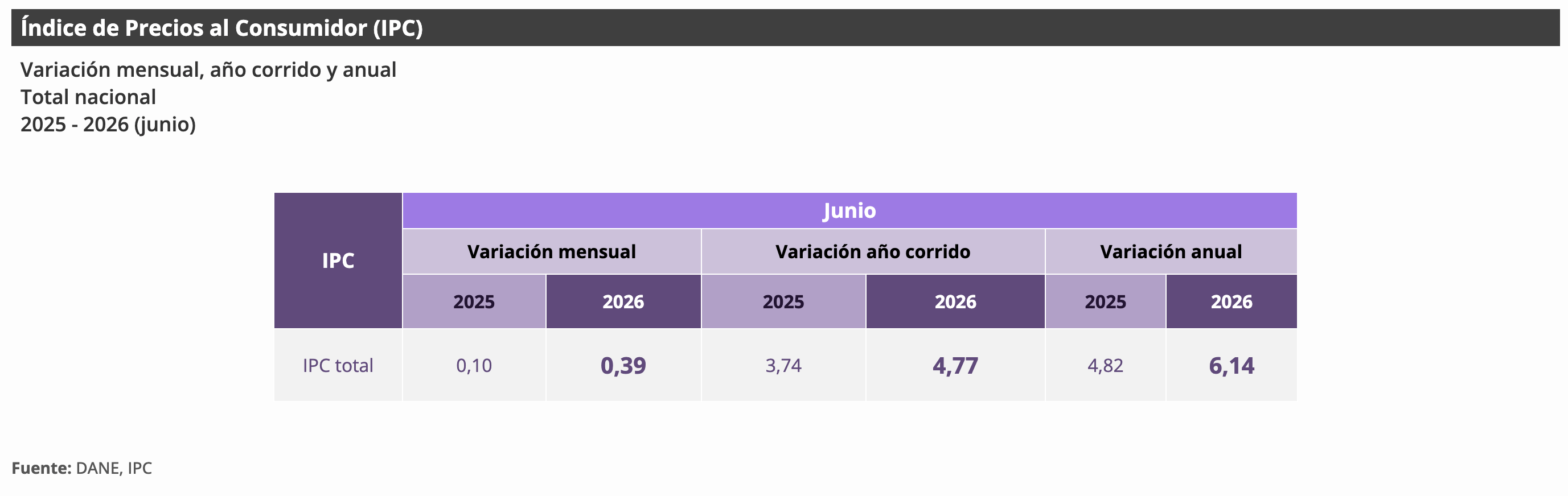
Annual inflation came in at 6.14%. The hottest division is restaurants and hotels at 9.59%, with health second at 8.39%. Alojamiento, agua, electricidad y gas, the division carrying fuel and utilities, printed 5.02%, below the headline.
The contribution table settles it. The largest contributors to annual inflation were meals at table-service and self-service establishments at 0.74 percentage points, imputed rent at 0.62, and urban transport at 0.51. Every one of them a domestic service. The COICOP structure agrees: services carry 57.46% of the basket and rose 0.29% on the month, while durables at 4.92% weight fell 0.12%.
This is domestic demand working through the services side. Energy is dragging the headline down. A central bank looking at restaurant prices near 10% and imputed rent adding 62 basis points is not looking at an energy shock it can wait out. The second-round effects are already in the index.
For the acceleration question, use the year-to-date figure rather than the annual, which flatters itself against a soft base. Through June, 4.77% against 3.74% for the same stretch of 2025.
The policy rate has been 12.00% since 1 July, the third step from 9.25%. Against 6.14%, the ex-post real rate is 5.86%, among the highest available anywhere.
Levels
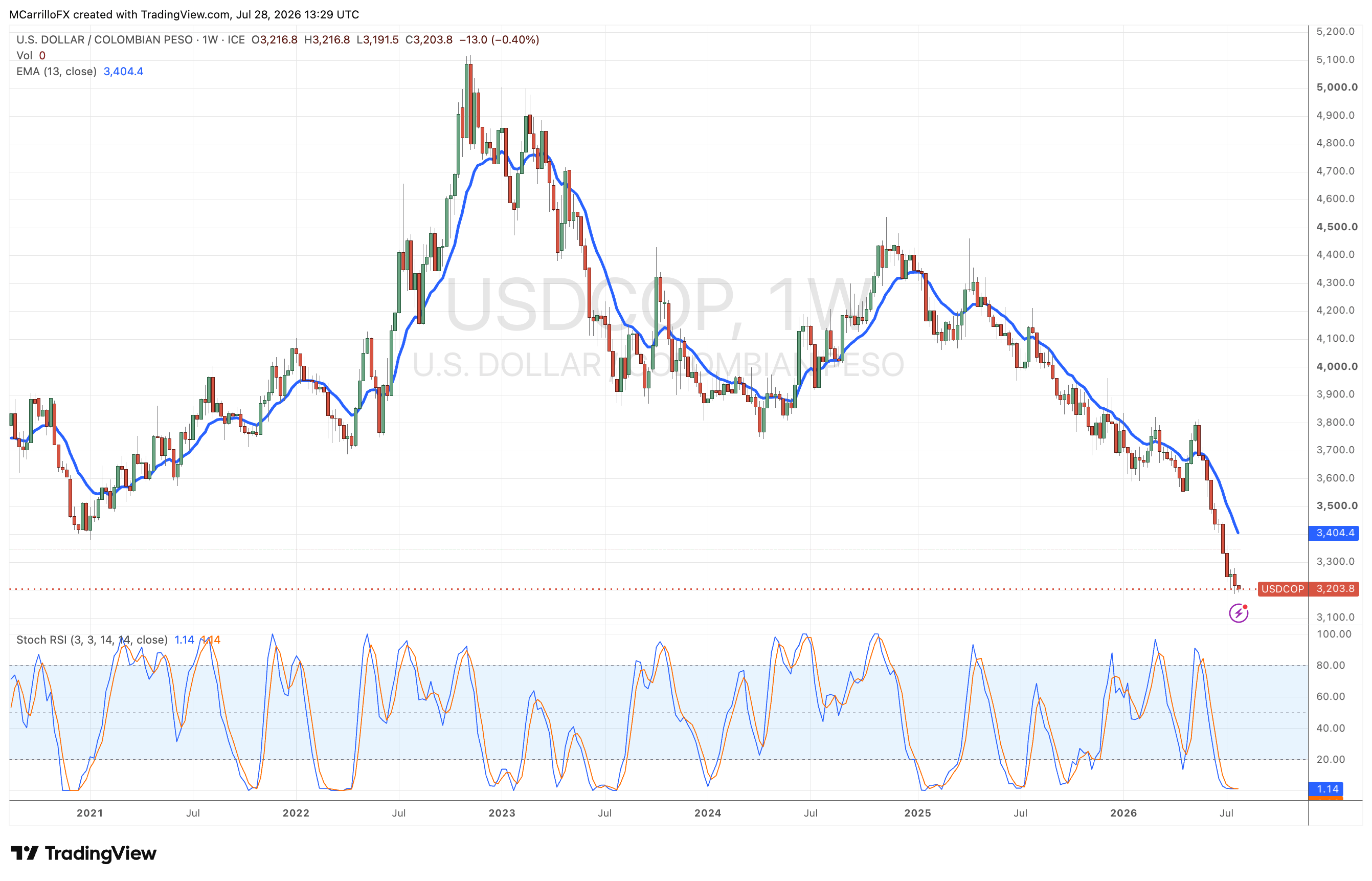
Resistance: 3,237.1 at the daily 13 EMA, then a band from 3,400 to 3,455 where the weekly 13 EMA at 3,404.5 meets the July high of 3,427.1 and the 30-day high at 3,452.23.
Support: 3,186.3 is July's low. Below it, the chart thins considerably until 2,992.7, which served as the 2003 high and then as the floor of the 2016 to 2018 congestion. Beneath that, 2,689.4 marks the mid-2018 low.
The USD/COP scenario
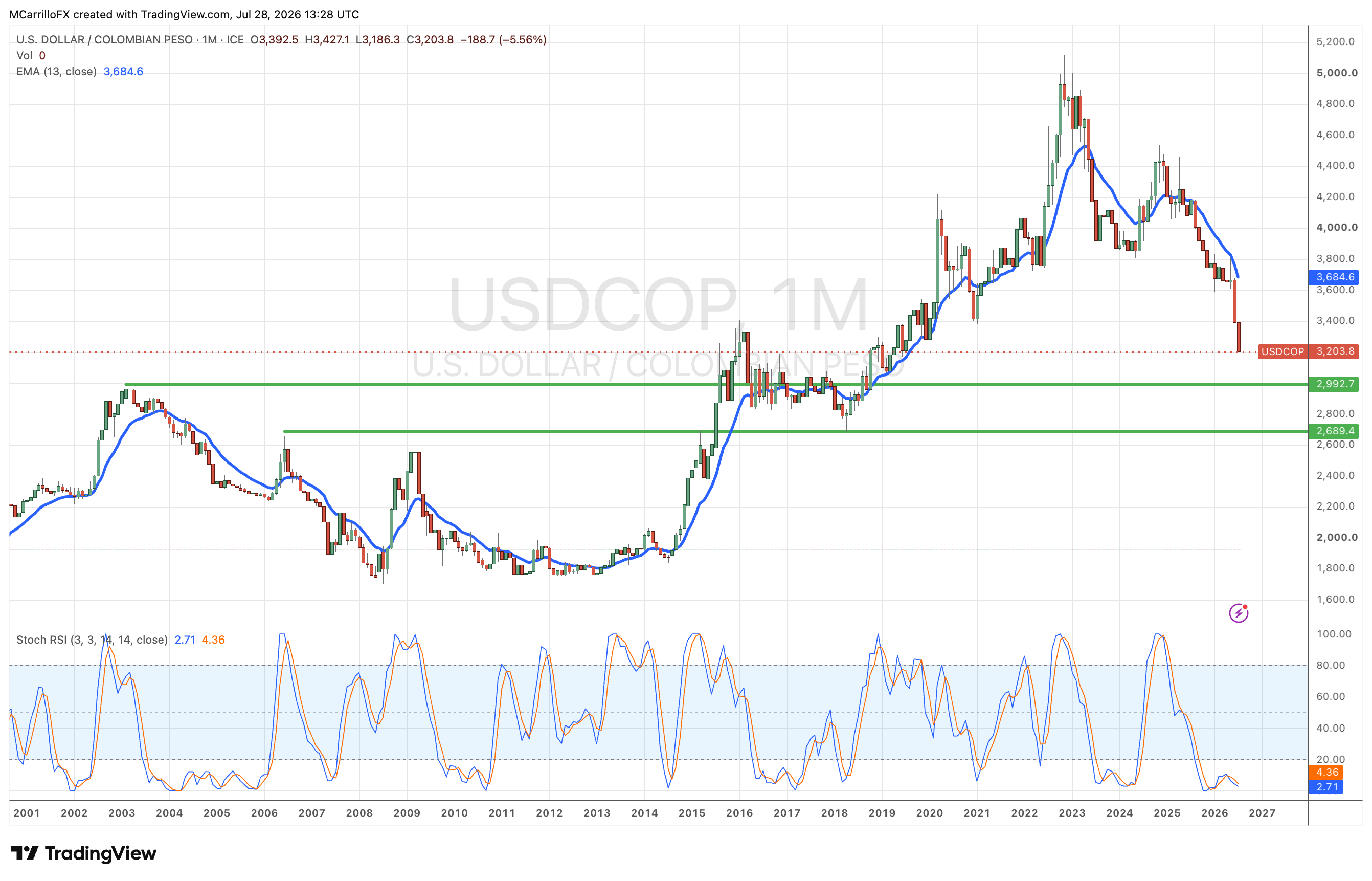
My second-half scenario is a test of the 3,000 area, with 2,800 to 3,000 as the zone to watch and structural buying expected near 2,700. The 3,400 handle has flipped to resistance, and any recovery has to clear it first.
The magnitude reads worse than it is. From 3,205 to 2,689 represents a 16.1% decline over five months, and the market has already delivered 16% in ten weeks. This is a deceleration.
It will not be a straight line. Weekly and monthly momentum are washed out, with the weekly Stoch RSI at 1.14, about as oversold as this pair gets in twenty-six years of data. Tuesday's bounce is the start of that, and a move back toward 3,237 or into the 3,400 band before continuation is the likelier path.
Two things would force a near-term rethink: a hawkish Fed that hands DXY its breakout, or a BanRep hold against a consensus 50. A resolution in Hormuz would do it more slowly, by removing the terms-of-trade support.
WTI has already given back roughly half the rally it built in July, trading at 81.28 against a 13-day EMA of 82.43.
The longer-term risk lies beyond this horizon.
Services inflation this broad, with imputed rent already contributing 62 basis points, indexes into next year's wage and contract rounds. Through December, that keeps BanRep high and works for the peso. Into 2027 it becomes a different question entirely.
Author

Mauricio Carrillo
Witbrew
Mauricio Carrillo is a financial journalist, fintech executive, and inter-markets analyst with fifteen years of experience at the intersection of traditional finance and digital asset infrastructure.