July’s US PCE rates to shake the markets
July’s US PCE rates and Q2 GDP rate to shake the markets
USD remained relatively stable yesterday in anticipation of the release of the US PCE rates for July in today’s early American session. Market worries for inflationary pressures in the US economy run high as currently they exceed the Fed’s tolerance level of 2%. A possible acceleration of the rates given also that oil prices remain high may force the Fed to harden its hawkish stance and thus provide support for the USD, while a wider than expected easing of inflationary pressures may weigh on the USD.
NVIDIA’s earnings report in focus
US stock markets are still mixed, also with some focus on the release of the US PCE rates. An acceleration of the rates could weigh on US equities while a wider-than-expected slowdown could lift them. Yet the main focus of US equities is expected to be NVIDIA’s earnings report in today’s aftermarket hours. If the EPS and revenue figures are better than expected and accompanied possibly by a robust forward guidance, we may see a lifting of the market sentiment which could benefit US equities.
Oil prices fall
Oil prices were on the retreat yesterday as market worries for the situation in the Middle East tended to ease. Please note that Iran and Oman are in negotiations for the creation of a corridor, which would reopen the Straits of Hormuz. Any further easing of the market worries for the US-Iran confrontation and the flow of oil through the Straits could weigh on oil prices.
Gold’s price stabilises
Gold’s price stabilised yesterday and edged lower today, with its negative correlation with the USD being blurred at the current stage, given the low volatility in the markets. The release of the US PCE rates for July today could shake things up, including gold’s price with higher rates possibly weighing on the precious metal’s price, while a lower-than-expected reading could lift gold’s price.
Other highlights for today
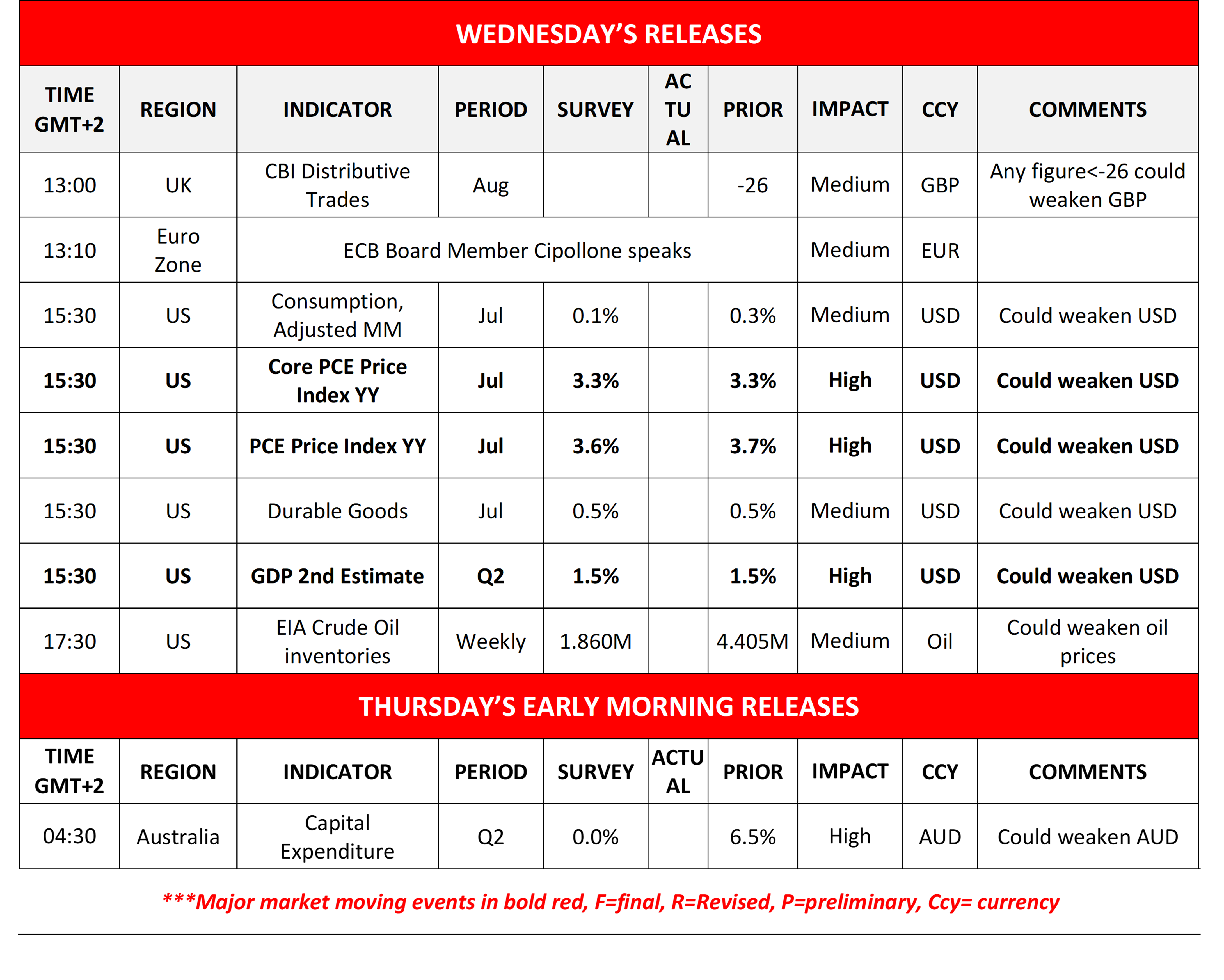
Today we get UK’s Distributive trades for August, while ECB’s Cipollone speaks and the US revised GDP rates for Q2, and the consumption rate, durable goods orders both for July and the EIA weekly crude oil inventories figure. In tomorrow’s Asian session, we get Australia’s capital expenditure for Q2.
Charts to keep an eye out
Nasdaq remained relatively stable yesterday, between the 29675 (R1) resistance line and the 28200 (S1) support level. We maintain a bias for a sideways motion of the index at the current stage, given also that the RSI indicator runs along the reading of 50, implying a rather indecisive market, which could allow the sideways motion of Nasdaq to continue. Yet fundamentals as mentioned above may alter the index’s direction. Should the bulls continue to lead Nasdaq, we may see it breaking the 29675 (R1) resistance base and start aiming for the all-time high 30770 (R2) resistance level. Should the bears take over, we may see the Nasdaq breaking the 28200 (S1) support line and aim for the 26870 (S2) support level.
Gold’s remained stable yesterday, well north of the 4550 (S1) support line. We maintain yesterday’s bullish outlook for gold’s price and intend to keep it as long as the upward trendline remains intact. Yet we also warn for a possible correction lower, given that the RSI indicator remains above the reading of 70, implying a possibly overbought position. Should the bulls maintain control, we may see XAU/USD aiming for the 4890 (R1) resistance line. If the bears take over we may see gold’s price breaking initially the 4550 (S1) support line continue to break also the prementioned upward trendline, in a first signal that the upward motion has been interrupted and continue to reach if not breach the 4275 (S2) support level.
Calendar follows
US 100 Cash daily chart
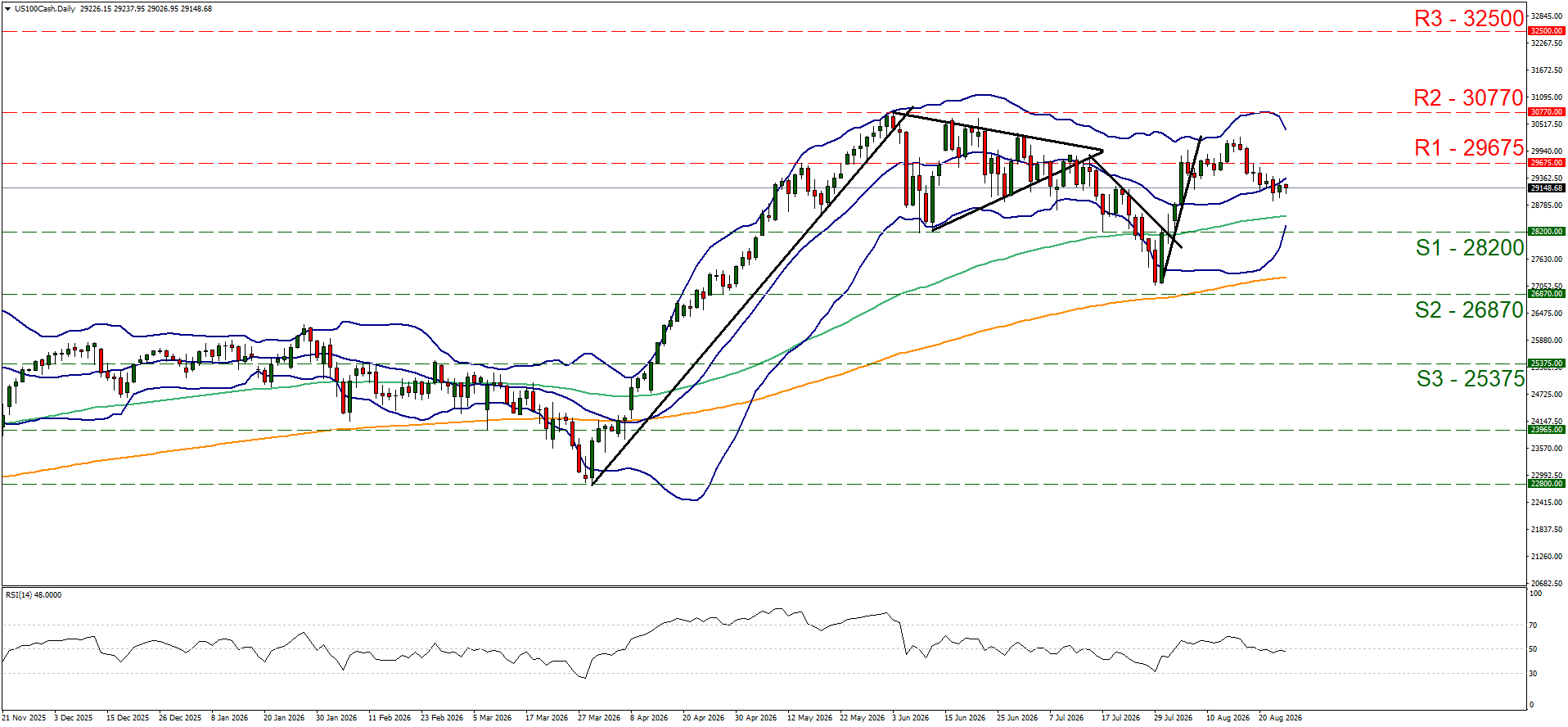
- Support: 28200 (S1), 26870 (S2), 25375 (S3).
- Resistance: 29675 (R1), 30770 (R2), 32500 (R3).
XAU/USD daily chart
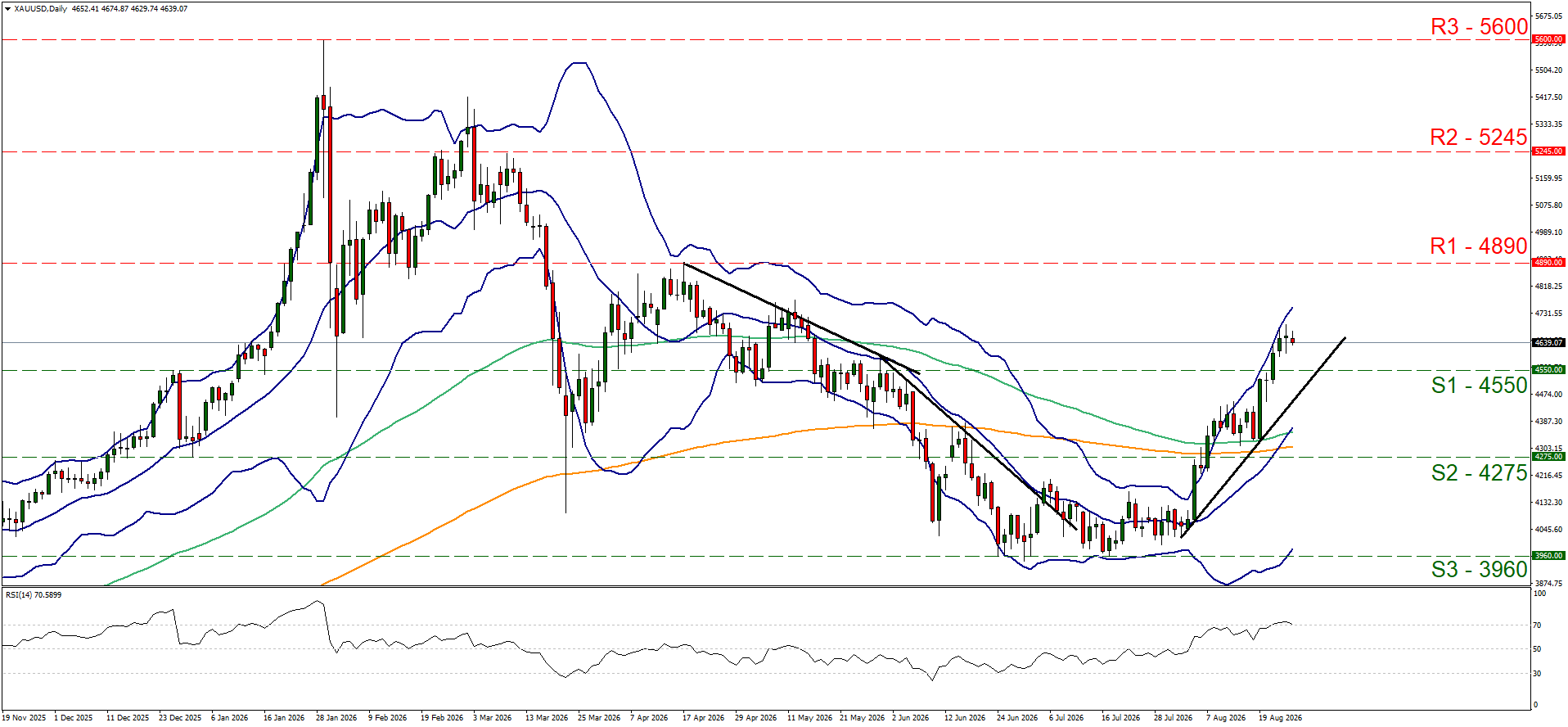
- Support: 4550 (S1), 4275 (S2), 3960 (S3).
- Resistance: 4890 (R1), 5245 (R2), 5600 (R3).
Author

Peter Iosif, ACA, MBA
IronFX
Mr. Iosif joined IronFX in 2017 as part of the sales force. His high level of competence and expertise enabled him to climb up the company ladder quickly and move to the IronFX Strategy team as a Research Analyst. Mr.
















