USD/JPY: Triple retest of 7th-order supply cluster fuels 160.00 breakout pressure

Market reaction and structural triple-test mechanics
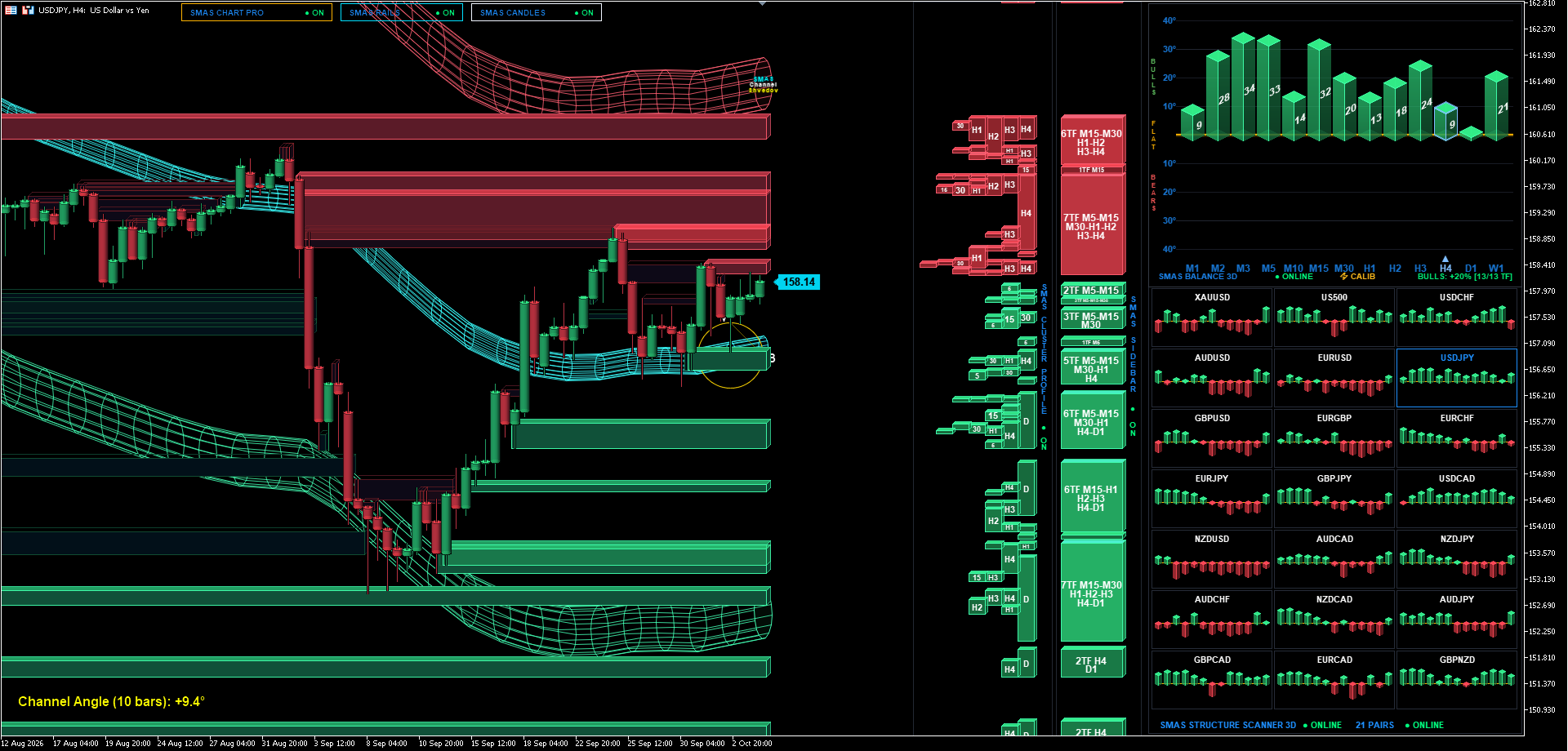
On the 4-hour timeframe, USD/JPY is currently executing its third consecutive test of the major institutional supply ceiling at the 158.12–158.80 zone. Market microstructure analysis reveals a clear pattern of ascending higher lows entering the resistance boundary.
The sequential retests have progressively absorbed the dormant limit sell orders within the barrier. Rather than producing aggressive multi-candle downward rejections, each pullback from the supply zone has become shallower, resulting in a classic ascending compression structure. This price behavior indicates that institutional liquidity providers are systematically consuming the sell-side inventory, preparing the market for a high-velocity breakout cascade.
Cluster density analysis (Sidebar and cluster profile architecture)
Data aggregation via the SMAS Sidebar 3D and Cluster Profile 3D modules reveals a distinct structural polarization:
- Overhead Institutional Ceiling: The primary resistance is concentrated in a heavy 7th-Order Supply Super-Cluster (7TF: M5-M15-M30-H1-H2-H3-H4) spanning the 158.80–160.20 range, backed by an auxiliary 6th-order massif (6TF: 160.60–161.40). The current price action at 158.12 is actively eroding the lower boundary of this massif.
- Underlying Structural Support: The base of the current ascending impulse is heavily fortified by a 2nd-Order Cluster (2TF: M5-M15) at 157.80–157.95, a 3rd-Order Cluster (3TF: M5-M15-M30) at 157.30–157.50, and a major institutional foundation of the 5th Order (5TF: M5-M15-M30-H1-H4) situated at 156.80–157.10.
Multi-timeframe phase telemetry (Structure balance 3D)
The Structure Balance 3D quantum engine registers an overwhelming, unanimous bullish alignment across the global market spectrum:
- Tensor Status: BULLS +20% [13/13 Timeframes in the Green Zone].
- Micro & Intraday Spectrum (M1–M30): Full positive synchronization with peak momentum vectors on M3 (+34°), M5 (+33°), and M15 (+32°), generating continuous buy-side order flow into the order book.
- Macro Framework (H1–W1): The operational core maintains strong positive structural velocity across H1 (+13°), H2 (+18°), H3 (+24°), and W1 (+21°).
- Quantum Deduction: Complete 13-timeframe resonance confirms that the buying pressure is not a transient speculative wick, but a coordinated multi-scale institutional expansion.
Dynamic vector geometry and channel trajectory (Structure engine)
The SMAS Structure Engine confirms that the central Ordinary Least Squares (OLS) regression spine has firmly locked into a positive trajectory with an invariant slope angle of +9.4 degrees. The lower two-sigma Gaussian boundary rail has successfully acted as dynamic support across the last twenty bars, providing mathematical confirmation of trend stability and sustained structural momentum.
Execution protocol and quantitative trade parameters
Because price is currently testing the hardened core of the 7TF supply cluster for the third time, chasing market orders directly at 158.12 carries unnecessary friction. The optimal statistical setup is buying the shallow pullback into established intraday demand:
- Order type: Buy Limit
- Execution coordinate: 157.45 (Zone of the 3rd-Order Demand Cluster 3TF & Channel Midline).
- Structural invalidation (Stop Loss): 156.75 (Placed strictly below the 5TF institutional block; Risk: 70 pips).
- Target objective 1 (Take Profit 1): 158.45 (+100 pips; 50% volume realization & move Stop Loss to Breakeven).
- Target objective 2 (Take Profit 2): 159.85 (+240 pips; Full liquidation inside the upper tier of the 7TF cluster upon breakout).
- Risk / reward ratio: 1 : 3.42.
Alternative Breakout Trigger: An immediate H4 candle close firmly above 158.85 validates instant market momentum continuation toward 160.20.
Author

Andrey Shvedov
SMAS Quantum Research
Andrey Shvedov is an active quantitative trader, software architect, and financial market researcher with over 24 years of live market microstructure experience.