|

Japanese Yen extends losses, wage growth expected to fall

The Japanese yen is down for a second straight day. In the European session, USD/JPY is trading at 144.67, up 0.59% on the day.

The Bank of Japan released the minutes of its March meeting today. At the meeting, the BoJ held the key policy rate at 0.5% in a unanimous vote. According to the minutes, members expressed concern about the downside risks to Japan's economy due to the US tariffs, which were not announced until April.

The BoJ met last week and again held rates. Governor Ueda said that the uncertainty over US trade policy remained "extremely high" and the tariffs would weigh on Japan's economy.

The BoJ is still looking to raise rates but is waiting to see how the tariff issue plays out, with the US and Japan currently holding trade talks. The central bank will be keeping a close eye on Friday's wage growth, which is expected to ease to 2.4% from 2.7%. The BoJ has said that stronger wage growth is key to achieving sustainable 2% inflation.

Fed holds rates

The Federal Reserve maintained rates on Wednesday, as widely expected. There was plenty of anticipation ahead of the meeting, as Fed Chair Powell was expected to push back against President Trump who has publicly called on Powell to lower rates.

Powell said that if the tariffs stayed in place, they would likely lead to stagflation, a toxic combination of high inflation and a rise in unemployment. Powell held his ground, saying that the Fed would 'wait and see' before making any rate moves.

The markets have responded to Powell's comments by lowering the odds of a June rate hike to 17%, a huge change from 58% a week ago.

USD/JPY technical

  • USD/JPY has pushed above resistance at 144.43 and put pressure on resistance at 145.02 earlier.
  • 143.40 and 142.81 are providing support.
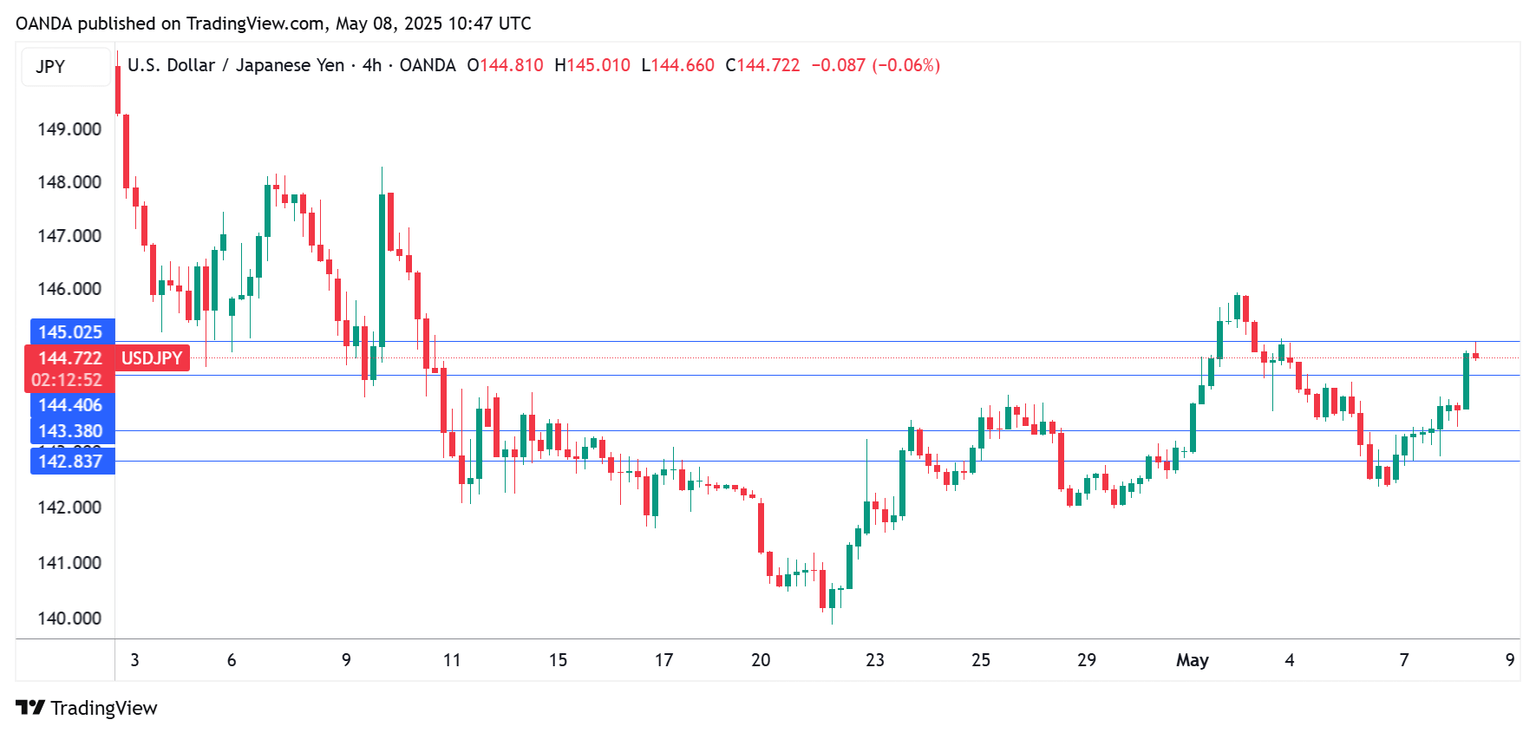
Chart

USDJPY 1-Day Chart, May 8, 2025

Author

Kenny Fisher

Kenny Fisher

MarketPulse

A highly experienced financial market analyst with a focus on fundamental analysis, Kenneth Fisher’s daily commentary covers a broad range of markets including forex, equities and commodities.


More from Kenny Fisher
Share:

Markets move fast. We move first.

Orange Juice Newsletter brings you expert driven insights - not headlines. Every day on your inbox.

By subscribing you agree to our Terms and conditions.

Editor's Picks

EUR/USD bounces toward 1.1750 as US Dollar loses strength

EUR/USD returned to the 1.1750 price zone in the American session on Friday, despite falling Wall Street, which indicates risk aversion. Trading conditions remain thin following the New Year holiday and ahead of the weekend, with the focus shifting to US employment and European data scheduled for next week.

GBP/USD nears 1.3500, holds within familiar levels

After testing 1.3400 on the last day of 2025, GBP/USD managed to stage a rebound. Nevertheless, the pair finds it difficult to gather momentum and trades with modest intraday gains at around 1.3490 as market participants remain in holiday mood.

Gold trims intraday gains, approaches $4,300

Gold retreated sharply from the $4,400  area and trades flat for the day in the $4,320 price zone. Choppy trading conditions exacerbated the intraday decline, although XAU/USD bearish case is out of the picture, considering growing expectations for a dovish Fed and persistent geopolitical tensions.

Cardano gains early New Year momentum, bulls target falling wedge breakout

Cardano kicks off the New Year on a positive note and is extending gains, trading above $0.36 at the time of writing on Friday. Improving on-chain and derivatives data point to growing bullish interest, while the technical outlook keeps an upside breakout in focus.

Economic outlook 2026-2027 in advanced countries: Solidity test

After a year marked by global economic resilience and ending on a note of optimism, 2026 looks promising and could be a year of solid economic performance. In our baseline scenario, we expect most of the supportive factors at work in 2025 to continue to play a role in 2026.

Crypto market outlook for 2026

Year 2025 was volatile, as crypto often is.  Among positive catalysts were favourable regulatory changes in the U.S., rise of Digital Asset Treasuries (DAT), adoption of AI and tokenization of Real-World-Assets (RWA).













