|

Japanese Yen declines as Tokyo Core CPI eases

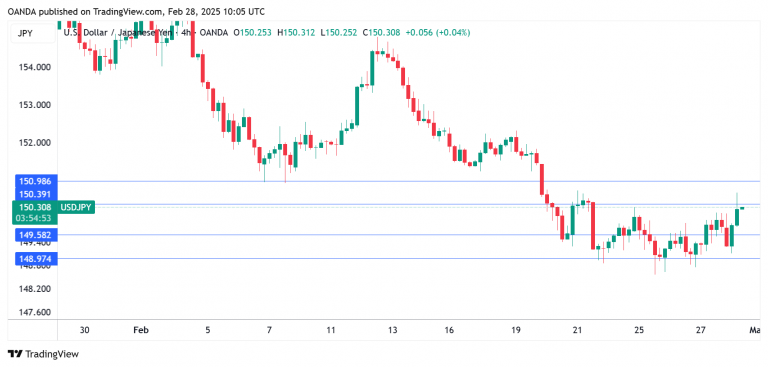
The Japanese yen has extended its losses on Friday.  In the European session, USD/JPY is trading at 150.39, up 0.40% on the day.

Tokyo core CPI edges lower to 2.2%

After a string of releases that pointed to an upswing in inflation, Tokyo core CPI for February reversed the trend on Friday.  Japan’s CPI, PPI and the Bank of Japan Core CPI all accelerated in the most recent releases but Tokyo Core CPI surprised to the downside, with a gain of 2.2% y/y.  This was down from 2.5% in January and below the market estimate of 2.3%.

The soft Tokyo Core CPI reading is unlikely to raise many eyebrows at the Bank of Japan. The index remained above the BoJ’s 2% target for a fourth consecutive month and Bank policymakers are expected to remain hawkish about monetary policy.  The BoJ raised rates in January and also revised its inflation forecasts upwards, a signal that further rate hikes are on the table.

The markets are expecting the BoJ to continue tightening and this has been resulted in higher yields for Japanese government bonds, which hit a 15-year high earlier this month. Governor Kazuo Ueda responded to the sharp rise in bond yields with a warning that the central bank stood ready to intervene in the bond markets. Ueda’s threat appears to have worked as bond yields have retreated slightly.

US Core PCE expected to tick lower

The US wraps up the week with core PCE inflation, the Fed’s peferred inflation gauge. The market estimates for January stand at 2.6% y/y (vs. 2.8% in December) and 0.2% m/m (vs. 0.3% in December). This would still be above the Federal Reserve’s target of 2%. The Fed is not expected to lower rates before May, barring an unexpected surprise from inflation or employment data.

USD/JPY technical

  • USD/JPY tested resistance at 150.39 earlier.  Above, there is resistance at 150.98.

  • There is support at 149.57 and 148.98.
USDJPY

Author

Kenny Fisher

Kenny Fisher

MarketPulse

A highly experienced financial market analyst with a focus on fundamental analysis, Kenneth Fisher’s daily commentary covers a broad range of markets including forex, equities and commodities.


More from Kenny Fisher
Share:

Markets move fast. We move first.

Orange Juice Newsletter brings you expert driven insights - not headlines. Every day on your inbox.

By subscribing you agree to our Terms and conditions.

Editor's Picks

EUR/USD ticks lower following the release of FOMC Minutes

The US Dollar found some near-term demand following the release of the FOMC meeting minutes, with the EUR/USD pair currently piercing the 1.1750 threshold. The document showed officials are still willing to trim interest rates. Meanwhile, thinned holiday trading keeps major pairs confined to familiar levels.

GBP/USD remains sub- 1.3500, remains in the red

The GBP/USD lost traction early in the American session, maintaining the sour tone and trading around 1.3460 following the release of the FOMC meeting minutes. Trading conditions remain thin ahead of the New Year holiday, limiting the pair's volatility.

Gold stable above $4,350 as the year comes to an end

Gold price got to recover some modest ground on Tuesday, holding on to intraday gains and changing hands at $4,360 a troy ounce in the American afternoon. The bright metal showed no reaction to the release of the FOMC December meeting minutes.

Ethereum: ETH holds above $2,900 despite rising selling activity

Ethereum (ETH) held the $2,900 level despite seeing increased selling pressure over the past week. The Exchange Netflow metric showed deposits outweighed withdrawals by about 400K ETH. The high value suggests rising selling activity amid the holiday season.

Economic outlook 2026-2027 in advanced countries: Solidity test

After a year marked by global economic resilience and ending on a note of optimism, 2026 looks promising and could be a year of solid economic performance. In our baseline scenario, we expect most of the supportive factors at work in 2025 to continue to play a role in 2026.

Crypto market outlook for 2026

Year 2025 was volatile, as crypto often is.  Among positive catalysts were favourable regulatory changes in the U.S., rise of Digital Asset Treasuries (DAT), adoption of AI and tokenization of Real-World-Assets (RWA).