Is the United States so disadvantaged in terms of customs duty?

To reduce the United States' bilateral trade deficits, a subject already raised in a previous Chart of the week, the Trump administration has broadened its angle of attack, by attacking the differences in customs duties between the country and its trading partners. The introduction of reciprocal tariffs, still under study, would be specified at the beginning of April.
Difference in tariff rates between the United States and the rest of the world (2023) rest of the world (2023)
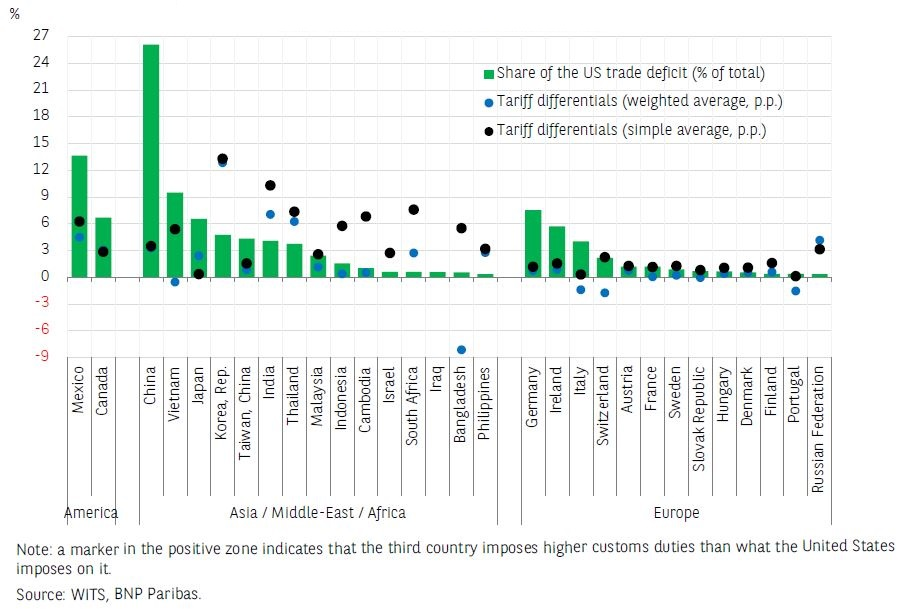
At first glance, that is with a simple average of tariffs (black marker), and therefore unweighted of trade, Asian countries – South Korea, China, India, Thailand and Vietnam – could be among the main countries targeted, as they combine high tariff differentials and trade surpluses with the United States. Despite the North American free trade agreement (USMCA), which exempts much but not all traded goods from tariffs, Mexico and Canada also have a positive tariff differential. Germany and Ireland were also singled out, although the average difference between tariffs is moderate (an average that nevertheless masks sectoral differences, notably on trade in chemicals and dairy products in the case of Ireland, and in the automotive and aeronautics sectors in the case of Germany).
The weighted measure (blue marker) offers, in some cases, a different vision of the balance of power. The situation changes especially with regard to emerging countries: firstly Vietnam where the differential goes from largely positive on the unweighted measure (+5.4 p.p.) to negative on the weighted measure (-0.5 p.p.). The gap also narrowed significantly in the case of Indonesia (from +5.8 p.p. to 0.4 p.p.), and to a lesser extent in the case of India and Mexico.
How can these differences be explained? Some countries impose higher tariffs on certain goods, especially manufactured products, in order to protect the development of their industries, for example. However, these goods make up only a small part of their imports, while they import more intermediate products or raw materials that are less taxed when they arrive in the country, which also benefits the United States.
The situation is different for developed countries, which trade relatively more final products with the United States, and often in similar segments, resulting in smaller differences between simple and weighted tariffs. Japan and Korea are in fact more exposed in both cases, but for many other countries, notably the euro area countries and the United Kingdom, the differences are quite small, and sometimes even negative.
All this obviously does not presage the future decisions of the Trump administration, and a hardening of the trade war leaves little room for doubt. Nevertheless, the situation described by the American President, which would be that of outrageously unfair competition, appears much more nuanced when we take into account the structure of trade.
Author
BNP Paribas Team
BNP Paribas
BNP Paribas Economic Research Department is a worldwide function, part of Corporate and Investment Banking, at the service of both the Bank and its customers.