Is the tide turning for commercial real estate?

Summary
The Fed plants the seeds for a CRE recovery
The Federal Reserve's 50 bps cut at the September FOMC meeting marks the beginning of the end of the worst CRE downturn since the Global Financial Crisis. Given inflation appears contained and strains are emerging in the labor market, we expect the Fed to follow with a string of rate cuts through the summer of 2025 in order to keep the economic expansion intact.
Lower interest rates are not a magic bullet, but less restrictive monetary policy lays the groundwork for a commercial real estate recovery. Decreased long-term interest rates appear to be easing upward pressure on cap rates and slowing declines in property valuations. Meanwhile, increased expectations for an economic soft-landing look to be giving capital the green-light to move off the sidelines. There's no shortage of obstacles ahead, especially when it comes to the office market. That said, reduced interest rates should prevent distress from spreading and shorten the hurdles coming down the road.
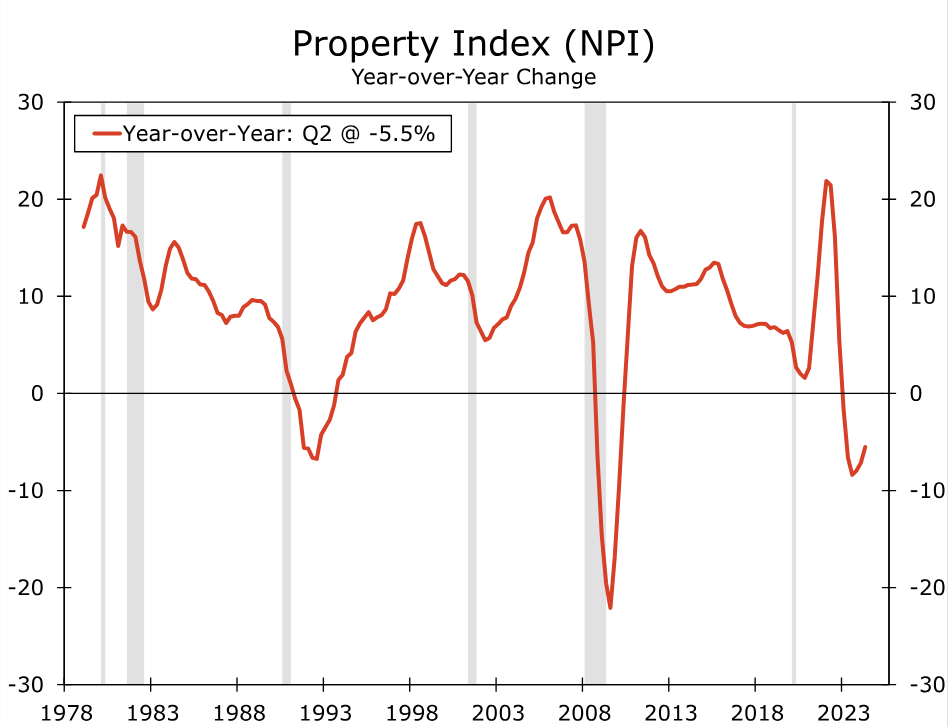
Source: NCREIF and Wells Fargo Economics
The Federal Reserve has started to ease monetary policy
Trees don't grow to the sky and falling acorns eventually hit the ground. Conditions in the CRE market have deteriorated significantly since early 2022 when the Federal Reserve began raising the federal funds target rate in order to bring down inflation. The increase in interest rates resulted in a sizable drop in transactions, higher cap rates, lower property values and a pull-back in lending. Although supply and demand fundamentals have been more resilient to the effects of tighter monetary policy, occupancy generally has shifted lower amid a post-pandemic surge of new construction completions, resulting in sharply higher vacancy rates and slower rent growth for many property types.
The good news is that a monetary easing cycle is upon us. The Federal Reserve reduced the federal funds target rate by 50 bps at the September FOMC meeting and strongly hinted that additional cuts are coming soon. Although several measures of inflation generally are still slightly above the Federal Reserve's 2% target, underlying price pressures appear well contained and the path back to target looks to be in reach. Meanwhile, labor market conditions have softened. The unemployment rate stood at 4.2% in August, up from 3.7% in January. The uptick in the unemployment rate demands that the Fed shift its attention to the employment side of the mandate. Although economic growth remains solidly intact, with real GDP expected to expand more than 2% in Q3, the Fed will need to shift monetary policy toward a neutral stance in order to prevent a recession and sharp deterioration in the labor market. As such, we look for the FOMC to follow up September's 50 bps cut with a string of reductions amounting to 175 bps of additional cuts by the summer of 2025.
Author

Wells Fargo Research Team
Wells Fargo